What Is Masonry Sand Used For? A Complete Guide to Brick Sand Applications
Walk into any building supply yard in Dallas or San Antonio and ask for “brick sand.” Then drive to the next supplier and ask for “masonry sand.” In most cases, you’ll be quoted the same material. The names are used interchangeably across Texas and Oklahoma — and that’s the first thing worth knowing before we get into what the product actually does.
Masonry sand (also called brick sand, mortar sand, or simply “fine sand”) is a washed, finely screened sand with a smooth, consistent texture. It’s been a staple of construction in this region for as long as people have been laying brick — which is a long time. At Select Sand & Gravel, we carry it in both the standard beige variety and as White Brick Sand, a lighter option used where appearance matters as much as function.
This guide covers the full range of what masonry sand is actually used for, where it works well, and — just as importantly — where you should reach for something else instead.
What Masonry Sand Is, Exactly
Before getting into applications, it helps to be specific about what you’re working with.
Masonry sand sits in a middle zone of the sand gradation spectrum. It’s finer than concrete sand (which is coarser and more angular, designed for structural mixes) and coarser than play sand (which is so fine it’s really only useful for recreation). That middle ground is precisely what makes it useful across so many applications — fine enough to spread smoothly and fill tight spaces, but not so fine that it behaves like powder or washes out at the first rain.
The particles are rounded and smooth from the washing and screening process. That smooth texture is what allows it to slide easily between joints, mix into a workable mortar, and spread evenly across a surface. It’s also what makes it unsuitable for applications requiring the angular, mechanical grip that concrete sand provides.
Select Sand & Gravel carries masonry sand as Brick Sand / Masonry Sand and as White Brick Sand — a lighter-colored variety used in decorative and recreational applications where the standard beige color isn’t quite right. Both are available for delivery across Dallas, Fort Worth, Austin, Houston, San Antonio, and Oklahoma City.
The Primary Uses of Masonry Sand
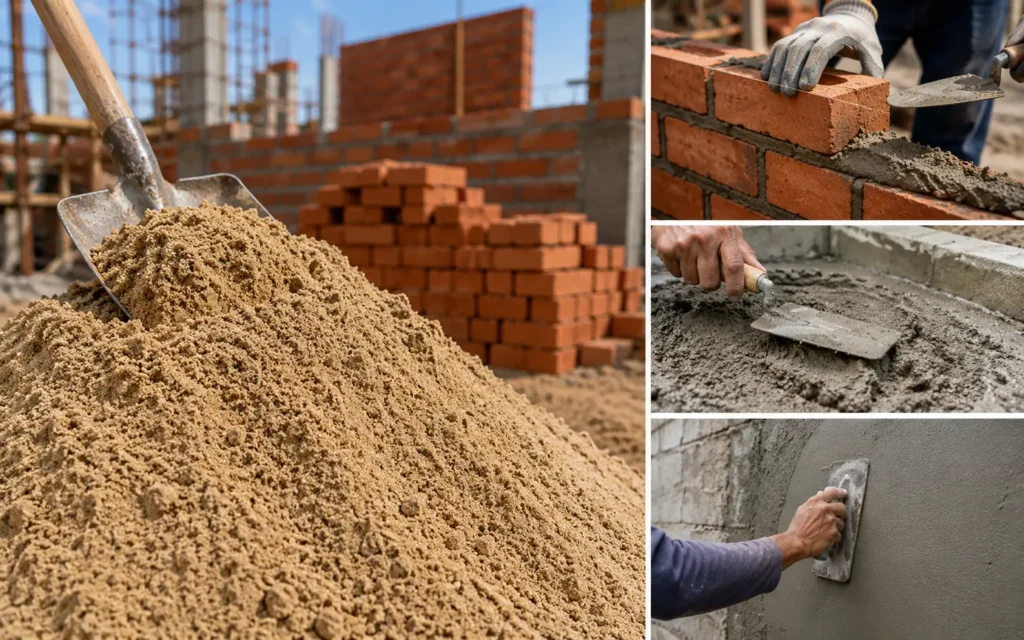
Brick Laying and Mortar Mixes
This is the original application, and it’s right there in the name. When a mason mixes mortar to lay brick, block, or stone, masonry sand is the aggregate that goes into the mix alongside Portland cement and water.
The reason this specific sand type is used — rather than concrete sand or regular dirt — comes down to gradation. Masonry sand’s fine, consistent particle size produces a mortar that’s smooth enough to spread easily, bonds tightly to brick surfaces, and fills joints without leaving voids. Coarser sand creates grainy, weak mortar joints. Sand that’s too fine becomes sticky and difficult to work with at proper water ratios.
A standard type S mortar mix — commonly used for below-grade masonry and in Texas and Oklahoma where wind loads matter — typically uses a 1:0.5:4.5 ratio of Portland cement, lime, and masonry sand by volume. Getting the sand right is what makes the mortar workable and the wall strong.
Stucco and Plaster
Masonry sand is a primary ingredient in stucco and plaster mixes, which is a use case many people don’t associate with “brick sand” at all.
Exterior stucco systems use multiple coats — a scratch coat, a brown coat, and a finish coat — each requiring a consistent fine aggregate that allows the material to be troweled smoothly onto the wall substrate. Masonry sand’s uniform texture prevents lumps, allows good adhesion to lath and block, and produces the smooth wall surface that stucco is known for.
Interior plaster works the same way. The fine gradation of masonry sand allows plasterers to achieve a flat, smooth finish that coarser sands simply can’t deliver.
If you’ve ever seen a stucco repair that looks bumpy or mismatched, wrong sand gradation is often part of the reason.
Tuck Pointing and Repointing Old Masonry
When the mortar joints in an old brick wall start to crack, spall, or crumble — which is common in older homes and commercial buildings across North Texas — the repair process is called tuck pointing or repointing. The deteriorated mortar is ground out to a depth of about 3/4 inch, and fresh mortar is packed back in to restore the joint.
Masonry sand is the aggregate used in that fresh mortar. The particle size has to match what was originally used, or the new joint will look different and may cure at a different rate than the surrounding material. This is also why color-matching matters for visible tuck pointing work — the sand color affects the final mortar color significantly.
Paver Joint Filling
Masonry sand swept into the joints between brick or concrete pavers locks them in position and allows minor movement without cracking. It’s one of the more common residential applications across Texas, where paver patios and driveways are standard in many neighborhoods.
This is covered in detail in the existing article What Kind of Sand Goes Between Brick Pavers?, so we won’t repeat that ground here. The short version: mason sand works for paver jointing in low-to-moderate traffic areas; polymeric sand is the upgrade for high-traffic installations or anywhere weed resistance is a priority.
Recreational and Specialty Applications
White Brick Sand specifically is used in applications where the standard tan/beige color of masonry sand either doesn’t look right or isn’t appropriate for the surface. Common examples include:
- Volleyball courts — the fine, smooth texture is comfortable underfoot, and the light color doesn't absorb as much heat as darker materials
- Above-ground pool surrounds — clean, washed, and softer than concrete sand
- Sandboxes — Select Sand & Gravel recommends White Brick Sand or fine Mason Sand over concrete sand for play applications because of the texture difference. Concrete sand is coarser and can be abrasive on skin
- Horseshoe pits — fine texture allows clean embedding of horseshoes without excessive bounce
The common thread across these uses is that the smooth, fine texture of masonry sand is an asset — it’s comfortable, spreadable, and aesthetically neutral.
Where Masonry Sand Does Not Belong
Knowing what a material is good for is only useful if you also know what it’s wrong for. Masonry sand gets misused on job sites and in residential projects more often than you’d think.
Not for concrete structural mixes. Concrete requires angular, coarser sand — specifically ASTM C33 concrete sand — whose jagged particles interlock within the cement matrix to develop structural strength. Masonry sand is too fine and too smooth for this. Substituting it in a concrete pour weakens the final product. This is the distinction the concrete-sand/ product page addresses directly: concrete sand and masonry sand are different products for different jobs.
Not for a paver base layer. The bedding layer under pavers — the material you screed to create the flat, level surface on which the pavers sit — should be concrete sand or cushion sand, not masonry sand. Masonry sand is too fine and can shift or wash out under load. It also compacts less predictably than coarser bedding materials. The existing post on bedding sand and pavers covers this directly.
Not for pipe bedding or utility trenches. Utility trench work calls for a coarser, well-graded material — what’s typically called utility bedding sand or cushion sand — that can be compacted around the pipe without creating voids. Masonry sand is too fine for this application and won’t compact the way a utility spec requires.
Not for drainage applications. If you need a material that allows water to move freely through it — a French drain, a perimeter drain, a dry well — masonry sand is the wrong choice. Its fine particles restrict water movement compared to coarser aggregates like pea gravel or concrete sand. If drainage is what you need, the product is different.
Not for structural concrete block fill. Hollow concrete block cores are sometimes filled with grout for structural reinforcement. That grout uses specific aggregate — not general-purpose masonry sand — and the mix has to meet engineering specifications for the wall system.
Masonry Sand Compared to the Other Sands Select Sand & Gravel Carries
Texas and Oklahoma contractors often need to sort through several sand options depending on the project. Here’s how masonry sand relates to the others in the lineup:
Masonry Sand vs. Concrete Sand Concrete sand is coarser and angular — it bonds mechanically in structural mixes and drains freely. Masonry sand is finer and smoother — it mixes into workable mortar and fills joints cleanly. They are not interchangeable. The concrete sand product page on this site has a clean summary of this distinction.
Masonry Sand vs. Cushion Sand Cushion sand is coarser than masonry sand and used primarily for pipe bedding, base preparation, and utility work. Masonry sand is finer and used for mortar, jointing, and finishing work. Cushion sand is often compared to masonry sand for lawn leveling — the existing post Can I Use Cushion Sand for Lawn Leveling? works through that specific question in detail.
Masonry Sand vs. Crushed Limestone Sand Crushed limestone sand is angular and sharp — a byproduct of the crushing process — used for compactable bases, equestrian arena footing, and precision grading. It’s a structural material with very different performance characteristics from the smooth, washed masonry sand used in mortar and jointing.
Masonry Sand vs. Granite Sand Granite sand is gray, medium-grained, and used in decorative landscaping and as a base material. Masonry sand is finer, beige, and suited to construction finishing work. Different product, different purpose.
Standard Brick Sand vs. White Brick Sand Both are masonry sand — the difference is color. Standard brick sand is tan/beige. White brick sand is lighter, closer to off-white, and is specified for recreational applications (volleyball courts, sandboxes, pool surrounds) or decorative work where a lighter appearance is preferred.
How Much Masonry Sand Do You Need?
For bulk delivery orders, use this formula:
Length (ft) × Width (ft) × Depth (ft) ÷ 27 = Cubic yards
Depth in feet: 1 inch = 0.083 ft | 2 inches = 0.167 ft
For a paver patio that’s 20 ft × 15 ft with a 1-inch joint sand layer: 20 × 15 × 0.083 ÷ 27 = 0.92 cubic yards
For mortar work, the material quantities are typically calculated by the mix ratio rather than by area. A standard type S mortar at 1:0.5:4.5 ratio uses roughly 4.5 parts sand per batch. A mason who’s been doing this for years generally knows how much sand a day’s work consumes; if you’re working through it for the first time, start with your mortar bag instructions and scale from there.
For most residential paver and mortar projects, bagged sand from a hardware store is practical for small quantities. For anything covering more than a few hundred square feet — or any project where you’re mixing your own mortar in volume — bulk delivery from Select Sand & Gravel is more economical and eliminates the hassle of hauling bags.
Frequently Asked Questions
Is masonry sand the same as brick sand?
Yes. The two names describe the same material — a fine, washed sand used in mortar, stucco, paver jointing, and related applications. “Brick sand” is the older trade name that refers to its original use in brick mortar; “masonry sand” is the broader industry term. You’ll hear both at supplier yards across Texas and Oklahoma, and they refer to the same product.
Can I use masonry sand for a paver base layer?
No. The bedding layer under pavers — the material you screed flat before laying the pavers — should be concrete sand or cushion sand, both of which have a coarser gradation that compacts and drains more reliably. Masonry sand is too fine for this application and can shift or wash out under load. It belongs in the joints between pavers, not beneath them.
Can masonry sand be used in concrete?
No. Structural concrete requires coarser, angular aggregate — specifically ASTM C33 concrete sand. Masonry sand is too smooth and fine to develop the mechanical interlock that makes concrete strong. Substituting masonry sand in a concrete mix produces a weaker result.
What is the difference between masonry sand and play sand?
Play sand is finer, rounder, and more processed than masonry sand — it’s designed specifically for use in children’s sandboxes and play surfaces and is screened for safety and texture. Masonry sand is coarser than play sand and intended for construction use. That said, White Brick Sand is a softer, lighter option that Select Sand & Gravel recommends for play and recreational surfaces rather than standard concrete sand, which is too coarse and abrasive.
What is white brick sand?
White Brick Sand is a lighter-colored variety of masonry sand, screened to a similar fine gradation but with a lighter, off-white appearance. It’s used where the tan color of standard brick sand isn’t appropriate — volleyball courts, sandboxes, pool surrounds, and some decorative applications. Both are available through Select Sand & Gravel.
How much masonry sand do I need for paver joint filling?
For a typical patio installation, plan for approximately 50 pounds of sand per 40–50 square feet of paved surface, depending on paver size and joint width. For larger projects, bulk delivery is significantly more cost-effective than carrying bags. Use the formula: Length × Width × joint depth (in feet) ÷ 27 = cubic yards needed.
Is masonry sand good for stucco?
Yes. Masonry sand is a standard aggregate in stucco scratch coats, brown coats, and exterior plaster mixes. Its fine, uniform gradation allows the stucco to be troweled smoothly and adhere well to lath and block substrates. It’s one of the applications where masonry sand specifically — not concrete sand or other coarser materials — is the right choice.
Does Select Sand & Gravel deliver masonry sand for large commercial masonry projects?
Yes. Select Sand & Gravel supplies bulk masonry sand for both residential and commercial projects across all six service markets. For high-volume masonry work — where consistent sand gradation across the job matters — sourcing through a supplier with multiple pit relationships ensures no supply gaps. Call 1-817-572-6310 for availability and pricing.

