How Deep Should a Road Base Be for a Parking Lot?
A parking lot is not a wide driveway. The two share the same base material — compacted road base — but they put that material under a different kind of stress, and the depth requirements reflect that. Understanding why the difference exists helps you specify the right base for your lot instead of guessing or defaulting to whatever the contractor suggests.
The short answer: for a private gravel lot carrying passenger vehicles, 6 inches of compacted road base is the standard minimum. For an asphalt lot with occasional truck access, 8 inches. For heavy commercial truck traffic, the base needs to be engineer-specified because rule-of-thumb guidance is no longer enough. Everything in between depends on what drives on it, what goes on top of it, and what the subgrade beneath it looks like.
At Select Sand & Gravel, we supply road base for everything from small church overflow lots to large commercial parking projects across Dallas, Fort Worth, Austin, Houston, San Antonio, and Oklahoma City. This guide covers what we’ve seen work — and what we’ve seen fail — across forty-plus years of aggregate delivery to Texas and Oklahoma parking lot projects.
Why Parking Lots Are Harder on Base Material Than Driveways
The gravel roadbase driveway article on this site recommends 4 inches of compacted base for personal vehicle driveways and 6 or more inches for commercial traffic. Those numbers are starting points for driveways. For parking lots, they’re generally the floor, not the target.
Here’s why lots demand more from the base:
Lateral loading from stopping and turning. A vehicle driving through a driveway applies primarily vertical load as it rolls. A vehicle parking applies vertical load — and then a stopping force, a turning force, and eventually a backing force. All of that lateral stress transmits into the base, working to push material aside rather than simply compress it downward. Repeated lateral loading is what creates shoving failure in poorly specified lots.
Concentrated load points. Driveways distribute vehicle weight over a moving line. Parking lots concentrate vehicle weight at stationary points — every parked car sits in the same spot for hours, repeatedly. Over months and years, those stationary load points compact the base more than surrounding areas, creating differential settlement and surface depressions at the parking stall positions.
Surface area and stormwater. A residential driveway might be 600 square feet. A small commercial parking lot is 6,000 square feet or more — ten times the impervious surface generating stormwater runoff. The drainage design for a lot is a real engineering problem; the base material and its grading work together to manage that water.
Vehicle mix. Even a lot nominally intended for passenger vehicles will see garbage trucks, delivery vans, and fire apparatus at some point. In Texas, pickup trucks with trailers are standard. The base has to accommodate occasional heavy vehicles, not just the lightest ones that will use it.
Road Base Depth by Parking Lot Type
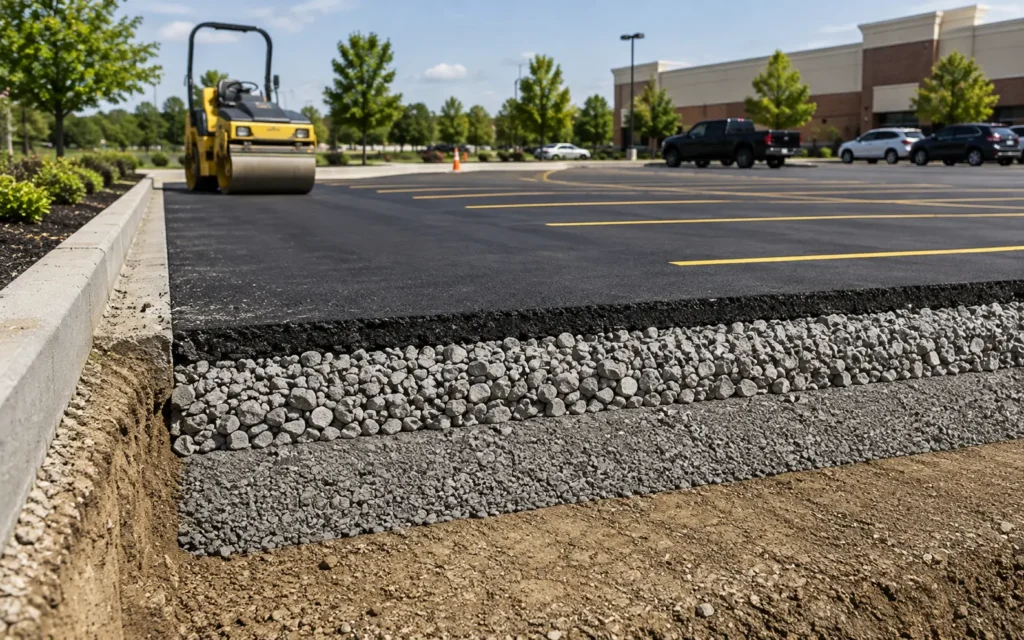
Small Private Gravel Lot — Passenger Vehicles Only
Standard depth: 6 inches compacted road base
Small private gravel lots — a church overflow lot, a small rental property, a storage facility, a rural business — that carry primarily passenger cars and light trucks should be built on 6 inches of compacted road base as a minimum. This is two inches more than the residential driveway minimum, for exactly the reasons described above: lots see more lateral load, more stationary concentrated load, and more vehicle variety than a single-car driveway does.
In DFW, Houston, and the Blackland Prairie clay belt running through central Texas, move to 6 inches as the absolute minimum and consider 8 inches in areas where clay-induced subgrade movement is a known problem. The expansive clay common in these regions actively pushes up against whatever sits on top of it during wet cycles; a deeper base reduces the degree to which that movement translates into surface depressions and ruts.
Surface: road base as the finished driving and parking surface. Periodic top-dressing every 2–3 years in high-traffic areas maintains the surface without rebuilding the lot.
Medium Commercial Asphalt Lot — Light to Moderate Traffic
Standard depth: 6–8 inches compacted flex base under asphalt
A small strip mall, office park, school, medical office, restaurant, or apartment complex parking lot carrying primarily passenger vehicles with occasional service truck access should be built on a minimum of 6 inches of compacted flex base, with 8 inches recommended where delivery trucks or garbage trucks will access the lot regularly.
For asphalt-surfaced lots, flex base to TxDOT Item 247 Grade 2 is the appropriate base material — not general road base. The tighter gradation and quality specifications of flex base produce more consistent compaction density, which in turn supports the asphalt more uniformly and reduces reflective cracking through the pavement from uneven base settlement. The road base vs flex base article on this site explains when each is appropriate.
Asphalt thickness on top of the base: typically 2 inches of surface course for light commercial traffic. Some projects use a binder course plus surface course (2 + 1.5 inches) for better durability.
In DFW and Houston clay soil: 8 inches of flex base with geotextile fabric between the clay and the base. Clay-related subgrade movement is the most common cause of premature asphalt lot failure in North Texas — the base heaves, the asphalt follows, and reflective cracks appear within 3–5 years of installation. Proper base depth and fabric significantly extend the time before the first resurfacing is needed.
Parking Lot with Regular Truck Access
Standard depth: 8 inches compacted flex base
Any lot that will see regular garbage truck service, delivery trucks, box trucks, or service vehicles should be built on 8 inches of compacted flex base. This applies to most retail lots, multi-family residential developments, school bus lanes, and any lot adjacent to loading or service areas.
The critical distinction here is between “occasional” and “regular.” A restaurant lot that gets one garbage truck weekly can be built to the lighter standard; a retail center with multiple daily deliveries, semi-truck access, and heavy service vehicle use needs the heavier specification.
High-load point treatment: Certain areas within a commercial lot carry disproportionately high loads regardless of the overall lot specification:
- Dumpster pads: Garbage trucks apply very high loads over small footprints. The standard practice for dumpster areas is to pour a concrete pad — typically 6 inches of concrete over 6 inches of compacted base — rather than trying to protect the asphalt with extra base depth alone. Asphalt under a garbage truck will fail regardless of base depth; concrete is the right surface material for this point.
- Loading zones and dock approaches: Areas where semi-trucks and heavy delivery vehicles repeatedly stop and pull should receive additional base depth (10–12 inches) or a concrete surface.
- Fire lanes: Fire apparatus can weigh 40–80 tons. Fire lane areas within a parking lot should be specified at 8 inches of compacted flex base minimum, or concrete. Many municipalities require fire lanes to be concrete or heavy-duty asphalt regardless of the rest of the lot surface.
Heavy Commercial or Industrial Lot — Semi-Trucks, Equipment
Depth: engineer-specified — typically 10–12+ inches
Truck stops, distribution center yards, construction equipment staging areas, intermodal facilities, and industrial parking areas carry loads that require a structural engineer’s specification. Rule-of-thumb guidance isn’t appropriate here — the axle loads, load repetitions, and subgrade conditions all feed into a pavement design calculation that produces the actual base depth and composition.
If you’re planning this category of lot, what Select Sand & Gravel brings to the table is supply reliability and logistics coordination for high-volume base delivery, not the design specification. Bring an engineer’s design; we’ll source and deliver the material to it.
Concrete Parking Lot
For concrete surface lots — which offer better long-term durability and lower maintenance than asphalt for high-traffic commercial applications — the base depth requirements from the road base under concrete article apply directly: 6 inches minimum for light commercial, 8 inches for regular truck access, engineer-specified beyond that.
The concrete surface is more expensive upfront but typically extends the resurfacing cycle from 10–15 years (asphalt) to 20–30 years or more, which makes the lifetime cost competitive for high-traffic lots.
Subgrade Conditions That Change the Number
The depth recommendations above assume a stable, reasonably uniform subgrade. Texas and Oklahoma deliver enough soil variation that a one-size answer would be wrong for a meaningful percentage of projects.
Blackland Prairie clay (DFW, Waco, parts of central Texas): The most problematic subgrade condition for parking lot construction in Texas. This expansive clay swells and contracts with moisture — literally moving the base and surface with it. Standard practice for lots on Blackland Prairie clay: 8 inches of base minimum, geotextile fabric between clay and base, aggressive drainage crown to move water off the surface quickly, and on asphalt lots, consideration of a lime-treated subgrade before the base is placed. Lime stabilization of the clay layer reduces its plasticity and dramatically extends the performance life of everything above it.
Sandy and coastal soils (Houston coastal, South Texas): Sandy soils are more stable than clay under load and generally well-drained. Six inches of base is often adequate for light commercial asphalt lots on sandy subgrade. The primary risk shifts from subgrade movement to edge erosion — water undermining the lot perimeter and base materials migrating off uncontained edges during heavy rain.
Fill areas: Any area of the lot that is built on recently placed fill material — a low spot that was filled to grade, an old pond or retention area, a demolition backfill — needs special attention. Fill material that hasn’t consolidated can settle unevenly under the base and surface, creating depressions within a year or two. Engineered fill placed and compacted in lifts is the correct approach; simply grading and topping fill with base is a common cost-cutting mistake that produces warranty calls.
Rocky or caliche subgrade (West Texas, Hill Country): Rocky native subgrade is inherently stable. The base layer in these areas is primarily for leveling, drainage, and surface uniformity rather than structural bearing capacity. Six inches is generally adequate for most commercial lot applications on rock or dense caliche.
Geotextile Fabric: More Critical for Lots Than Driveways
The road base installation article on this site explains geotextile fabric for driveways. For parking lots, the same logic applies at greater scale.
A parking lot’s larger surface area means more water infiltrating the base perimeter, more load cycles over more area, and more opportunity for clay to migrate upward into the base over time. Fabric installed between the native subgrade and the road base:
- Prevents base material from migrating into soft clay below
- Prevents clay from working upward into the base (a process called "pumping" that reduces base depth effectiveness)
- Provides additional tensile reinforcement of the base under repeated loading
- Extends the time between resurfacing or base rebuilding
For any lot on clay subgrade in Texas — which covers most of the DFW and central Texas market — geotextile fabric is standard practice, not an optional upgrade. The cost is modest relative to the base material, and the performance benefit is measurable.
Drainage: The Factor That Determines Whether Your Lot Lasts
A parking lot that doesn’t shed water is a parking lot that fails early, regardless of how much base material is under it. Water trapped beneath an asphalt or gravel lot surface:
- Softens clay subgrade, reducing its bearing capacity
- Accelerates freeze-thaw damage in northern Oklahoma and the Texas Panhandle
- Migrates into the base and gradually displaces the fines that give road base its strength
- Emerges through asphalt as surface distress — alligator cracking, potholes, depressions
For gravel lots: Crown the surface — build the center of the lot 4–6 inches higher than the edges, creating a gentle slope that sheds water to both sides. The slope should continue off the lot perimeter into drainage swales, French drains, or the street gutter.
For paved lots: A civil engineer’s grading plan sets the drainage design, typically using a combination of lot crown, drainage islands, and catch basins to collect and route stormwater. For small commercial lots, a simpler cross-slope design (1–2% grade toward one edge and a catch basin or drainage outlet there) handles the water adequately.
Why this matters specifically in Texas: The Gulf Coast and central Texas receive intense, short-duration rainfall events — 2–4 inches per hour is not unusual during peak storm activity. A lot that manages a gentle sprinkle acceptably can be overwhelmed by a standard Texas thunderstorm if the drainage design is inadequate. Build the drainage as if the heavy event is coming, not the average one.
Gravel Lot vs Asphalt Lot vs Concrete Lot: Base Depth and Long-Term Cost
The surface material choice affects both the base depth required and the long-term maintenance cost of the lot. Here’s how they compare for a standard light commercial application:
Gravel / Road Base Surface:
- Base depth: 6–8 inches compacted
- Upfront cost: lowest
- Maintenance: top-dressing every 2–3 years in high-traffic areas; re-grading every 5–8 years
- Lifespan before major rework: 8–12 years with maintenance
- Best for: private lots, rural applications, budget-constrained projects, temporary lots
Asphalt Surface:
- Base depth: 6–8 inches compacted flex base under 2–3 inches of asphalt
- Upfront cost: moderate
- Maintenance: sealcoating every 3–5 years; crack filling as needed; resurfacing every 10–15 years
- Lifespan before reconstruction: 20–25 years with maintenance
- Best for: commercial lots with moderate traffic where appearance matters; residential HOAs; school and church lots
Concrete Surface:
- Base depth: 6 inches compacted under 5–6 inches of reinforced concrete
- Upfront cost: highest
- Maintenance: minimal — crack sealing as needed; joint resealing every 10 years
- Lifespan before reconstruction: 25–35 years or more
- Best for: high-traffic commercial lots, dumpster areas, fire lanes, loading zones, lots where long-term cost of ownership is the priority
For many commercial lot applications in Texas, asphalt over a properly specified flex base is the lifecycle cost winner — lower upfront than concrete while delivering significantly longer life than a gravel lot.
Calculating Road Base for a Parking Lot
The same formula used for driveways applies to lots. Use the road base calculator article on this site for the full walkthrough. For parking lots:
Formula: Length (ft) × Width (ft) × (Depth ÷ 12) ÷ 27 × 1.5 × 1.10 = Tons to order
Quick examples:
- 60 ft × 100 ft lot at 6-inch depth: 60 × 100 × 0.50 ÷ 27 × 1.5 × 1.10 = 183 tons
- 60 ft × 100 ft lot at 8-inch depth: 60 × 100 × 0.67 ÷ 27 × 1.5 × 1.10 = 245 tons
- 120 ft × 200 ft lot at 6-inch depth: 120 × 200 × 0.50 ÷ 27 × 1.5 × 1.10 = 733 tons
- 120 ft × 200 ft lot at 8-inch depth: 120 × 200 × 0.67 ÷ 27 × 1.5 × 1.10 = 982 tons
For irregular-shaped lots — L-shaped, angled, or lots with landscape islands — break the area into rectangles, calculate each section separately, and add the results.
For projects at the scale of hundreds to thousands of tons, Select Sand & Gravel coordinates sequential rolling delivery — trucks arriving in order so the crew spreads and compacts one load before the next arrives, keeping the operation moving without piling material or running short at the wrong moment.
Frequently Asked Questions
How deep should road base be for a gravel parking lot?
For a private gravel parking lot carrying passenger vehicles, 6 inches of compacted road base is the standard minimum. In DFW and Houston clay soil areas, 6 inches is the floor — 8 inches provides meaningfully better long-term performance. For lots that regularly see trucks, delivery vehicles, or heavy pickups, 8 inches regardless of soil conditions.
How deep should the base be under an asphalt parking lot?
For a light commercial asphalt parking lot with primarily passenger vehicle traffic, 6 inches of compacted flex base is the standard minimum. For lots with regular truck access — garbage trucks, delivery trucks, service vehicles — 8 inches is appropriate. High-load areas like dumpster pads and loading zones should be concrete regardless of the base depth used elsewhere in the lot.
Do I need flex base or road base for a parking lot?
For a private gravel lot without permits or engineer oversight, general road base works fine. For any paved lot or any project with a building permit, municipal oversight, or an engineer of record, flex base to TxDOT Item 247 Grade 2 is appropriate. The road base vs flex base article covers when each applies.
Why do parking lots need more base than driveways?
Parking lots subject the base to lateral loading from vehicles stopping, turning, and backing — not just the rolling vertical load of a vehicle passing through. They also concentrate vehicle weight at stationary parking positions repeatedly over time, and they manage far more stormwater runoff than a driveway. All three factors push the base depth requirement higher than the driveway minimum.
Should I use geotextile fabric under a parking lot base?
In clay soil areas of Texas — which covers most of DFW, Waco, and central Texas — yes. Geotextile fabric between the native clay and the road base prevents clay migration into the base and base migration into the clay, significantly extending the life of the base layer. For sandy or rocky subgrades, it’s still beneficial but less critical.
How much road base do I need for a 100-car parking lot?
A 100-car parking lot is typically 25,000–35,000 square feet including drive lanes and perimeter. At 6-inch depth, that’s approximately 1,500–2,100 tons of road base. At 8-inch depth, approximately 2,000–2,800 tons. Call with your lot dimensions for an accurate quote — the calculation is straightforward once you have the actual square footage.
How long does a gravel parking lot last?
With proper base depth, compaction, geotextile fabric, and drainage design, a gravel parking lot typically needs top-dressing every 2–3 years in high-traffic areas and a full regrading every 8–12 years. Regular maintenance significantly extends the interval between major rework. The lot itself — the base — lasts much longer than the surface material visible on top.
Does Select Sand & Gravel supply road base for large commercial parking lot projects?
Yes. Select Sand & Gravel coordinates high-volume sequential delivery for commercial projects of all sizes. For projects requiring hundreds or thousands of tons delivered across multiple days to keep a grading crew productive, that’s a core logistics capability. Call 1-817-572-6310 for a project quote.

