What Is the Difference Between Limestone and Caliche?
Anyone sourcing base material in Texas eventually encounters both terms, sometimes in the same conversation. A contractor in West Texas might quote you caliche and limestone in the same breath, as if they’re interchangeable. A contractor in DFW will likely never mention caliche at all. The confusion is understandable — both materials are predominantly calcium carbonate, both are whitish-tan in color, and both end up getting used for similar applications in certain parts of the state.
But they are not the same material. They form in completely different ways, over completely different timescales, and the difference in their origin is exactly what explains why one is a consistent, spec-able construction product and the other is a highly variable natural deposit that may or may not perform comparably to the first.
This article covers what each material actually is — the geology, the chemistry, the formation process — and how those origins translate into the performance characteristics that contractors and property owners experience in the field. For the full decision guide on which to use and when, the caliche road base article on this site covers that ground in depth.
What Is Limestone?
Limestone is a sedimentary rock — one of the most abundant rock types on Earth, making up roughly 10–15% of the sedimentary record. It is composed primarily of calcium carbonate (CaCO₃) in the mineral form called calcite, with smaller amounts of aragonite (another calcium carbonate crystal form), clay, silica, and trace minerals depending on the deposit.
How limestone forms:
Most limestone is biological in origin. Ancient marine organisms — corals, mollusks, brachiopods, crinoids, and microscopic single-celled organisms called foraminifera — build their shells and skeletons from calcium carbonate dissolved in seawater. When these organisms die, their calcium carbonate remains accumulate on the seafloor as sediment. Over millions of years, the weight of overlying sediment compresses the accumulation, mineral cements fill the pore spaces, and the loose material lithifies — transforms — into coherent rock.
This process requires a specific marine environment: warm, shallow, clear water where light penetrates and carbonate-secreting organisms thrive. The tropics and subtropics — generally within 30 degrees of the equator — produce the most prolific limestone-forming environments.
Texas limestone and the Cretaceous sea:
Texas has an abundance of limestone because Texas was once an abundance of shallow tropical sea. During the Cretaceous period, from roughly 145 to 66 million years ago, a warm inland sea called the Western Interior Seaway covered much of central North America, including what is now Texas. The shallow margins of this sea — particularly the Texas platform — were warm, clear, and teeming with limestone-forming organisms for tens of millions of years.
The result is the thick stack of Cretaceous limestone formations that underlie most of central and North Texas today. When you drive the I-35 corridor between San Antonio and Dallas, you’re traveling above limestones that were once seafloor — the Edwards, the Glen Rose, the Austin Chalk, the Buda — each representing a different chapter of that ancient marine environment.
These formations are what Texas limestone quarries tap. A quarry in the Hill Country or along the Balcones Escarpment is essentially mining a compressed snapshot of that 100-million-year-old seafloor. The rock is coherent, dense, and chemically uniform within a given formation — which is why it can be quarried, crushed, and screened to a precise, repeatable gradation.
What Is Caliche?
Caliche (pronounced “cah-LEE-chee,” from the Spanish word for lime) is a fundamentally different kind of material — not a rock formed in a geological sense, but a soil accumulation. Where limestone is a product of ancient ocean biology compressed over geological time, caliche is a product of rainfall chemistry happening in soil, relatively recently, and still happening today in parts of Texas.
How caliche forms:
The formation process is called pedogenesis — soil formation — and specifically involves the movement and redeposition of calcium carbonate within a soil profile.
It starts with rainfall. In any soil that contains some calcium carbonate — from weathering rock, dust, or decomposing shells — rainwater, slightly acidic from dissolved carbon dioxide, dissolves some of that calcium carbonate as it percolates downward through the soil. Plant roots amplify this process significantly: roots release large amounts of carbon dioxide into the upper soil horizons, concentrating acidity and dramatically increasing the rate at which calcium carbonate dissolves into solution.
In a humid climate, this calcium carbonate solution is carried completely away by groundwater moving downward and laterally toward streams and rivers. Nothing accumulates.
In a semi-arid climate — where rainfall is enough to dissolve and carry calcium carbonate downward but not enough to flush it away completely — something different happens. The water moves a certain distance down the soil profile and then evaporates, either because it reaches a depth where it can’t percolate further, or because the rate of evaporation exceeds the rate of infiltration. When the water evaporates, the dissolved calcium carbonate reprecipitates — comes back out of solution — coating whatever soil particles, sand grains, gravel pieces, and rock fragments happen to be present.
Year after year, century after century, this coating builds up. The individual carbonate coatings thicken. Adjacent coated particles begin to fuse. The whole layer becomes increasingly cemented, progressing from scattered carbonate nodules to a continuous, hardened layer — what geologists call a K horizon — that can range from crumbly near the surface to nearly as hard as limestone at depth.
The precipitation threshold for caliche formation is roughly 15–25 inches of annual rainfall. Below about 10 inches, rainfall is too infrequent to move calcium carbonate very far and the accumulations stay thin and surficial. Above about 25–30 inches, rainfall is sufficient to flush calcium carbonate through the system rather than accumulate it. Texas’s geology produces this window across its more arid regions — West Texas, the Panhandle, South Texas, and parts of the Permian Basin — while the wetter eastern and Gulf Coast areas have little to no caliche.
The Chemical Connection — And Why It Creates Different Materials
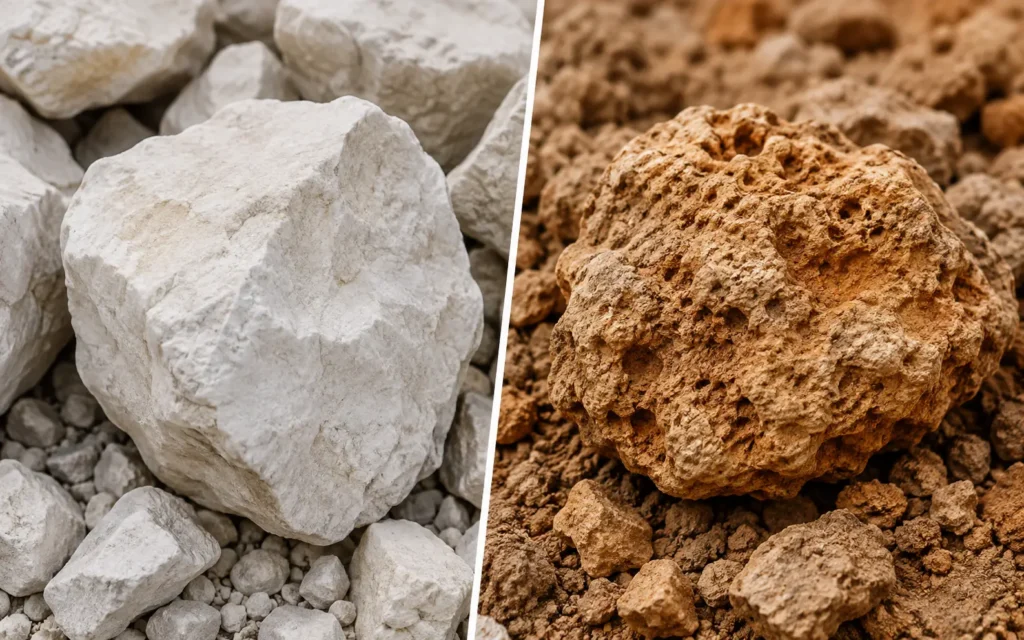
Both limestone and caliche are predominantly calcium carbonate, and this shared chemistry is the source of most of the confusion between them. They look similar, both respond to acid (a few drops of vinegar on either will fizz), both raise soil pH, and both are described as “whitish-tan” aggregate material in a quarry or construction context.
But the critical difference is what the calcium carbonate is doing in each material:
In limestone: The calcium carbonate is the rock itself. It is a coherent, dense, interlocking crystalline structure that formed under pressure over millions of years. Limestone is calcium carbonate as primary mineral structure — the entire mass is calcium carbonate in crystallized form.
In caliche: The calcium carbonate is the cement. Whatever was in the soil — sand grains, clay, small gravel pieces, rock fragments — that’s the matrix. The calcium carbonate coats and bonds those particles together, but the particles themselves are often not calcium carbonate. A caliche deposit in sandy West Texas soil is sand cemented with calcium carbonate. A deposit in gravelly Hill Country soil is gravel cemented with calcium carbonate. A deposit in silty Panhandle soil is silt cemented with calcium carbonate.
This is why caliche is so variable. The performance of a caliche deposit as a base material depends not just on how much calcium carbonate cement is present, but on what that cement is binding. Dense calcium carbonate cement binding coarse gravel produces a material close to limestone in performance. The same density of cement binding fine silt produces something that falls apart when saturated and compacts poorly.
An analogy: Limestone is like a building made entirely of brick. Caliche is like a building made of whatever was available — brick, cinder block, wood, stone — held together with mortar. The mortar is the same in both, but the underlying structure is completely different.
Texas Geography: Where Each Occurs and Why
The distribution of limestone and caliche across Texas is essentially a geological and climatic map.
Limestone formations are concentrated along the Balcones Escarpment — the ancient reef edge that marks the boundary between Cretaceous marine sediments to the west and older, deeper formations to the east. This escarpment runs roughly from Del Rio to San Antonio to Austin to Waco to Dallas. The limestone quarries that supply crushed aggregate to Texas’s metropolitan markets are clustered along and west of this line. The I-35 corridor sits on or near this escarpment, which is why limestone base material is readily available and cost-competitive across the DFW-to-San Antonio urban spine.
The Hill Country interior is anchored by the Llano Uplift — a dome of much older rock, primarily granite and metamorphic stone, that formed the core around which the Cretaceous sea deposited its limestone. The edges of this uplift expose the oldest and thickest limestone sequences in the state, which is why Burnet, Llano, and Mason counties are major quarry sources.
Caliche deposits are found where the climate is dry enough for accumulation — roughly the western two-thirds of the state: West Texas, the Permian Basin, the Trans-Pecos, the Panhandle, South Texas, and the drier portions of the Edwards Plateau. Annual rainfall in these regions typically runs below 20 inches. Some of the thickest and hardest caliche deposits in Texas occur in the Chihuahuan Desert region of far West Texas, where extremely low rainfall and high evaporation rates have allowed calcium carbonate to accumulate for millennia.
An important nuance: the Hill Country and Edwards Plateau contain both limestone bedrock and caliche subsoil layers. The limestone is the source rock; the caliche formed in the soils above it as the region’s climate became progressively drier over the past several million years. A rancher digging a post hole in the Hill Country may encounter both within a few feet of each other — limestone bedrock below and a caliche hardpan in the soil above it.
How the Formation Difference Shows Up in Practice
Understanding the geological origin of each material explains a set of practical performance characteristics that would otherwise seem arbitrary:
Consistency: Quarried limestone is consistent because it comes from coherent bedrock. The same formation, quarried and crushed the same way, produces the same gradation and the same performance every time. Caliche is variable because the parent material — whatever soil was present when the calcium carbonate cemented — varies by location, depth, and local geology. Two caliche deposits from different parts of West Texas may look identical but perform very differently as base material.
Specification compatibility: TxDOT and municipal specifications can be written for crushed limestone because its performance is predictable and verifiable through laboratory testing. The gradation, the plasticity index, the wet ball mill value — all can be measured and guaranteed because the parent material is coherent bedrock. Caliche cannot be written into a formal construction specification because its properties vary by source in ways that cannot be guaranteed without testing each individual deposit.
Moisture behavior: Limestone is chemically stable in the presence of water — it doesn’t swell, contract, or change plasticity based on moisture content (within the range of normal weather). Caliche behavior in moisture depends heavily on its matrix. Caliche bound around clay-rich soil particles inherits some of the clay’s moisture sensitivity — it can soften and lose cohesion when saturated. Caliche bound around sandy or gravelly particles remains more stable. This is one reason caliche performs unpredictably in high-rainfall parts of Texas.
Agricultural hardpan: In agricultural contexts, caliche is often an obstacle rather than an asset. A solid caliche hardpan layer at 18–24 inches below the surface — common in parts of West Texas, South Texas, and the Panhandle — restricts root penetration and creates a perched water table during heavy rain events. Farmers and ranchers sometimes have to mechanically break up caliche layers (a process called ripping or subsoiling) before establishing crops or improved pasture. This agricultural context is one reason caliche has a complicated reputation in Texas: it’s useful material when mined and used as base aggregate, but a real headache when it’s underground where you’re trying to grow something.
The Naming: Where These Words Come From
Limestone is straightforwardly descriptive in English — a stone composed of lime (calcium compounds). The term has been in use since at least the 14th century.
Caliche comes from the Spanish word for lime or calcium, itself derived from the Latin calx (lime). Spanish-speaking settlers in the arid regions of Texas, New Mexico, and Mexico encountered this whitish hardpan material and named it after its obvious calcium content. The same material goes by different regional names internationally: calcrete in Australian and British geological literature, kankar in India, croûte calcaire in French. The Spanish term caliche stuck in Texas and the American Southwest because Spanish was the dominant language of the region when European settlers first encountered and named the material in large quantities.
Which One Is Right for Your Project?
The geological and material science distinction between limestone and caliche explains, rather than replaces, the practical decision guide. If you need a quick reference:
- Any project with formal specification, permits, or engineer oversight: Crushed limestone. Caliche cannot be spec'd to TxDOT or municipal standards.
- Private projects in West Texas, South Texas, or Panhandle where caliche is locally abundant: Caliche is a legitimate, cost-effective option when sourced from a quality deposit and the rainfall is low enough to keep it stable.
- Any project in the major Texas metros or high-rainfall areas (DFW, Houston, Austin, San Antonio): Crushed limestone. Caliche's variability and moisture sensitivity are real risks in these markets.
Frequently Asked Questions
Is caliche the same as limestone?
No, though they’re chemically related. Both contain calcium carbonate, but they form in completely different ways. Limestone is a coherent sedimentary rock formed on ancient seafloors over millions of years — it is calcium carbonate as primary crystalline structure. Caliche is a soil accumulation where calcium carbonate acts as cement binding whatever soil particles happened to be present. Limestone is consistent; caliche is highly variable.
Why does caliche look like limestone? Both are predominantly calcium carbonate, which gives them similar whitish-tan color. But the similarity is mostly surface-level — the internal structure of limestone (coherent interlocking crystals formed under geological pressure) is fundamentally different from caliche (a soil matrix loosely cemented with calcium carbonate that precipitated from groundwater).
Where does limestone come from in Texas?
Most Texas construction limestone comes from Cretaceous formations along and west of the Balcones Escarpment — the geological boundary running roughly from Del Rio through San Antonio, Austin, Waco, and Dallas. These formations are the compressed remains of a warm, shallow sea that covered central Texas roughly 66–145 million years ago. The Hill Country quarries around Burnet, Llano, and Mason counties tap some of the thickest and most consistent of these formations.
Where does caliche come from?
Caliche forms in semi-arid soils where annual rainfall is roughly 15–25 inches — enough to dissolve and move calcium carbonate downward through the soil, but not enough to flush it away. In Texas, caliche deposits are found across West Texas, the Permian Basin, the Panhandle, South Texas, and parts of the Edwards Plateau. It is actively forming in these areas today, though the accumulation rate is extremely slow on a human timescale.
Does caliche contain limestone?
Sometimes. In areas where limestone is the underlying bedrock — the Hill Country, for example — caliche may contain fragments of limestone rock within its calcium carbonate-cemented matrix. But caliche itself is classified as a pedogenic (soil-formed) deposit, not a limestone formation. The calcium carbonate in caliche came from groundwater chemistry, not from marine sediment accumulation.
Why is caliche so variable between locations?
Because caliche cements whatever soil material is present at the time and depth of formation. A deposit in sandy West Texas soil is cemented sand. A deposit in gravelly Hill Country soil is cemented gravel. A deposit in silty Panhandle soil is cemented silt. The calcium carbonate cement is the same; the matrix it binds is not — and the matrix determines how the caliche performs as a base material under load and in wet conditions.
Can caliche be used in place of crushed limestone for construction?
For formal construction projects with specifications, permits, or engineer oversight, no — caliche cannot meet TxDOT or municipal specification requirements that crushed limestone can. For private, low-traffic applications in the arid regions where caliche is abundant and quality, it can be a legitimate and cost-effective alternative. The caliche road base article on this site covers this decision in detail.
Does Select Sand & Gravel supply crushed limestone across Texas?
Yes. Select Sand & Gravel delivers crushed limestone and flex base across Dallas, Fort Worth, Austin, Houston, San Antonio, and Oklahoma City, sourcing from multiple quarries to match the most competitive source to each delivery location. Call 1-817-572-6310 for a quote.

