What Is Caliche Road Base and Is It Good for Driveways?
If you’ve spent any time sourcing base materials in Texas, West Texas, or New Mexico, you’ve almost certainly heard the word “caliche.” It shows up in contractor conversations, material quotes, and land-clearing discussions — sometimes interchangeably with road base or flex base, sometimes as something clearly different.
It’s not always clear what caliche actually is, how it performs, or whether it belongs on your driveway or project. This guide answers all of it.
What Is Caliche?
Caliche (pronounced “cah-LEE-chee”) is a naturally occurring sedimentary material found in arid and semi-arid regions. It forms when calcium carbonate — dissolved by rainwater percolating through soil — migrates downward and re-precipitates in lower soil layers as water evaporates. Over thousands of years, this calcium carbonate accumulation binds surrounding soil particles, gravel, sand, and rock fragments into a cemented, hardpan-like layer.
The result is a whitish to tan-colored material that can range from loose and crumbly near the surface to nearly rock-hard at depth. In Texas, caliche deposits are found throughout the Hill Country, West Texas, the Panhandle, South Texas, and wide stretches of the Permian Basin — anywhere rainfall is low enough that calcium carbonate accumulates rather than leaching away completely.
Caliche is not a single uniform material. Depending on where it’s mined and at what depth, it can vary significantly in hardness, grading, and performance. This variability is one of the most important things to understand before specifying it.
How Is Caliche Different from Road Base / Flex Base?
This is where most of the confusion comes from — and the distinction matters practically.
Crushed limestone road base (flex base) is a manufactured product. Quarried limestone is mechanically crushed to a controlled gradation under ASTM or TxDOT specifications, then screened to ensure a consistent blend of particle sizes from coarse aggregate down through fine screenings. The gradation is engineered — the ratio of coarse to fine particles is calibrated to produce maximum compaction density and structural performance. Every load meets a written spec.
Caliche is a mined natural deposit. It’s extracted from the ground, often with minimal processing — sometimes screened, sometimes simply excavated and hauled as-is. Its composition depends entirely on the deposit: how deep it was mined, what soil types surrounded it, and how much calcium carbonate cementation is present. One caliche deposit can perform comparably to flex base. Another from a different location can be loose, silty, and structurally weak.
| Caliche | Crushed Limestone Road Base / Flex Base |
|
|---|---|---|
| Origin | Naturally deposited, mined from the ground | Quarried limestone, mechanically crushed |
| Gradation | Variable — depends on deposit | Engineered to spec (TxDOT Grade 1 or Grade 2) |
| Consistency | Load-to-load variation is common | Consistent — meets written spec |
| Calcium carbonate content | High (defines the material) | Moderate — varies by quarry |
| Compaction performance | Good to excellent when high quality | Excellent — designed for compaction |
| Availability | Regionally specific (arid areas of TX, NM, OK) | Widely available across TX and OK |
| Cost | Generally lower | Moderate — depends on haul distance |
| Specification acceptance | Not accepted for most TxDOT or municipal work | Accepted for permitted road and infrastructure work |
How Does Caliche Perform as a Base Material?
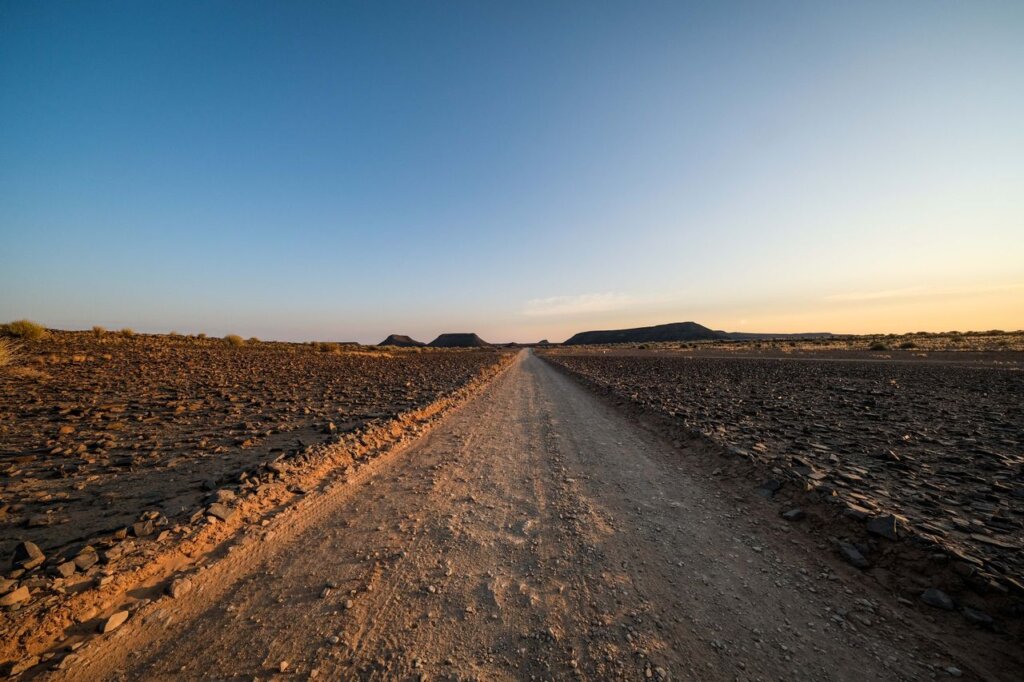
When caliche is high quality — well-cemented, properly graded, and sourced from a consistent deposit — it performs genuinely well as a base material. The calcium carbonate that defines it acts similarly to the fines in crushed limestone flex base: it fills voids between larger particles, creates cohesion when moisture and compaction are applied, and produces a surface that hardens over time with traffic and exposure.
In the regions where it naturally occurs, caliche has been used for ranch roads, rural driveways, and unpaved farm-to-market access roads for generations. In West Texas and South Texas particularly, it’s the default material for low-budget road building simply because it’s available locally when quarried limestone would require significant haul distance and cost.
Where caliche tends to perform well:
- Low to moderate traffic rural driveways and ranch roads
- Temporary access roads on construction sites
- Fill and grading applications in caliche-rich areas
- Areas where TxDOT or municipal specifications are not required
Where caliche tends to underperform:
- High-traffic driveways, especially with heavy vehicles
- Areas with significant rainfall — caliche with high fines content can become muddy and soft when saturated, and repeated wet-dry cycles can cause surface deterioration
- Any application requiring a formal material specification
- Urban and suburban settings where consistent performance is expected
Is Caliche Good for Driveways?
The honest answer is: it depends on the quality of the source material, your traffic load, and your climate.
For a lightly used rural driveway in West Texas or South Texas — where caliche is locally abundant, rainfall is low, and formal specs aren’t required — caliche is a cost-effective and legitimate base material. Landowners in these areas have used it successfully for decades, and the low precipitation means the material stays intact and hard rather than cycling through wet-soft and dry-hard states repeatedly.
For a suburban residential driveway in DFW, Houston, Austin, or San Antonio — where rainfall is higher, traffic may include heavy vehicles, and long-term surface performance matters — crushed limestone flex base is the more reliable specification. The engineered gradation and consistent quality of flex base produces more predictable compaction, better moisture resistance, and a harder finished surface than variable-quality caliche can guarantee.
Key questions to ask before choosing caliche for a driveway:
- What is the source of this caliche? Has it been tested or graded?
- How much rainfall does this area receive? High rainfall + high fines caliche = soft surface problems.
- What vehicle loads will the driveway handle? Light passenger cars or heavy trucks regularly?
- Is a dust-free or polished finish expected, or is a natural unpaved surface acceptable?
If you can’t get a clear answer on the source quality, and if you’re in a higher-rainfall Texas market, road base / flex base is the lower-risk choice.
Caliche and Texas Soils: An Important Context
Texas has some of the most geologically varied soils in the country, and caliche interacts with that variability in important ways.
In the Blackland Prairie soils of Central Texas and DFW — the heavy, expansive clay that causes so much foundation movement — caliche on its own is not a long-term solution for driveways without a proper subgrade preparation. The expansive clay beneath will move seasonally regardless of what sits on top of it, and a caliche layer without sufficient depth or stabilization can crack and shift as the subgrade heaves.
Crushed limestone flex base handles this better because its engineered gradation produces a denser, more rigid mat that bridges subgrade movement more effectively than loosely graded caliche. For clay subgrade conditions, depth also matters — 6 to 8 inches of compacted base is far more protective than 3 to 4 inches regardless of the material chosen.
In West Texas and South Texas, where subgrade soils are more stable and caliche deposits are high quality, the material is genuinely appropriate and practical.
Caliche vs. Road Base: Which One Should You Choose?
| Project Type | Recommended Material |
|---|---|
| Rural West/South Texas ranch road | Caliche (locally sourced, cost-effective) |
| Temporary construction access road | Caliche or recycled material |
| Suburban residential driveway | Crushed limestone flex base |
| Commercial driveway or parking lot | Crushed limestone flex base (Grade 2 minimum) |
| Any TxDOT or municipal permitted work | Crushed limestone flex base (Grade 1 or 2 to spec) |
| Building pad or slab subbase | Crushed limestone flex base |
| High-rainfall area (Houston, Austin, San Antonio) | Crushed limestone flex base |
The pattern is consistent: where spec, reliability, and rainfall matter, flex base wins. Where local availability, cost, and low rainfall converge — particularly in West Texas — caliche is a practical and time-tested choice.
Can You Mix Caliche and Road Base?
Yes, and in some Texas markets this is done — a caliche base layer topped with crushed limestone flex base as a wear course. The caliche provides cost-effective bulk fill to bring a road or driveway to grade, while the flex base top layer delivers the compaction performance and surface quality that caliche alone may not achieve consistently.
This hybrid approach makes economic sense in areas where caliche is cheap and abundant but the project requires a finished surface that can handle real traffic. The caliche does the heavy lifting on volume; the flex base does the performance work on top.
If you use this approach, the caliche layer should be fully compacted before flex base is applied on top, and the caliche source should be assessed for fines content — high-fines caliche used as a base under flex base can create a weak, moisture-sensitive layer that undermines the flex base above it if the ground gets wet.
What Does Caliche Cost Compared to Road Base?
In the Texas markets where caliche is naturally occurring and locally mined, it is typically 20 to 40 percent less expensive per ton than crushed limestone flex base. The savings come entirely from reduced processing — caliche is mined and hauled with minimal crushing or screening versus the quarrying, crushing, and gradation control required for flex base.
In the DFW, Houston, Austin, and San Antonio metros — where caliche isn’t locally abundant and would need to be hauled from source areas — the cost advantage shrinks or disappears entirely. In these markets, crushed limestone flex base is both the practical and cost-competitive choice because it’s quarried regionally.
The cost comparison only favors caliche meaningfully where the deposit is close to the project. Factor in haul distance before assuming caliche is the cheaper option for your specific location.
The Bottom Line
Caliche is a naturally cemented calcium carbonate soil material that forms in arid regions and functions as a base material for roads and driveways where it’s locally abundant — primarily West Texas, South Texas, the Panhandle, and similar low-rainfall areas. It’s not a manufactured product, and its quality varies significantly by source.
For rural, low-traffic applications in caliche-rich regions with low rainfall, it’s a legitimate and cost-effective choice that landowners have relied on for generations.
For suburban driveways, commercial pads, high-traffic applications, high-rainfall markets, or any project requiring a formal material specification, crushed limestone road base / flex base is the more reliable, consistent, and better-performing material — and in most of the major Texas metro markets, it’s the material your contractor will default to for good reason.

