What Is the Difference Between Utility Sand and Fill Sand?
Both terms show up on supplier lists, project specs, and contractor invoices — sometimes in the same paragraph. A homeowner planning a drainage correction, a plumber replacing a sewer line, and a site contractor grading a commercial pad might all find themselves asking a supplier for “sand” without being entirely sure which type they mean.
The distinction matters more in some situations than others. For most fill applications, using a slightly different sand than specified won’t cause a noticeable problem. For utility trench work — pipe bedding — using the wrong material creates a failure mode that takes years to develop and costs significantly more to fix than the price difference between the two products.
This article draws the line clearly between utility sand and fill sand, explains where each belongs, and covers what to tell your supplier when your project documents specify one or the other.
Utility Sand: What It Is and What It Does
Utility sand — also called utility bedding sand, pipe bedding sand, trench sand, or pipe sand — is a clean, screened sand used specifically to surround underground pipes, conduits, and buried infrastructure in a utility trench.
The utility bedding sand article on this site covers the full underground application in detail, including the trench zone system and how to calculate quantities. The short version: utility sand sits beneath the pipe (the bedding layer), around the sides of the pipe (the haunching zone), and above the pipe up to a specified height (the initial backfill zone). Its job is to protect the pipe from point loading — concentrated stress from rocks, hard clay chunks, or debris pressing against the pipe wall — while providing a uniform, compressible medium that distributes load evenly around the pipe circumference.
Key characteristics of utility sand:
- Rock-free — no stones, gravel, or hard debris that could create a point load on the pipe
- Clean — no organic material, frozen lumps, or clay balls
- Consistent gradation — particles screened to a defined size range (typically 3/8" maximum, less than 5% passing the No. 200 sieve)
- Low plasticity index — doesn't behave like clay when wet, won't swell against the pipe
- More expensive than fill sand — the extra screening and quality control cost something
The utility bedding sand product page describes the function precisely: providing “a consistent, stone-free environment” that prevents the point loading that causes pipes to crack or deform over time.
Fill Sand: What It Is and What It Does
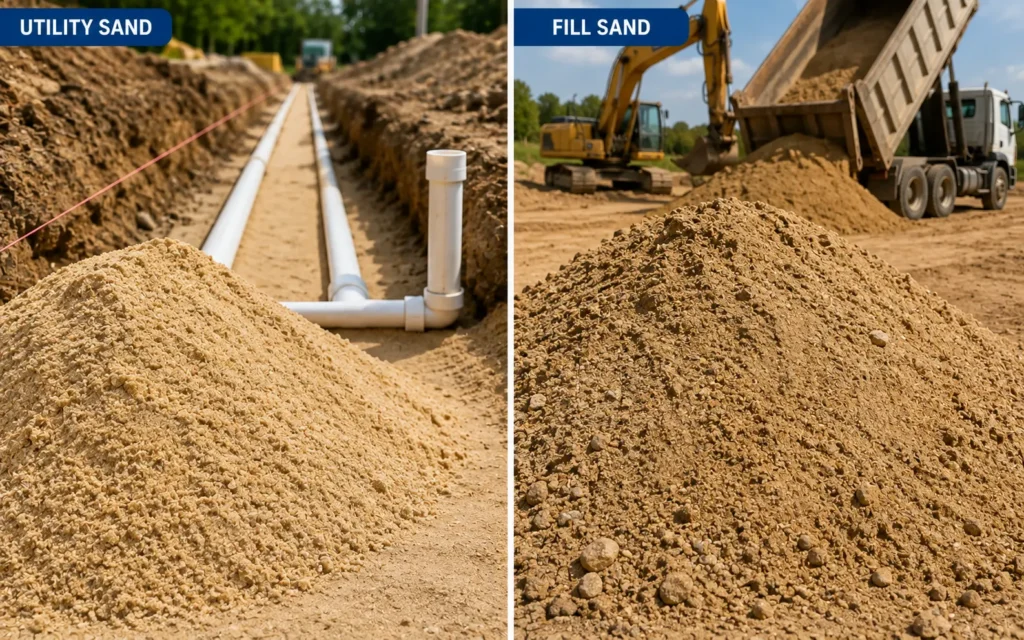
Fill sand is a general-purpose sand used to fill excavated voids, build up low areas to grade, provide a granular sub-base layer, or replace unsuitable native material in construction and landscaping applications. It is not a precision product — it doesn’t need to be, because most fill applications don’t require the same pipe-protection performance that utility trenching does.
Fill sand characteristics vary by supplier and region:
- Coarser and less precisely screened than utility sand
- May contain small gravel pieces — typically acceptable for fill applications
- Does not need to be rock-free
- Gradation is variable — what one supplier calls "fill sand" another might call "pit sand" or "bank sand"
- Lower cost than utility sand because less processing is required
The best-sand-for-construction article on this site defines fill sand as coming from riverbeds, washed and graded to a coarse texture, commonly used as a sub-base in road construction, parking lots, and foundations. That’s an accurate description of one type, but the term “fill sand” in practice covers a wider range of materials depending on who’s selling it and where.
A Texas-specific note: In the Texas construction market, the term “fill sand” isn’t always used. What other markets call fill sand, Texas suppliers often call “washed sand,” “pit sand,” “bank run sand,” or simply “sand” depending on the source. When a Texas spec document says “fill sand,” it most commonly means a clean, granular sand suitable for a general fill application — not a precision utility bedding spec. If you’re ordering from Select Sand & Gravel and your project calls for “fill sand,” the most direct conversation is to describe the application (what are you filling, where, and whether compaction in lifts is required) rather than the material name.
Side-by-Side Comparison
| Factor | Utility Sand | Fill Sand |
|---|---|---|
| Primary purpose | Protect underground pipes from point loading | Fill voids, build grade, sub-base layer |
| Rock-free requirement | Yes — essential | No — minor rock or gravel acceptable |
| Gradation | Precisely screened, 3/8" maximum typical | Variable, coarser acceptable |
| Plasticity index | Low — must not swell or behave like clay | Not typically specified |
| Organic matter | None permitted | Minimal preferred but not always tested |
| Compaction requirement | Compacted in trench zones around pipe | Compacted in lifts, less critical gradation |
| Municipal spec required | Usually — city/utility owner spec | Rarely for general fill work |
| Cost | Higher — more processing, tighter spec | Lower — less screened |
| Where it goes | Underground trench around pipe/conduit | General fill, behind walls, sub-slab layer |
| SelectSG product | Utility and Bedding Sand | Cushion Sand / Washed Sand (context-dependent) |
Why Using Fill Sand for Pipe Bedding Is a Real Risk
The performance difference between utility sand and fill sand is most consequential in one specific scenario: pipe bedding in a utility trench. This is worth explaining clearly, because “it’s just sand” is the logic that leads to expensive pipe failures.
A utility pipe — PVC sewer line, HDPE water main, copper gas service, fiber optic conduit — sits in a trench surrounded by whatever material the installer places there. If that material contains a rock, a hard clay chunk, or any other object with an edge harder than the pipe material, that object presses against the pipe wall under the weight of the backfill and surface loads above.
This is called a point load. Under hundreds or thousands of pounds of backfill pressure, a point load concentrates stress on a tiny area of the pipe wall. A PVC pipe doesn’t fail immediately — the process takes months or years. The pipe slowly deforms or cracks at the point load location. Joints separate. A sewer line develops a “belly” — a low point that collects solids and causes recurring blockages. A water main develops a slow leak that eventually becomes an emergency repair.
The cost of excavating a failed pipe — renting equipment, a crew, traffic control if it’s in a road, emergency service — is orders of magnitude higher than the cost difference between utility sand and fill sand. Fill sand works fine in fill applications. It is not the right tool for pipe bedding, and the specification for utility sand in a project document exists specifically because someone learned this the hard way.
Common Applications for Each Material
Where Utility Sand Belongs
Water and sewer line installation. The most common application — residential water service lines, sewer laterals, municipal water mains. Standard bedding depth is 4–6 inches below the pipe invert with haunching to the springline and initial backfill 12 inches above the pipe crown.
Electrical conduit and fiber optic cable. Protects from mechanical damage by soil movement and rocks. Also makes future excavation safer — working through sand is predictable; working through unknown fill is not.
Gas lines. Chemically neutral, won’t corrode metal piping. Low salt content and non-reactive.
Underground storage tanks. Levels and stabilizes the base beneath buried tanks.
For the full application guide including trench zone calculations, see the utility bedding sand article.
Where Fill Sand Belongs
Filling excavations and voids. Old pool demolitions, old tank removals, building demolition backfill, foundation void fills — anywhere a large excavated area needs to be brought back to grade without a specific pipe protection requirement.
Behind retaining walls. Fill sand placed behind a retaining wall provides a freely draining granular backfill that reduces hydrostatic pressure on the wall face. In this application the free drainage of sand is an asset — soil backfill would hold water and increase lateral pressure on the wall.
Sub-base under pavement. A layer of fill sand or pit sand beneath road base can improve drainage and provide a separation layer between native soil and the aggregate base course. In Texas this application is more common in areas with very wet or unstable native soils.
General grading and leveling. Filling low spots in a yard, leveling a slab area, filling depressions in a driveway approach — any application where granular fill material is needed without a specific spec.
Under concrete slabs in some applications. In certain slab-on-grade applications, particularly where drainage beneath the slab is important, a sand layer is placed between the vapor barrier and the compacted base. This is sometimes called “fill sand” in residential construction documents. The material used is typically a clean, washed sand — closer to utility sand than coarse fill in practice.
The "Can I Substitute" Questions
Can I use fill sand for pipe bedding?
No — and the pipe failure risk described above is the reason. If your project specification says “utility bedding sand,” it means utility bedding sand. Substituting fill sand risks a spec failure on a inspected project and a real pipe failure risk on any project. The cost difference between the two materials is not worth this exposure.
Can I use utility sand as fill?
Yes, and it works perfectly well. The issue is cost: utility sand is more expensive because it’s more carefully screened and processed. If you have leftover utility sand from a trench operation and an adjacent fill area to address, using it there is entirely practical. Ordering utility sand specifically for a fill-only application where the extra screening provides no benefit means paying more than necessary. The reverse is true if you’re on a tight timeline — it’s better to use utility sand in a fill application than to delay a project waiting for fill sand delivery.
Can concrete sand substitute for utility sand in pipe bedding?
Often, yes — concrete sand’s angular, coarse gradation compacts well around pipes and meets many municipal utility specifications. Some specs differentiate between the two by gradation; others accept either. Check the project spec or ask the city engineer before substituting. Concrete sand costs slightly more than utility sand in most Texas markets, but less than the cost of a failed inspection or pipe repair.
What if my spec says “fill sand” for a trench application?
“Fill sand” in a trench context typically means the material used in the final backfill zone — the upper portion of the trench above the initial backfill zone — not the pipe bedding zone itself. Read the spec carefully: it should specify utility bedding sand for the zones immediately around the pipe and may allow fill sand or native material for the upper trench zones. If it’s ambiguous, ask the engineer of record before ordering.
What to Tell Your Supplier
The most productive conversation when ordering sand for any project isn’t naming a product — it’s describing the application. Tell the supplier:
- What it's going around or under. Pipe bedding? Behind a wall? Under a slab? Filling a demolition excavation?
- Whether there's a spec. If there's a city or utility owner specification, share it. Select Sand & Gravel's team matches the source pit to the spec requirement.
- Whether compaction in lifts is required. This affects gradation recommendations.
- The quantity. Utility trench calculations use pipe diameter, trench width, and linear footage. Fill calculations use volume. The team can help calculate either.
Frequently Asked Questions
What is the main difference between utility sand and fill sand?
Utility sand is a precisely screened, rock-free sand used specifically to protect underground pipes and conduits from point loading. Fill sand is a general-purpose, less precisely screened sand used to fill voids, build grade, and provide granular sub-base layers. Utility sand requires more processing and costs more; fill sand is variable and less expensive.
Can I use fill sand for pipe bedding?
No. Fill sand may contain rocks or hard debris that create point loads on a buried pipe — exactly the failure mechanism utility bedding sand is designed to prevent. On inspected utility projects, substituting fill sand for specified utility bedding sand will fail the inspection. On uninspected projects, it creates a long-term pipe failure risk that shows up as cracks, joint separation, or sewer belly months or years after installation.
What is fill sand used for in construction?
Fill sand is used to fill excavated voids and large holes, provide granular backfill behind retaining walls, create sub-base layers under pavement, and level general grading areas. It is a workhorse general fill material for applications where precise gradation and rock-free screening aren’t required.
Is utility sand the same as cushion sand?
In practice the materials are often similar, and in Texas and Oklahoma construction markets the terms are sometimes used interchangeably for underground work. The distinction is contextual: “utility bedding sand” appears in DOT and municipal utility specifications; “cushion sand” is more common in residential and commercial construction. When your project has a formal specification, share the document with your supplier to confirm the right material.
Does Select Sand & Gravel sell fill sand?
Select Sand & Gravel’s sand product lineup includes utility bedding sand, cushion sand, concrete sand, masonry sand, and limestone sand — products that cover the range of what “fill sand” means in different project contexts. The most useful conversation is to describe your application when you call, and the team will recommend the right product. Call 1-817-572-6310.
What gradation is required for utility bedding sand?
Most municipal and utility owner specifications require a maximum particle size of 3/8 inch, less than 5% passing the No. 200 sieve, no organic material or large aggregates, and a low plasticity index. Always refer to the project specification — the city or utility owner’s standard — and provide that document to your supplier so the correct source pit is selected.
How do I know if my project needs utility sand or fill sand?
The simplest guide: if the sand is going around or beneath a pipe, conduit, or cable in a trench, use utility bedding sand. If it’s filling a void, bringing a low area to grade, or providing a general sub-base layer without a pipe protection requirement, fill sand or cushion sand is appropriate. When the project specification is unclear, ask the engineer of record before ordering.

