What Is Utility Bedding Sand? Underground Pipe and Conduit Applications Explained
Most people think of sand as a surface material — something that goes under pavers, fills a sandbox, or levels a yard. But one of the most important places sand ends up is somewhere you’ll never see: buried several feet underground, wrapped around the pipes and conduits that carry water, gas, electricity, and data to every building in Texas and Oklahoma.
That’s where utility bedding sand does its job. And the job matters more than most people realize.
At Select Sand & Gravel, utility bedding sand is one of the products we supply most consistently to civil contractors, utility crews, and municipal projects across all six of our service markets. This article explains what the material is, why it’s specified the way it is, where it’s used, and what separates it from the bedding sand used in surface applications like pavers — which is a different use case covered in its own posts on this site.
What Is Utility Bedding Sand?
Utility bedding sand — also called pipe bedding sand, utility sand, or trench sand — is a clean, screened sand used to surround underground pipes, conduits, and other buried infrastructure. It’s placed beneath the pipe before it’s laid in a trench (the bedding layer), packed around the sides of the pipe (the haunching zone), and used to fill the trench above the pipe up to a specified height (the initial backfill zone) before the rest of the trench is filled with native material or engineered fill.
The defining characteristic of utility bedding sand is that it is rock-free and non-corrosive. The screened material should contain no stones, clay balls, frozen lumps, or organic matter. No debris of any kind that could press against the pipe wall. That’s the whole point.
On the Select Sand & Gravel product page for Utility and Bedding Sand, this is described as providing a “consistent, stone-free environment” — a rock-free envelope around infrastructure that prevents what engineers call point loading.
Why It Matters: The Point Loading Problem
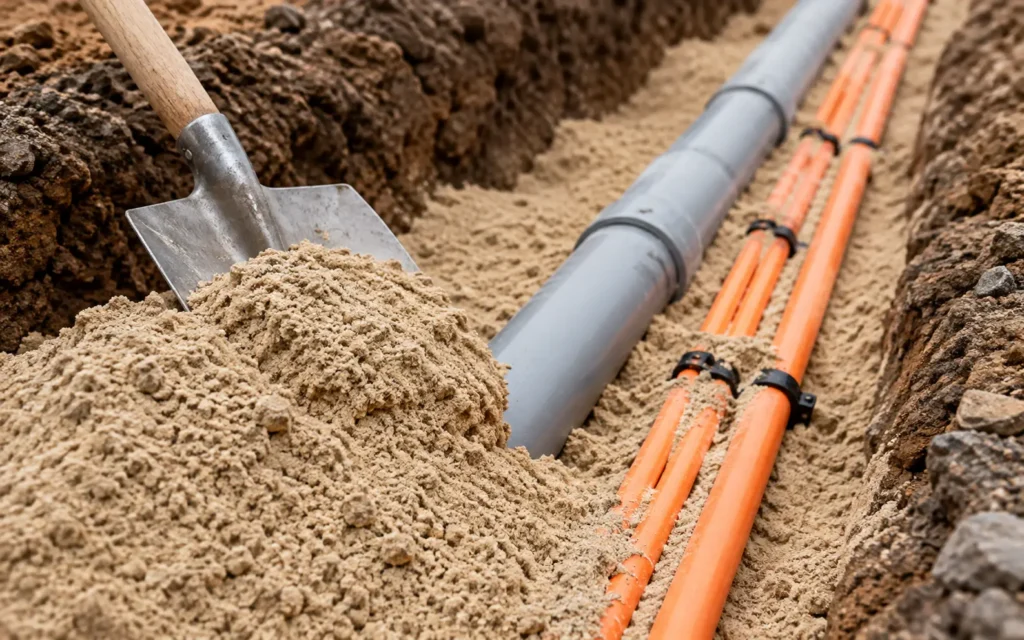
Underground pipes are not buried in ideal conditions. Texas and Oklahoma soils include expansive clay that swells and contracts with moisture, rocky caliche and limestone formations common in Hill Country and West Texas, loose sandy soil along the Gulf Coast, and dense urban backfill in cities like Dallas and Houston that may contain construction debris, old utilities, and unpredictable fill material.
When a pipe sits directly in native soil — without a protective sand envelope — any rock, hard clay chunk, or debris in contact with the pipe wall creates a point load. That’s a localized concentration of stress on a very small area of the pipe surface. Under the weight of backfill, foot traffic, and vehicle loads above, that point load acts like a wedge. Over months and years, it can crack PVC, deform HDPE, corrode metal, or compromise the joint between pipe sections.
Utility bedding sand eliminates point loads by replacing that unpredictable native material with a uniform, compressible medium that distributes load evenly around the entire pipe circumference. The pipe is supported from all sides — not just resting on whatever happened to be in the bottom of the trench.
This is the core reason utility bedding sand is specified in municipal, DOT, and private utility installation standards rather than being optional.
The Trench Zone System: Where Utility Sand Goes
Understanding how utility bedding sand is actually placed requires knowing how a properly constructed utility trench is organized. Engineers divide the trench cross-section into four zones, each with specific material requirements:
Zone 1 — Bedding The sand placed at the bottom of the trench before the pipe is laid. Standard depth is 4–6 inches below the pipe’s barrel (the bottom of the pipe). The bedding is leveled and compacted lightly before the pipe is set on it. In areas with very soft or unstable subgrade — which is common in Houston’s high water table zones — this layer may need to be deeper, or a granular sub-base may be required first.
Zone 2 — Haunching The sand placed from the bedding up to the pipe’s springline (the centerline, or widest point of the pipe). This is the most structurally critical zone because the haunching material must fill the curved underside of the pipe completely — no voids. Voids in the haunching zone are a leading cause of pipe deflection in flexible pipes (PVC, HDPE). Utility sand’s consistent gradation allows it to flow and settle into the curved geometry of the pipe without requiring aggressive compaction that could damage the pipe itself.
Zone 3 — Initial Backfill Sand placed from the pipe springline to a specified height above the pipe crown — typically 12 inches above the top of the pipe, though this varies by specification. The initial backfill zone continues to protect the pipe from damage during the final backfill operation, when heavier material is placed and compacted above.
Zone 4 — Final Backfill The material from the initial backfill height up to the surface. This is typically native excavated material, engineered fill, or road base depending on what the surface above will be used for. Utility sand is generally not used here — it’s not necessary for pipe protection at this depth, and using premium bedding sand as final backfill is an unnecessary cost.
Understanding these four zones is why the question “how much utility sand do I need?” depends on more than just the trench length — you need to know pipe diameter, trench width, and how far above the pipe the sand specification requires.
Where Utility Bedding Sand Is Used
Water and Sewer Lines
The most common application. Municipal water mains, residential water service lines, and sewer pipes — whether PVC, ductile iron, HDPE, or concrete — are installed in bedding sand per the utility owner’s standard specification. Most Texas cities and water districts specify a minimum of 4 inches of bedding below the pipe invert and haunching to the springline, with initial backfill to 12 inches above the crown.
The Select Sand & Gravel utility product page notes that maintaining level grade for gravity-fed sewer lines is a key function of this material: a smooth, consistent bedding layer prevents the “bellies” in the pipe that cause blockages and backups. A sagging sewer line — one that dips below its design grade — collects solids and causes repeated maintenance problems. The bedding sand layer is part of what prevents that.
Electrical Conduit and Telecommunications Cable
Underground electrical conduit — whether PVC schedule 40, rigid metal conduit, or high-density polyethylene — is bedded in utility sand to protect it from mechanical damage by soil movement and rocks. This matters especially for conduit carrying high-voltage lines, where a damaged sheath creates a serious hazard.
Fiber optic and telecommunications cables are even more sensitive. A single point of pressure on a fiber optic cable can degrade signal transmission or sever the strand entirely. The sand envelope is what allows these cables to survive the underground environment — not just at installation, but over decades of soil movement and surface loading above. That’s why municipal fiber projects and broadband infrastructure buildouts in Texas and Oklahoma consistently specify utility bedding sand by name.
Beyond protection during service, the sand envelope makes future excavation safer. When a crew needs to repair or replace an underground line, working through sand is predictable. Working through unknown native fill is not — and hitting a buried electrical line with an excavator bucket is an event no one wants.
Gas Lines
Natural gas distribution lines require a bedding material that is both non-reactive and compactable. The corrosive clays common in parts of Texas — particularly the black expansive clays of the Blackland Prairie region running through Dallas, Waco, and Austin — can accelerate corrosion of metal pipe surfaces over time. Utility bedding sand, with its low salt content and chemical neutrality, provides a non-reactive environment around the pipe exterior. The Select Sand & Gravel product page specifically calls out thermal and chemical protection as performance attributes of their utility bedding sand for exactly this reason.
Underground Storage Tanks
Buried fuel storage tanks and underground water cisterns require a stable, level base that distributes the tank’s weight evenly and prevents differential settlement that could stress tank fittings and connections. Utility bedding sand is the standard material for leveling and stabilizing the base beneath underground storage tanks before they’re set in the excavation.
Foundation Perimeter Drainage
Foundation drainage systems — the perforated pipe that runs around the perimeter of a building’s foundation to intercept groundwater — are typically installed in a combination of utility sand and clean drainage gravel, wrapped in a filter fabric sock. The sand layer sits immediately around the pipe to prevent soil migration into the perforations, while the gravel layer outside the fabric allows rapid water movement toward the pipe. This application is common in areas of Texas with clay-heavy soils and seasonal drainage challenges.
Utility Bedding Sand vs. Paver Bedding Sand
This distinction causes real confusion on job sites. Both are called “bedding sand.” They are not the same product or the same application.
The bedding sand used under pavers — covered in detail in What Is Bedding Sand? and How Thick Should Bedding Sand Be Under Pavers? — is a thin screed layer (typically 1 inch) used for leveling and seating the pavers. It sits on top of a compacted aggregate base and is deliberately left uncompacted before the pavers are placed.
Utility bedding sand is a structural specification material installed in a trench at depths of 4 to 24 or more inches, compacted in the haunching zone, and selected to meet specific sieve analysis requirements set by the municipality or utility owner. The two applications share a name — and sometimes the same physical material — but the depth, purpose, compaction method, and specification context are completely different.
When your project documents specify “bedding sand,” the context tells you which one you need. A civil engineering spec for a utility trench and a landscape contractor’s paver installation both use the words “bedding sand” — but they mean different things, and you should confirm with your supplier which product fits your specific application.
Gradation and Specification: What "City Spec" Means
Utility bedding sand is not generic. Most municipalities and utility owners specify gradation requirements — meaning the distribution of particle sizes in the material — that the sand must meet before it can be used on their projects.
A typical specification requires:
- Maximum particle size: 3/8 inch or smaller
- Fines content: less than 5% passing the No. 200 sieve (limiting clay and silt)
- No organic material, frozen lumps, or debris
- Low plasticity index (the material should not behave like clay when wet)
These requirements are documented in a sieve analysis — a lab test that measures what percentage of the material passes through a series of progressively smaller screens. When you’re bidding a municipal utility project in Houston, Dallas, Austin, or Fort Worth, the project spec sheet will usually reference a specific gradation table or city standard. Your supplier needs that spec to confirm they’re pulling from the right source pit.
As the Select Sand & Gravel utility product page states: “Provide us with your specific Sieve Analysis or City Spec requirements, and we will match the source pit accordingly.” That’s the correct way to handle spec-driven utility projects — not ordering generic sand and hoping it qualifies.
How to Calculate How Much You Need
Unlike surface applications where you’re working with area and thin depths, utility bedding sand quantities are driven by trench geometry and pipe size.
Basic formula for a pipe bedding installation:
- Trench width = pipe outside diameter + 24 inches (typical minimum clearance each side)
- Sand depth = bedding depth (typically 6 inches below pipe invert) + pipe outside diameter + 12 inches of initial backfill above crown
- Volume = Trench width (ft) × Total sand depth (ft) × Trench length (ft) ÷ 27 = Cubic yards
- Tons = Cubic yards × 1.4 (utility sand weighs approximately 2,700–2,800 lbs per cubic yard)
- Add 10% for waste and over-excavation variation
Worked example — 200 linear feet of 8-inch sewer line:
Ordering Masonry Sand in Texas and Oklahoma
- Pipe OD ≈ 9.5 inches = 0.79 ft
- Trench width = 0.79 + 2 ft = 2.79 ft
- Sand depth = 0.5 ft (bedding) + 0.79 ft (pipe OD) + 1 ft (initial backfill) = 2.29 ft
- Volume = 2.79 × 2.29 × 200 ÷ 27 = 47.3 cubic yards
- Tons = 47.3 × 1.4 = 66.2 tons
- With 10% buffer = 73 tons to order
For large projects with multiple pipe sizes and varying depths, Select Sand & Gravel’s dispatch team can work through the calculation with you on the quote call. Providing your linear footage, pipe size, and trench depth is enough to get a reliable tonnage estimate.
What to Have Ready When You Call
For spec-driven utility projects, the more information you have available the faster the quote process goes:
- Job site address — for delivery logistics and freight cost
- Project specification or sieve analysis — the city or utility owner's gradation requirement
- Pipe diameter and material — helps confirm appropriate sand gradation
- Trench length and estimated depth — for quantity calculation
- Delivery schedule — utility trenching is often phased; coordinating multiple drops along an active trench line is something Select Sand & Gravel handles routinely
For residential plumbing repairs or smaller drainage projects without a formal specification, describe the pipe size, depth, and soil conditions. The team can recommend the appropriate material and help confirm quantity.
Frequently Asked Questions
What is the difference between utility sand and regular sand?
Utility sand is a screened, rock-free sand selected specifically to protect underground pipes and conduits from point loading. Regular or play sand is finer and not structurally suited for pipe bedding. Regular fill sand may contain clay, organics, or inconsistent gradation — none of which is acceptable in a utility trench. Utility bedding sand is screened to remove all debris and sized to compact uniformly around a pipe without leaving voids.
Is utility bedding sand the same as cushion sand?
The materials are often similar in gradation, and in Texas and Oklahoma markets the terms are sometimes used interchangeably for underground utility work. The primary difference is the context: “utility bedding sand” appears in DOT, municipal, and civil engineering specifications; “cushion sand” is more commonly used in residential and commercial paver and structural applications. When your project has a formal specification, share it with your supplier to confirm the material matches — don’t assume the terms are identical.
Can concrete sand be used for pipe bedding?
Concrete sand can be used for pipe bedding in many situations — its gradation is coarse enough to compact around a pipe and it meets many municipal specifications. However, utility bedding sand is often more economical because it doesn’t require the same “structural sharpness” that makes concrete sand premium-priced for concrete mixes. The project specification should be the deciding factor, not price alone.
What gradation is required for utility bedding sand?
Gradation requirements vary by project specification. A typical municipal requirement specifies a maximum particle size of 3/8 inch, less than 5% passing the No. 200 sieve, and no organic material or large aggregates. Always refer to your project’s specification document — the city or utility owner’s standard — before ordering, and provide that specification to your supplier so they can match the correct source pit.
How deep should utility bedding sand be under a pipe?
Standard practice is 4–6 inches of bedding sand below the pipe’s barrel (invert). The haunching zone fills from the pipe bottom to the springline (centerline), and the initial backfill zone covers from the springline to 12 inches above the pipe crown. Exact requirements are governed by the project specification, not general guidelines.
Can utility bedding sand be used in a French drain?
Yes. Utility sand can be part of a French drain system around perforated pipe. It is often paired with clean drainage gravel — pea gravel or crushed limestone — inside a filter fabric sock to prevent long-term sand migration into the perforations. The fabric does the filtering; the sand provides the initial cushion around the pipe.
Does Select Sand & Gravel deliver utility bedding sand to meet city specifications for Houston and Dallas?
Yes. Select Sand & Gravel sources from pits that regularly supply municipal utility projects across Texas and Oklahoma. For city-spec projects, provide the sieve analysis or specification number and the team will confirm the source pit matches the requirement before delivery is scheduled. Call 1-817-572-6310 to get started.
How do I calculate how many tons of utility bedding sand I need for my project?
The quantity depends on trench length, pipe diameter, trench width, and the specified sand depth above and below the pipe. A general formula: Trench width (ft) × Total sand depth (ft) × Trench length (ft) ÷ 27 = cubic yards; multiply by 1.4 for tons; add 10% for waste. The Select Sand & Gravel dispatch team can work through this calculation with you on the quote call if you have the trench dimensions and pipe size available.

