What Are Limestone Screenings Used For? Applications, Performance, and Limitations
Walk into a quarry yard in central Texas and ask for “limestone screenings.” The person behind the counter might hand you an invoice labeled “crushed limestone sand,” “limestone fines,” “crusher dust,” “stone dust,” or “crusher fines.” They’re all the same material. The aggregate industry has never settled on one name for it, which is why contractors and homeowners encounter it under several labels depending on who they’re buying from.
At Select Sand & Gravel, we carry this material as Crushed Limestone Sand and confirm on the product page what the industry knows: “Limestone Screenings and Limestone Sand are used is nterchangeably.” This article goes past that name clarification and into what the material actually does — where it performs well, where it outperforms other options, and where you should reach for something else instead.
What Limestone Screenings Are and How They're Made
Limestone screenings are a byproduct of the limestone crushing process, not a primary quarry product. When a quarry crushes raw limestone to produce #57 stone, road base, gabion rock, and other sized aggregates, the material passes through a series of vibrating screens that separate it by particle size. The fine material that falls through the smallest screens — typically 1/4 inch or 1/8 inch — is limestone screenings.
The particles range from small angular chips down to powder-fine dust, all limestone calcium carbonate. Because they come from the same crushing process as road base and crushed stone, the particles are angular and sharp-edged — not rounded the way river sand or beach sand is. That angularity is the defining performance characteristic: it allows the particles to interlock under compaction, creating a surface that resists lateral movement and holds its shape under load.
This is the distinction the product page calls out directly: “Unlike rounded river sand, Crushed Limestone Sand is a byproduct of the stone-crushing process. The sharp edges of the limestone particles lock together under compaction, creating a semi-rigid base.”
The calcium carbonate content adds a second performance characteristic: when the fine dust particles are moistened and compacted, the calcium carbonate acts as a weak natural binder — not cement-strength, but enough to create a surface that feels noticeably firm and resists shifting in dry conditions. This is why screenings compact harder than most sands and why they’re described as creating a “semi-rigid” surface.
Color varies by quarry source — from bright white-gray to warm tan-cream — because it reflects the mineral composition of the parent limestone formation.
Applications Where Limestone Screenings Work Well
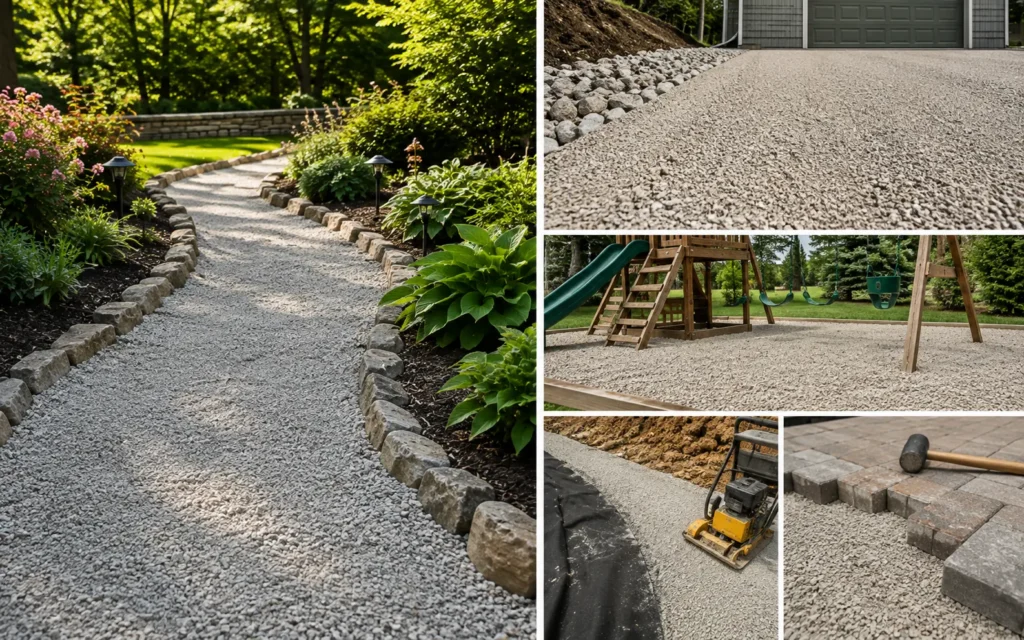
Paver and Stone Bedding
The fine bedding layer directly beneath pavers, flagstone, and stepping stones is one of limestone screenings’ strongest applications. The bedding layer — typically 1 inch deep, screeded level on top of the compacted road base sub-base — needs to be fine enough to allow precise leveling and firm enough to seat the pavers without allowing them to shift over time.
Screenings compete directly with concrete sand for this application, and each has its advocates among Texas and Oklahoma paving contractors. The practical difference:
Concrete sand is coarser and drains more freely, which makes it easier to re-screed if adjustments are needed during installation. It remains workable longer after being spread.
Limestone screenings compact more firmly under paver weight, which some contractors prefer for permanent installations where post-installation adjustment is not expected. The calcium carbonate binding makes the bedding layer slightly more cohesive. The product page describes the result as “a firm, non-shifting bed for high-end patios that prevents pavers from tilting over time.”
For high-foot-traffic commercial paving or heavy paver installations (thick concrete pavers, natural stone), the firmer bedding that screenings provide can be an advantage. For DIY residential patios where minor re-leveling is expected over the first season, concrete sand’s workability may be more forgiving.
Both materials work. The right choice depends on the installation type, traffic level, and the contractor’s preference. Seee What Kind of Sand Goes Between Brick Pavers? for the paver jointing question — that’s a separate material from the bedding layer.
Installation depth: 1 inch screeded level over compacted road base. The road base sub-base handles the structural load; the screenings layer is for leveling precision and paver seating.
Pathways and Walkways
Compacted limestone screenings produce a walking surface that is firmer than decomposed granite, more natural-looking than concrete, and more durable than mulch or wood chip. The angular particles compact into a dense layer that handles regular foot traffic without rutting and — unlike loose gravel — doesn’t scatter underfoot.
The product page’s claim that compacted screenings provide “a smooth, ADA-compliant surface” is worth unpacking. ADA accessibility guidelines for ground surfaces require that outdoor surfaces be firm (supporting a person’s weight without significant deformation), stable (not shifting or moving when stepped on), and slip resistant. Compacted limestone screenings — installed at proper depth over a compacted sub-base, with adequate drainage slope — can meet the firm and stable requirements of ADA PROWAG Section R302.
The conditions that matter for ADA compliance:
- The screenings must be compacted, not loose — loose or uncompacted screenings shift and do not meet the stable requirement
- A compacted road base sub-base is needed beneath the screenings layer — screenings alone over soft native soil will deform under foot traffic
- Adequate drainage slope prevents water from softening the surface — a flat screenings path on clay soil that holds water after rain will fail the firm requirement during wet periods
- Depth of the screenings layer: 2–3 inches over a compacted 3–4 inch sub-base is the standard for maintained pedestrian paths
In North Texas and central Texas, where municipal parks, trail systems, and public pathway projects regularly specify a compacted fines surface for accessibility, limestone screenings are a common specification material. The light color, drainage performance, and compaction characteristics all favor them over alternatives like decomposed granite (which can be sandy and loose) or crushed concrete (gray and variable).
What affects performance in wet conditions: The product page states that screenings “maintain structural integrity and promote vertical drainage even in wet conditions.” That’s accurate for well-installed, properly drained screenings. On flat or poorly drained surfaces over clay soil, surface water can soften the top layer temporarily. The path should be crowned or cross-sloped at 1–2% to shed water before it can soak in. A properly graded screenings pathway drains and firms up quickly after rain; an improperly graded one stays soft longer.
Equestrian Arena Footing Base
This is an application where limestone screenings’ properties align particularly well with the performance requirements — and where Texas’s significant equestrian industry creates real demand.
A horse arena’s footing system is layered. The base layer provides the structural foundation that doesn’t deform under thousands of hoof impacts per session. The riding surface sits on top of the base and provides traction, cushioning, and energy absorption for the horse. The quality of the base determines how long the riding surface performs — a base that gradually deforms under hoof impact creates an uneven riding surface and accelerates surface material deterioration.
Limestone screenings work well as the base layer in Texas equestrian arenas for several reasons:
Drainage under hoof impact. Arenas receive concentrated water inputs — irrigation to control dust, rain intrusion at open ends — and the base needs to drain rather than hold water. Screenings drain vertically more freely than clay-based fill material. A waterlogged arena base is soft, and a soft base allows the surface material to mix downward and the base material to come upward — a process called “pumping” that ruins arena footing within a season.
Resistance to churning. Hoof impact is more aggressive than vehicle loading in some ways — it is a concentrated, repeated, vertical impact at a small footprint. The angular particle interlock in compacted screenings resists the vertical and lateral forces of hoof strike better than rounded aggregate, which can work loose over time.
Dust control. The calcium carbonate fines in screenings retain some moisture after irrigation, which helps keep the footing damp enough to suppress dust without becoming deep and heavy. Coarser, clean stone has no fines to retain moisture and tends to dry out and produce dust faster.
Arena base installation: 4–6 inches of compacted limestone screenings over the graded and compacted native subgrade. The subgrade should be crowned 1–2% from center to edges to allow drainage. The riding surface material — sand, rubber, fiber, or a proprietary blend — sits on top of the screenings base at the specified depth for the discipline (barrel racing, dressage, cutting, reining all have different preferences).
The equestrian communities in North Texas (Parker, Weatherford, Granbury, Decatur), central Texas (Boerne, Kerrville, Blanco), and the Hill Country represent a significant and recurring market for this application. Select Sand & Gravel supplies arena base material across these markets and can coordinate large-volume delivery for full arena installations.
Road Base Filler and Stabilization
This is a behind-the-scenes application that most project owners never think about but contractors use regularly: adding limestone screenings to road base or crusher run that’s running short on fines.
Road base requires a specific gradation — a blend of coarser particles and fines — to achieve maximum compaction density. If the crusher run from a particular quarry batch runs light on fines, the material won’t compact to full density and the finished surface will be weaker than spec. Blending in a proportion of screenings corrects the gradation and restores the compaction potential.
This same principle applies to topping an existing road base surface that has lost fines over time through traffic and rain erosion. A thin top-dressing of screenings swept into the surface voids and compacted restores the binding and firms up a road base driveway or parking area without requiring a full reconstruction.
Agricultural Soil pH Adjustment
The calcium carbonate content in limestone screenings — the same mineral that defines agricultural lime — raises soil pH over time when incorporated into acidic soil. This makes screenings a legitimate, if slow-acting, soil amendment for acidic agricultural ground in East Texas and Oklahoma, where sandy, leached soils often run below the pH range optimal for most forage crops and row crops.
The difference between limestone screenings and commercial agricultural lime is particle size. Agricultural lime is ground to a very fine powder specifically to maximize surface area and speed dissolution in the soil. Screenings are coarser — the fines are present but the larger chip particles dissolve slowly. This makes screenings a slow-release pH amendment: effective over a multi-year period but not the tool for rapid pH correction before a planting season.
Practical notes for agricultural use:
- Application rate: depends on existing soil pH, buffer pH, and target pH — a soil test is the starting point, and a county extension agent can convert those results to a lime equivalent rate
- Caution on over-application: too much calcium carbonate raises pH above the target range, which locks out micronutrients like manganese, iron, and zinc. Apply based on soil test data, not as a general amendment
- Not appropriate for acid-loving plants: blueberries, azaleas, and similar plants that require low pH should not have limestone screenings applied anywhere near their root zone
Where Limestone Screenings Are Not the Right Choice
Drainage applications. The fine gradation of limestone screenings restricts water movement compared to open-grade aggregate. For French drains, perforated pipe bedding, infiltration trenches, and any application where water must move freely through the aggregate, use clean crushed stone — #57 limestone, pea gravel — not screenings.
Structural concrete mixes. ASTM C33 specifies the gradation requirements for sand in structural concrete. Limestone screenings do not conform to C33 gradation; their use in standard concrete mixes reduces workability and may reduce strength. The product page mentions “specialty concrete mixes” — this is a narrow application for specific mix designs, not general concrete.
Steep slopes without containment. On sloped driveways or paths without edging, the fines in screenings are vulnerable to surface erosion during heavy Texas rain events. The same fine particles that create the binding also wash away when surface water builds velocity going downhill. Edging, drainage design, and possibly a coarser top material are needed on slopes.
As a replacement for road base sub-base. Screenings alone, without a compacted road base sub-base beneath them, will deform under vehicle loads. They work as the fine leveling and surface layer; they are not structurally equivalent to a full road base base course.
How Limestone Screenings Compare to Similar Materials
| Material | Particle Shape | Primary Use | Compaction | Drainage | Available from SelectSG |
|---|---|---|---|---|---|
| Limestone Screenings | Angular, fine | Paver bedding, paths, arena base | Very high | Moderate | Yes |
| Road Base | Angular, blended | Driveways, pads, structural base | Very high | Moderate | Yes |
| Concrete Sand | Angular, coarse | Concrete mixes, paver bedding | High | Good | Yes |
| Decomposed Granite | Fine, sandy | Paths, landscaping | Medium | Moderate | Yes |
| #57 Limestone | Angular, coarse | Drainage, pipe bedding | Low (doesn't compact) | Excellent | Yes |
| Cushion Sand | Medium, varied | Pipe bedding, paver base | High | Good | Yes |
How Much Limestone Screenings Do You Need?
For paver bedding (1-inch depth): Length (ft) × Width (ft) × 0.083 ÷ 27 = Cubic yards A 20 × 20 ft patio at 1-inch bedding depth: 20 × 20 × 0.083 ÷ 27 = 1.2 cubic yards (approximately 1.8 tons)
For a pathway or walkway (2-inch depth): Length (ft) × Width (ft) × 0.167 ÷ 27 = Cubic yards A 4 ft × 50 ft path at 2 inches: 4 × 50 × 0.167 ÷ 27 = 1.2 cubic yards (approximately 1.8 tons)
For an equestrian arena base (4-inch depth): A standard 100 ft × 200 ft arena: 100 × 200 × 0.33 ÷ 27 × 1.5 × 1.10 = approximately 405 tons
Weight conversion: one cubic yard of limestone screenings weighs approximately 1.4–1.5 tons, similar to road base given the density of the calcium carbonate fines.
For smaller projects, bagged material from a hardware store is practical. For anything over a few hundred square feet, bulk delivery from Select Sand & Gravel is significantly more economical — and for arena-scale projects, the economics of bulk versus bags aren’t remotely comparable.
Frequently Asked Questions
Are limestone screenings the same as limestone sand?
Yes. Limestone screenings, limestone sand, crusher fines, crusher dust, stone dust, and crushed limestone sand are all names for the same material — the fine particles that pass through a 1/4″ or 1/8″ screen during limestone crushing. Select Sand & Gravel carries this material as Crushed Limestone Sand.
Can limestone screenings be used under pavers?
Yes. Limestone screenings are used as the 1-inch fine bedding layer directly beneath pavers and flagstone. Their angular gradation compacts firmly and resists shifting. The bedding layer should sit on top of a compacted road base sub-base, which provides the structural load-bearing; the screenings layer is for precise leveling and paver seating.
Are limestone screenings ADA compliant for pathways?
Properly installed limestone screenings — compacted to a firm, stable surface, on a compacted sub-base, with adequate drainage slope — can meet ADA PROWAG requirements for firm and stable ground surfaces. The key conditions are compaction, a sub-base layer, and drainage design. Loose or improperly drained screenings will not meet the standard.
Do limestone screenings get muddy in rain?
On a well-installed, properly drained surface, no — the calcium carbonate fines drain vertically and the surface returns to firm condition quickly after rain. On flat or improperly drained surfaces over clay soil, the top layer can soften temporarily after heavy rain. Proper cross-slope or crown during installation is the preventive measure.
What is the difference between limestone screenings and decomposed granite?
Limestone screenings are a crushed byproduct of quarried limestone — angular, gray-to-tan calcium carbonate. Decomposed granite is naturally weathered granite — finer and sandier in texture, with a warm gold or pink tone depending on the source. Both are used for pathways and arena surfaces, but screenings compact more firmly, are lighter in color, and have a higher calcium carbonate content that raises soil pH over time.
Can limestone screenings raise soil pH?
Yes. The calcium carbonate in limestone screenings is alkaline and will gradually raise soil pH when incorporated into the soil. This is useful for neutralizing acidic soils but should be avoided where neutral or slightly acidic conditions are required. Apply based on a soil test, not as a general amendment — over-application raises pH too high and can lock out micronutrients.
How much limestone screenings do I need for an equestrian arena base?
A standard 100 ft × 200 ft arena at 4-inch base depth requires approximately 400–410 tons. A smaller round pen (60 ft diameter) at 4-inch depth requires approximately 65–70 tons. Call Select Sand & Gravel with your arena dimensions for an accurate quote — arena projects are a regular part of the North and central Texas business.
Does Select Sand & Gravel deliver limestone screenings in bulk for large projects?
Yes. Crushed limestone sand / screenings are available for bulk delivery across all six service markets. For equestrian arenas, large commercial pathway projects, or any job requiring multiple loads delivered in sequence, the dispatch team coordinates timing around your installation schedule. Call 1-817-572-6310 for availability and pricing.

