Can You Use Play Sand for Pavers?
It’s a reasonable question. You have a bag of play sand left over from the sandbox, or you noticed it’s a few dollars cheaper per bag at the hardware store, or it just looks like — well, sand. How different can it really be from the mason sand the contractor is specifying?
Quite different, as it turns out. Not in a “works adequately but isn’t ideal” way. In a “will fail within one Texas summer and need to be pulled up and redone” way, at least for joint filling, and in a slower but still problematic way for bedding.
This article explains why — specifically what play sand is designed to do, why those design features work against it in paver applications, and what to use instead.
What Play Sand Actually Is
Play sand isn’t just “fine sand.” It’s a product engineered for a specific purpose: safe, comfortable contact with children’s skin over extended play periods. Everything about how it’s processed reflects that purpose.
Particle shape: rounded. Play sand is screened and sometimes tumbled to remove sharp edges. The particles are smooth and rounded — comfortable underfoot and in small hands, unlikely to abrade skin. This roundness is intentional and thorough.
Particle size: extremely fine. Most play sand passes through a No. 30 or No. 50 sieve — finer than concrete sand, finer than masonry sand, finer than almost any other construction sand type. The fine gradation contributes to the soft, smooth texture that feels good in a sandbox.
Processed for safety. Play sand is typically washed, dried, and sometimes treated to reduce dust and meet safety standards for children’s play surfaces. The processing removes the fines and dust that would be hazardous if inhaled in a play context.
Color: often white or near-white. Play sand is frequently silica sand — quartz — which gives it a light, clean appearance.
All of these properties make play sand excellent for its intended purpose. None of them translate into paver performance.
Why Play Sand Fails as Joint Sand
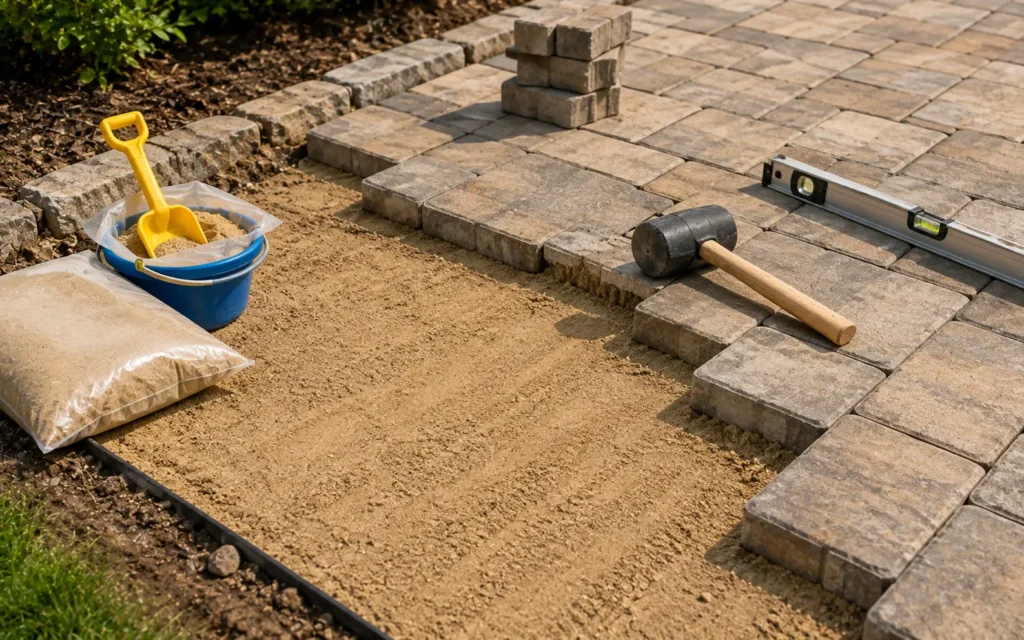
The joint sand between pavers does two things: it locks the paver units together laterally so they can’t shift, and it stabilizes the surface against the various forces trying to move individual pavers — foot traffic, vehicle loading, water flow, and freeze-thaw cycles.
Play sand fails at both through the same underlying reason: its particles don’t interlock.
The interlocking mechanism: Angular sand particles — like those in masonry sand or concrete sand — have jagged, irregular surfaces that catch and grip neighboring particles and the rough faces of the pavers themselves. When these particles are swept into a joint and compacted, they create mechanical resistance to both vertical and lateral movement. A paver filled with angular joint sand doesn’t rock or shift because the sand grains are physically interlocked with each other and with the paver surfaces.
Rounded play sand particles don’t interlock. They’re smooth spheres that roll over each other under load. A joint filled with play sand has essentially no resistance to lateral movement — the particles simply slide past each other when force is applied. The pavers rock. Over time, the rocking loosens the joint further, the play sand disperses, and the pavers shift progressively out of position.
The washout problem: Play sand’s extremely fine, rounded particles have very little resistance to water movement. Even moderate rainfall generates enough surface flow to carry play sand out of open paver joints. What you’ll find after the first significant rain is that the joints are noticeably emptier than they were — the sand has traveled with the water to wherever the surface runoff went. Empty joints mean unstable pavers.
The what kind of sand goes between brick pavers article on this site covers the correct jointing options in full. The short version: masonry sand (also called brick sand or mason sand) is the standard for budget-conscious or low-traffic paver joints; polymeric sand is the upgrade for high-traffic or weather-exposed applications. Either outperforms play sand for this purpose — not marginally, but fundamentally.
Why Play Sand Fails as Paver Bedding
The bedding layer is the 1-inch sand layer screeded level directly beneath the pavers, on top of the compacted aggregate base. It provides the precision leveling surface that allows individual pavers to be set exactly at the right height, and it seats the paver into a stable bed that distributes load evenly across the paver’s base.
Play sand fails here through a different mechanism.
Drainage and moisture retention: The bedding layer needs to drain water away from directly beneath the pavers. Water trapped under pavers causes soil expansion in wet conditions, salt efflorescence through the paver faces, and in northern Oklahoma where freeze-thaw is a factor, frost heave that lifts entire sections of a patio. Play sand’s extremely fine gradation restricts drainage — it holds moisture rather than shedding it. Coarser bedding materials (concrete sand, cushion sand) drain freely while still providing the precise leveling surface needed.
Compaction and stability under load: A paver bedding layer needs to seat firmly under the paver weight. Angular bedding sand compacts into a stable layer that distributes the paver’s load evenly. Play sand, being rounded, doesn’t compact into a stable layer the same way — it remains somewhat loose and deformable, which means pavers can rock and settle unevenly over time.
Screedability in Texas conditions: In the intense summer heat common across Texas — surface temperatures on a dark aggregate base can exceed 140°F in July — play sand dries to a powder-fine, talc-like consistency that is genuinely difficult to screed level. Concrete sand and masonry sand retain enough particle-to-particle friction to hold a screed line even in dry summer conditions. Play sand can blow off the screed board, float with any air movement, and settle inconsistently.
What Actually Happens: A Texas Patio Scenario
Here’s the practical trajectory of a paver patio installed with play sand in a DFW or Houston backyard:
Installation day: Looks fine. The patio is level, joints are filled, everything seems solid.
First Texas thunderstorm (likely within weeks of installation): Joint sand washes out at the low end of the patio. Some joints are visibly empty. A few pavers at the perimeter rock when stepped on.
First Texas summer: Heat dries the bedding layer thoroughly. Play sand’s fine particles compact unevenly under repeated foot traffic. Some pavers develop a slight wobble because the rounded particles beneath them have redistributed under load. Low spots appear.
End of year one: The patio surface is noticeably uneven. The perimeter pavers have shifted. Weed seedlings are established in the emptied joints — play sand’s fine, moisture-retentive texture turns out to be an excellent seedbed. Relaying the affected sections requires pulling up pavers, cleaning out the failed sand, replacing it with the correct material, and resetting everything.
The cost of that remediation — time, labor, materials — typically exceeds what the “savings” from using play sand were by a factor of several times.
The Cost Comparison That Doesn't Hold Up
The perceived cost advantage of play sand over mason sand often disappears when you calculate actual delivered cost per square foot.
Play sand at a hardware store typically runs $5–$8 for a 50-pound bag, which covers roughly 3–4 square feet at 1-inch bedding depth. A larger patio — say 400 square feet — would require 100–130 bags, costing $500–$1,000 just for play sand at retail bag prices.
Bulk masonry sand delivered by Select Sand & Gravel — by the ton, to your job site — costs a fraction of that per square foot for any project over a few hundred feet. At bulk pricing, the “savings” from using bagged play sand over bulk mason sand are not savings at all. The bagged play sand is often more expensive per unit of coverage, not less.
For small projects where bulk delivery isn’t practical — a single stepping stone path, a small decorative patio under 50 square feet — bagged masonry sand from a hardware store is the right scale. It’s usually available in the same aisle as the play sand. The price difference per bag is small, and the performance difference is significant.
What to Use Instead
For paver joints (between the pavers):
Masonry sand — also called brick sand, mason sand, or mortar sand — is the standard. Fine, washed, angular enough to sweep into joints and interlock. Doesn’t harden, so it may need replenishment over time, but it’s the correct material for standard residential paver jointing. Available in bulk from Select Sand & Gravel for any project over a few hundred square feet. The masonry sand uses article on this site covers this in full.
Polymeric sand — masonry sand plus polymer binders that harden when wetted. Locks the joint permanently, highly weed-resistant, dramatically more washout-resistant than plain mason sand. The upgrade for high-traffic patios, driveways, and any application exposed to frequent rain or irrigation. Available in bags at hardware stores; not typically ordered in bulk because the polymer activation requires specific application technique.
For paver bedding (under the pavers):
Concrete sand — coarser and more angular than masonry sand, drains freely, compacts well, holds a screed line in Texas summer conditions. The industry standard for paver bedding across the region.
Cushion sand — similar to concrete sand, used by some residential contractors for paver bedding particularly on lighter residential applications. Available from Select Sand & Gravel.
Limestone screenings — angular, fine-grained, compacts very firmly. A premium bedding option that creates a particularly stable paver bed. Covered in depth in the limestone screenings article on this site.
Where Play Sand Is the Right Choice
To close the loop fairly: play sand is a quality product for its intended applications. It’s the right choice for:
- Children's sandboxes and play areas, where the smooth, rounded texture and safety processing are genuine assets
- Volleyball courts — the fine texture is comfortable for bare feet and play
- Some above-ground pool surrounds where the soft texture is preferred
- Decorative or recreational applications where the clean white appearance matters more than structural performance
Select Sand & Gravel carries White Brick Sand — a lighter-colored masonry sand — for recreational surface applications. It’s a step up from play sand in that it has the light appearance people want for volleyball courts and sandboxes while being a properly screened construction-grade material. If you need a light-colored sand for a recreational surface that also needs to hold up to more than a sandbox’s demands, White Brick Sand is worth asking about.
Ordering Sand for Pavers in Texas and Oklahoma
Select Sand & Gravel delivers masonry sand (Brick Sand), concrete sand, cushion sand, and limestone screenings across Dallas, Fort Worth, Austin, Houston, San Antonio, and Oklahoma City. For any paver project where you’re calculating bulk quantities, call 1-817-572-6310 or request a quote here. If you’re not sure which product fits the specific layer you’re working on — joint sand vs bedding sand — describe the installation and the team can point you to the right material.
Frequently Asked Questions
Can you use play sand between pavers?
No — play sand is not recommended for paver joints. Its extremely fine, rounded particles don’t interlock to lock pavers in place, wash out easily in rain, and provide no resistance to lateral movement under foot or vehicle traffic. Masonry sand (also called mason sand or brick sand) is the correct material for standard paver joint filling. Polymeric sand is the upgrade for high-traffic or weather-exposed applications.
Can you use play sand under pavers as the bedding layer?
No. Play sand’s extremely fine gradation restricts drainage beneath the pavers, retains moisture that causes paver movement and efflorescence, and doesn’t compact into a stable bedding layer the way coarser, angular sands do. Concrete sand, cushion sand, or limestone screenings are the correct materials for the paver bedding layer.
What is the difference between play sand and mason sand?
Play sand is engineered for children’s play — extremely fine, rounded particles, processed for skin safety and comfort. Mason sand is a construction-grade material — slightly coarser, angular particles that interlock in joints and bond with mortar. Mason sand is used for paver jointing, mortar mixes, and stucco. Play sand is used for sandboxes and recreational surfaces. The visual difference is subtle; the performance difference in construction applications is significant.
What happens if you use play sand for paver joints?
The joints wash out in the first significant rain because play sand’s rounded particles have almost no resistance to water movement. With empty joints, the pavers rock under foot traffic and shift progressively out of position. Weed seedlings establish in the emptied joints because play sand’s fine, moisture-retentive texture is an excellent seedbed. Within one season, the patio typically needs to be releveled and refilled with the correct material.
Is play sand or polymeric sand better for pavers?
Polymeric sand is significantly better than play sand for paver joints. Polymeric sand contains polymer binders that harden when activated with water, locking the joint permanently, resisting weed growth, and providing far greater washout resistance than any plain sand. Play sand lacks all of these properties and fails at the basic joint-filling function that both polymeric sand and mason sand perform correctly.
Is play sand cheaper than mason sand for paver projects?
At retail bag pricing, play sand and mason sand are priced similarly per bag. For any project over a few hundred square feet where bulk delivery is practical, bulk mason sand from Select Sand & Gravel costs significantly less per square foot than play sand purchased in bags. The “savings” from using play sand are largely illusory and are eliminated entirely by the cost of remediating a failed installation.
What is White Brick Sand and is it the same as play sand?
White Brick Sand is a lighter-colored variety of masonry sand — angular, construction-grade, suitable for mortar, paver jointing, and recreational surfaces where appearance matters. It is not play sand. Play sand is processed for child safety with rounded particles and extreme fineness. White Brick Sand is a construction material that happens to have a lighter color. For volleyball courts or sandboxes where you want the light color but need a more durable material than standard play sand, White Brick Sand is worth considering.
Does Select Sand & Gravel deliver mason sand for paver projects?
Yes. Masonry sand (Brick Sand and White Brick Sand), concrete sand, cushion sand, and limestone screenings are all available for bulk delivery across Dallas, Fort Worth, Austin, Houston, San Antonio, and Oklahoma City. Call 1-817-572-6310 for a quote based on your project dimensions.

