Crushed Limestone vs Crushed Concrete for a Driveway: An Honest Comparison
Both materials work. That’s the honest starting point. Crushed limestone and crushed concrete have been building driveways across Texas and Oklahoma for decades, and properly installed, either one produces a driveway that holds up to daily use for 10–20 years without major rework.
The difference that matters is what you’re willing to accept in exchange for what. Crushed concrete is typically less expensive per ton and — because of a quirk in how residual cement behaves in Texas summer heat — can actually get harder over time, not softer. Crushed limestone is the regional standard, consistent in appearance, widely available from multiple quarry sources, and the material most local contractors know how to spec and install without thinking twice.
The existing crushed limestone vs crushed concrete article on this site covers both materials across all their applications. This article focuses specifically on the driveway decision — the factors that matter to a homeowner or small property owner comparing both materials for a single project. The crushed concrete product page and the crushed limestone product page cover the commercial and contractor perspective; this article covers the residential one.
What Each Material Is
Crushed Limestone is quarried natural limestone mechanically crushed and screened to a road base gradation — a blend of coarser particles and fines that compact into a dense, load-bearing layer. It’s the standard driveway base and surface material across Texas and Oklahoma. White to tan in color, consistent load-to-load, available from quarries distributed across the state.
Crushed Concrete is reclaimed concrete from demolished structures — old roads, building slabs, sidewalks — crushed, screened through magnetic separators to remove rebar, and processed to a road-base-like gradation. It contains residual (unhydrated) cement from the original concrete. That residual cement is the source of both its main performance advantage and its main visual disadvantage.
Both are sold by the ton, both require compaction, and both are used in the same depth range for driveway applications: 4–6 inches for passenger vehicles, 6–8 inches for heavier use.
The Factor Most People Don't Expect: Re-Cementing in Texas Heat
The crushed concrete product page describes this accurately: “the residual cement particles bond the aggregate together, creating a more rigid and stable foundation that is less prone to settling than traditional stone.”
What that means in practice for a Texas driveway owner is this: a crushed concrete driveway that’s been in place through one or two Texas summers — where pavement surface temperatures regularly exceed 140°F — will feel noticeably harder than it did when first installed. The residual cement particles in the fines reactivate under heat and moisture cycling and form weak bonds between the aggregate pieces. The surface won’t reach poured-concrete hardness, but it develops a rigidity that exceeds typical road base limestone.
The timeline for this effect is roughly six to eighteen months of Texas climate exposure. During that first period, the driveway is essentially functioning as compacted crusher run. After that, the surface has measurably more cohesion.
For a homeowner evaluating long-term driveway performance, this is a genuine advantage of crushed concrete over limestone in Texas conditions. Limestone doesn’t harden further once compacted — it performs at its installation spec for years, which is good, but it doesn’t improve. Crushed concrete does improve, which matters on a driveway that will carry 15 years of vehicle traffic.
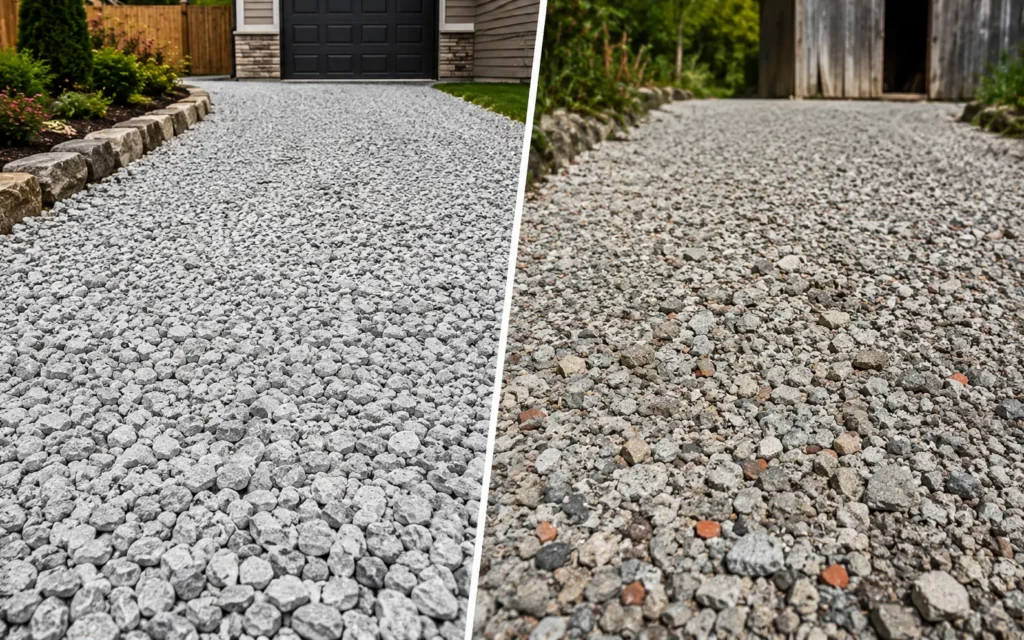
Appearance: The Area Where Limestone Wins Clearly
This is the clearest and most honest advantage limestone holds: it looks better, and it keeps looking better.
Crushed limestone is white to tan — a clean, consistent color that reads as “fresh gravel” and holds that appearance over time. The light color doesn’t show tire tracks as clearly as darker materials. In neighborhoods where curb appeal matters, it fits the visual language of a well-maintained property.
Crushed concrete is gray. Not a consistent, attractive gray — a variable, sometimes mottled gray that reflects the mixed origins of the demolition material. Fresh crushed concrete can have pieces that are darker where the old concrete was reinforced near rebar, lighter where it was more uniform mix, and occasionally pieces with visible aggregate that make the surface look patchy. Over time, weathering tends to homogenize the color somewhat, but it never approaches the uniform appearance of limestone.
The tracking issue on fresh installation: In the first several weeks after crushed concrete is placed and before the re-cementing process begins, the gray fines in the material transfer onto vehicle tires as a light-colored dust. This dust tracks onto garage floors, driveways, and in some cases onto paved road surfaces at the driveway entrance. It’s not permanent — it stops once the material sets and the loose fines are either bound or washed away — but it’s a real nuisance during the installation and early curing period that limestone doesn’t produce in the same way.
If the driveway is visible from the street, if the garage floor matters, or if the property is being managed for resale value, limestone’s appearance advantage is meaningful. For a rear-access driveway, a service yard, a back-of-property parking area, or any application where function is the priority and aesthetics aren’t, the appearance difference is irrelevant.
Cost: Crushed Concrete's Real Advantage
Crushed concrete is typically less expensive than crushed limestone, and the gap is real — usually 10–20% per ton in major Texas markets where demolition material is abundant (Dallas, Houston, San Antonio, Fort Worth, Austin). On a large project, that difference accumulates into meaningful budget relief.
The factors that drive this cost difference:
- Crushed concrete is a byproduct of demolition rather than a quarried primary material, which reduces the raw material cost
- Recycling facilities process the material in urban areas, which reduces haul distance to job sites in those markets compared to limestone quarried from rural sources
- No blasting or primary quarrying required — the processing step is crushing and screening of existing material
Where the cost advantage shrinks or disappears: Rural markets and areas far from active construction demolition have less consistent crushed concrete supply. If a recycling facility is 60 miles away while a limestone quarry is 20 miles away, the freight difference can erase the material cost savings. The cost advantage is most reliable in the major Texas metropolitan markets where demolition activity is continuous and recycling facilities are close.
Volume matters too: On a small residential driveway order of 15–20 tons, the cost difference between limestone and crushed concrete might be a few hundred dollars. On a long rural driveway at 100+ tons, the same percentage difference is a significant number. For large-volume projects where budget is a real constraint, it’s worth getting a delivered quote on both materials from Select Sand & Gravel and comparing the actual numbers for your specific job site.
Performance Under Vehicle Load: Effectively Equal
For standard residential driveway use — passenger cars, SUVs, pickups, occasional heavier vehicles — properly compacted crushed limestone and properly compacted crushed concrete perform essentially equivalently in structural terms. Both distribute vehicle loads adequately. Both resist rutting when installed at the right depth and compacted correctly. Both require the same installation approach: proper subgrade preparation, compaction in lifts, adequate drainage slope.
The distinction the crushed concrete product page makes — that crushed concrete is “equal to or even stronger than limestone due to its ability to re-cement” — is accurate for base applications under pavement, particularly in warm climates. For an untopped residential driveway surface, the re-cementing advantage becomes more relevant over time as the material hardens, but the practical performance difference in year one isn’t dramatic.
For applications where compaction consistency matters most — under poured concrete or asphalt — crushed concrete’s re-cementing behavior can actually produce a stiffer base in Texas conditions. Some contractors who regularly install asphalt driveways prefer crushed concrete as the base layer precisely because the heat activation makes it more rigid than standard limestone base, which translates to reduced reflective cracking through the asphalt over time.
Rain Behavior and Drainage
Both materials perform similarly in rain because both use the same crusher-run gradation logic: larger particles plus fines, compacted, with drainage managed through cross-slope and crown.
One difference worth noting: crushed concrete’s re-cementing properties make it slightly more water-resistant on the surface over time. A mature crushed concrete driveway (one or two years post-installation, having gone through Texas summer heat cycles) sheds surface water somewhat more effectively than a comparably aged limestone surface because the surface has partially bound. Fresh crushed concrete, before the re-cementing occurs, behaves similarly to fresh limestone — rain drains through the fines and the surface sheds water adequately when properly graded.
Neither material is waterproof, and neither is appropriate for flat or bowl-shaped installations. Cross-slope or crown drainage is essential for both. The installation guide on this site covers drainage design in the context of road base driveways — the same principles apply to crushed concrete surfaces.
Weed Growth
Weeds grow through both materials over time as organic matter accumulates in the surface fines and airborne seeds find their footing. Neither crushed limestone nor crushed concrete is meaningfully weed-resistant without geotextile fabric installed beneath the base.
Crushed concrete’s slightly higher alkalinity — from the residual cement — may inhibit certain weed species somewhat, but this is not a reliable weed control strategy and the effect diminishes as the surface weathers. For long-term weed suppression, geotextile fabric between the native subgrade and the base material is the effective solution regardless of which surface material is used.
The Layered Approach: Best of Both
The crushed concrete product page notes that many homeowners use crushed concrete as a structural base and top-dress with decorative stone such as pea gravel or river rock. This hybrid approach makes practical sense for some driveway projects and deserves a fuller explanation.
The approach: install 4–5 inches of compacted crushed concrete as the base layer, then add 2 inches of clean crushed limestone, pea gravel, or another clean stone on top as the visible surface. The crushed concrete handles the structural work at lower cost; the limestone topping provides the visual appearance and a cleaner, more consistent surface material.
The trade-off is installation complexity — two materials, two deliveries, two spreading and compaction operations — and the eventual migration of fines upward through the topping layer over time, which can make the surface look mottled as the gray concrete material works into the limestone top layer. Installing geotextile fabric between the crushed concrete base and the limestone topping helps slow this migration.
For a budget-conscious project where appearance matters somewhat but not completely, this layered approach is a legitimate middle ground.
Supply Consistency: An Honest Advantage for Limestone
This is a practical consideration that matters most on large projects or rural locations: crushed limestone is quarried and consistently available across all Texas and Oklahoma markets. There are many limestone quarries distributed across the region, and supply is reliable year-round.
Crushed concrete availability depends on local demolition activity. In active urban markets — Dallas, Houston, San Antonio, Austin — demolition generates a consistent stream of material and supply is reliable. In rural markets or during periods when large demolition projects aren’t active in a particular area, supply can tighten and quality can be more variable. Load-to-load consistency matters for large driveways where you want uniform surface appearance; crushed concrete from different recycling batches can look slightly different from each other.
Select Sand & Gravel sources crushed concrete from multiple recycling facilities and can often maintain consistency across a project, but it’s worth flagging for large-volume orders: confirm current availability and source when placing the quote request.
Which One Should You Choose?
Use this framework for the driveway decision:
Choose crushed limestone if:
- The driveway is visible from the street and appearance matters
- You want consistent, predictable material that's widely available in any quantity
- The property is being managed for resale value
- You want the material your local contractor knows by default
Choose crushed concrete if:
- Budget is the primary constraint and the cost difference is meaningful at your project scale
- The driveway is a rear-access, service, or rural application where appearance is not a priority
- You're in a major Texas metro where crushed concrete supply is consistent and the material cost advantage is real
- You plan to top-dress with clean limestone or decorative stone anyway, making the base appearance irrelevant
Either material works for:
- Base under asphalt or concrete driveway
- Rural ranch or agricultural driveway
- Construction staging area or temporary access road
- Equipment and vehicle storage pads
Frequently Asked Questions
Is crushed concrete as good as crushed limestone for a driveway?
For functional performance, yes — both materials produce a durable, load-bearing driveway surface when properly installed. Crushed concrete develops an advantage in long-term hardness through re-cementing in Texas heat conditions. The primary differences are appearance (limestone looks better), cost (concrete is typically 10–20% less per ton), and supply consistency (limestone is more broadly available and consistent).
Does crushed concrete really harden over time?
Yes. Crushed concrete contains residual unhydrated cement from the original concrete. In Texas summer conditions, repeated heat and moisture cycling reactivates that cement, which forms weak bonds between the aggregate particles. A crushed concrete driveway that has gone through one or two Texas summers is measurably firmer than it was at installation. This effect develops over roughly six to eighteen months and continues gradually beyond that.
Which looks better: crushed limestone or crushed concrete?
Crushed limestone looks better — it’s white to tan, consistent in color, and reads as clean gravel. Crushed concrete is gray and variable, with noticeable color inconsistency that reflects its mixed demolition origin. For driveways visible from the street or any application where curb appeal matters, limestone is the clear choice on appearance alone.
Will crushed concrete track gray dust into my garage?
In the first weeks after installation, yes — the gray fines in fresh crushed concrete transfer onto vehicle tires and can be tracked into the garage or onto adjacent paved surfaces. This stops once the loose fines are bound or washed away, typically within a few weeks of installation and the first rain events. Limestone produces some fine dust during installation but it’s less visually noticeable because of the lighter color.
Can I put crushed limestone on top of crushed concrete?
Yes. This is a common approach: crushed concrete as the structural base layer at lower cost, topped with 2 inches of clean crushed limestone or decorative stone for appearance. Geotextile fabric between the two layers slows migration of the concrete fines upward into the limestone topping over time. The result is a driveway that benefits from crushed concrete’s structural performance and limestone’s visual appeal.
Is crushed concrete cheaper than crushed limestone in Texas?
Generally yes, by 10–20% per ton in major Texas markets where demolition material is plentiful and recycling facilities are close to job sites. The gap shrinks in rural markets where freight from a nearby limestone quarry is shorter than freight from an urban recycling facility. Get a delivered quote on both materials for your specific address to know the actual difference for your project.
Is crushed concrete safe to use for a residential driveway?
Yes. Properly processed and screened crushed concrete is non-toxic and safe for residential use. The crushed concrete safety article on this site covers this question in full detail.
Does Select Sand & Gravel supply both crushed limestone and crushed concrete?
Yes. Both materials are available for delivery across all six service markets. The team can provide a delivered price comparison for your specific address and project quantity on the same call. Call 1-817-572-6310 or request a quote online.

