How Thick Should Road Base Be Under Concrete? A Depth Guide by Application
When people think about a concrete driveway, patio, or garage slab, most of the attention goes to the concrete itself — the mix, the thickness, the finish. The base underneath gets treated as an afterthought. That’s backwards. Concrete is rigid. It can’t flex when the ground beneath it moves. Every crack you’ve ever seen in a concrete slab started below the surface, in a base layer that wasn’t thick enough, wasn’t compacted properly, or couldn’t handle the soil conditions underneath it.
Getting the base right is cheaper than fixing the slab later. A cracked, sunken concrete driveway in Texas clay soil typically costs two to five times more to repair or replace than the base material that would have prevented the failure.
This guide breaks down road base depth requirements by application — residential driveways, patios, garage slabs, equipment pads, and commercial work — and covers the soil conditions across Texas and Oklahoma that change those requirements in practice. It’s meant for homeowners specifying their own concrete projects and contractors who want a clear reference before the pour.
Why Concrete Needs a Base Layer at All
Concrete is a compressive material — it handles downward load well, but it can’t tolerate uneven support from below. When the soil beneath a slab is soft in one area and firm in another, the slab bridges the soft spot and carries load across it. Eventually the unsupported span is too wide, the slab cracks, and the broken section sinks into the void.
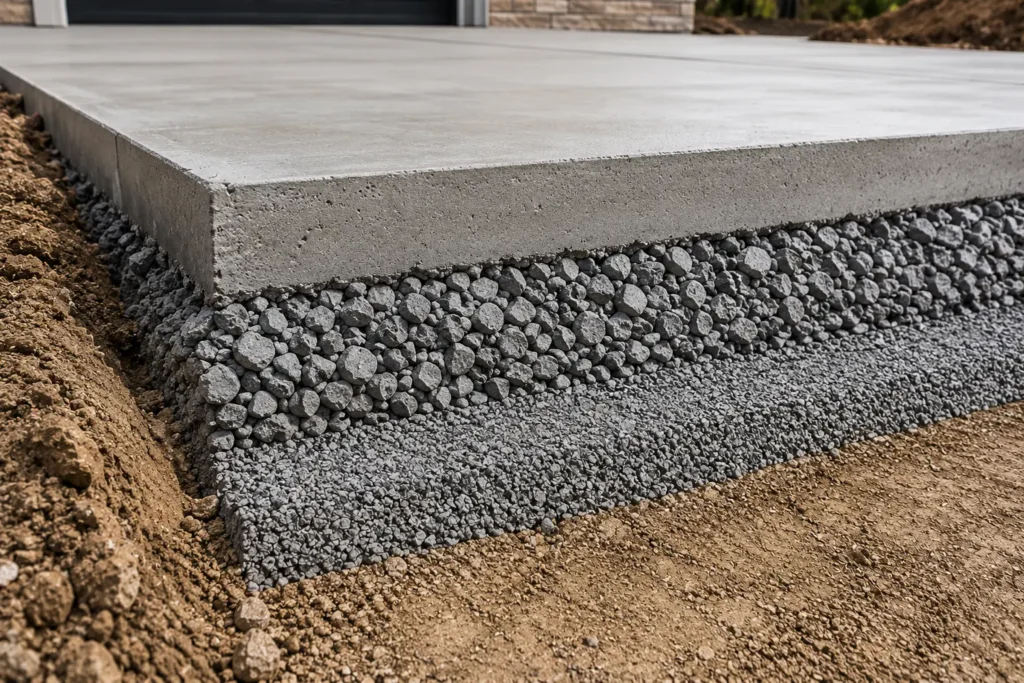
A properly compacted road base layer solves this in two ways. First, it creates a uniform, dense bearing surface across the entire slab area so there are no soft spots for the concrete to bridge. Second, road base with fines drains water laterally away from directly under the slab, preventing the moisture cycling that causes soil volume changes in clay subgrades.
Without a base, concrete poured directly on native soil — particularly the expansive black clay common across much of Texas — sits on a subgrade that swells with every rain and shrinks back during dry spells. The slab moves with it. Joints open, edges crack, and interior sections heave. You can see this on almost any unreinforced concrete sidewalk older than ten years in the DFW suburbs.
The base doesn’t replace good concrete or adequate reinforcement. It works alongside them. A well-specified base + correctly poured slab + appropriate rebar is how concrete survives decades in Texas soil conditions.
Road Base Depth by Application
Residential Concrete Driveway — Passenger Vehicles
Standard depth: 4 inches compacted
For a residential driveway designed for cars, SUVs, and light pickups, 4 inches of compacted road base or flex base is the accepted standard in Texas and Oklahoma. Most residential concrete contractors build on this depth by default.
At this depth, the base provides adequate bearing capacity for typical residential loads and acts as a drainage layer between the slab and the native subgrade. Paired with a 4-inch concrete slab, this is the most common residential concrete driveway specification across the state.
In DFW, Houston, and Waco clay soil: Move to 4–6 inches. The Blackland Prairie clay that underlies much of North and Central Texas is among the most active expansive clay in the United States. A 4-inch base is workable on stable subgrade; on highly active clay, adding 2 inches of base depth — or installing a moisture barrier between the clay and the base — noticeably extends slab life.
Concrete Driveway for Trucks, RVs, or Heavy Vehicles
Recommended depth: 6 inches compacted minimum
A driveway that will see regular use by pickup trucks hauling trailers, delivery trucks, RVs, or farm equipment carries significantly more load per axle than a passenger vehicle driveway. The base needs to distribute that load over a wider area to prevent point settlement.
At 6 inches of compacted road base, the load distribution improves substantially compared to 4 inches. For this application, flex base to TxDOT Item 247 specification (discussed in the road base vs flex base article on this site) is worth the slight cost premium over general road base because the tighter gradation and quality specifications produce more consistent compaction density.
Consider also increasing concrete thickness to 5–6 inches for heavy vehicle driveways, particularly at the entrance where trucks load and unload. Thicker concrete works with the base, not as a replacement for it.
Concrete Patio or Walkway
Standard depth: 4 inches compacted
A residential concrete patio carries lighter loads than a driveway — foot traffic, patio furniture, grills, and occasional heavy items rolled across it. Four inches of compacted road base is standard.
Two Texas-specific considerations apply here:
Proximity to the house foundation: Concrete patios adjacent to a home’s foundation sit in an area where soil moisture fluctuates significantly — irrigation water, downspout drainage, and house shade all affect how wet or dry the soil stays. Expansive clay in this zone moves more than clay further from the house. A 4-inch base is the minimum; going to 5–6 inches if the patio is directly adjacent to the foundation is reasonable insurance.
Drainage slope: Every concrete patio needs a slope away from the house — a minimum of 1/4 inch per foot. In Texas where rain arrives in intense events rather than gentle drizzle, water that sits against a foundation or under a slab edge is a real problem. The base layer’s slope should mirror the finished surface slope, built in during subgrade preparation, not corrected by varying the base thickness.
Garage Floor Slab
Standard depth: 4 inches compacted; 6 inches recommended in clay soil
Garage slabs carry vehicles but rarely at the load of a full commercial operation. The standard residential garage slab specification is 4 inches of compacted base under a 4-inch concrete slab.
However, garage slabs have one distinct difference from outdoor concrete: they’re enclosed, which means they sit in a moisture-stable environment during dry periods but can accumulate subslab moisture during wet seasons in regions with high water tables or poor drainage. Two practices address this:
Vapor barrier: A 6-mil polyethylene vapor barrier between the compacted base and the concrete slab is standard practice for garage floors across Texas. It prevents ground moisture from wicking up through the slab, which protects stored items, reduces mold risk, and prevents moisture-related concrete deterioration. The barrier lies on top of the compacted base, and the concrete is poured directly on it.
In clay soil: Move to 6 inches of compacted base to reduce the effect of clay volume changes on the slab. The additional base depth increases the drainage path and reduces the degree to which seasonal soil moisture changes translate into slab movement.
Equipment or Machinery Pad
Recommended depth: 6–8 inches compacted
Concrete pads for generators, HVAC equipment, air compressors, industrial tanks, and similar heavy machinery carry point loads — the weight concentrated on a small footprint rather than distributed across a vehicle axle and wheel.
Point loads are harder on both the slab and the base than rolling vehicle loads. For equipment pads, 6 inches of compacted road base is the minimum; 8 inches is better where the equipment weight is significant. This is also an application where specifying flex base over general road base is worth it — the higher compaction density of properly specified flex base provides more reliable bearing capacity under concentrated load.
For very heavy equipment — industrial machinery, cranes, transformers, large generators — a structural engineer should specify both slab thickness and base requirements. These are beyond rule-of-thumb guidance and require load calculations.
Commercial Parking Lot — Light to Medium
Standard depth: 6 inches compacted minimum
A commercial parking lot carrying passenger vehicles and the occasional service truck is typically designed to a 6-inch base minimum. This depth handles the repetitive loading from many vehicles over many years, provides adequate drainage, and creates the structural depth needed under a 4–5 inch commercial concrete slab.
For parking lots that will see regular semi-truck access, delivery bays, or dumpster service, 8 inches of base or more is appropriate. At commercial scale, a geotechnical engineer’s report and a civil engineer’s design typically govern the specification — contractor rules of thumb give way to stamped drawings and compaction testing requirements.
Commercial Slab — Warehouse, Industrial, High Traffic
Engineered: typically 8–12+ inches
Heavy commercial and industrial slabs — warehouse floors, manufacturing facilities, loading docks — are engineered structures. The base depth, slab thickness, rebar specification, and concrete mix are all determined by the structural engineer of record based on the actual expected loads, the soil report from a geotechnical investigation, and applicable building codes.
These applications are beyond what this article can specify. If you’re asking about base depth for a commercial slab with a permitted building permit, follow the engineer’s drawings. If you’re in the early planning stages and want to know what to expect, base depths of 8–12 inches of compacted engineered fill or flex base are typical for light-to-medium industrial use.
Soil Conditions That Change These Numbers
The depth recommendations above assume average to good subgrade conditions. Texas and Oklahoma have enough soil variation that a one-size answer would be wrong for a significant portion of projects.
Expansive Clay — DFW, Waco, Central Texas
This is the soil condition that matters most in the Texas market. The Blackland Prairie clay running through Dallas, Fort Worth, and Waco is a montmorillonite clay that expands dramatically when wet and contracts sharply when dry. The vertical movement in this soil over a year can be several inches in exposed areas.
Standard practice for concrete on Blackland Prairie clay includes: treating the subgrade before the base (either by lime stabilization or deep moisture conditioning), using a minimum of 4–6 inches of base, installing geotextile fabric between the clay and the base to prevent clay migration, and often including post-tension or reinforced concrete design to accommodate some movement.
The base alone cannot fully mitigate highly active clay movement — it works best as part of a complete system that includes proper drainage, moisture barriers, and reinforced concrete design. Contractors working in DFW know this and typically either specify deeper bases or post-tension their residential slabs.
Sandy or Well-Drained Soil — South Texas, Gulf Coast
Sandy soil drains well and is generally stable under load. Four inches of base is typically adequate for residential applications on sand or sandy loam subgrade. The primary concern shifts from volume change (as with clay) to edge erosion — water washing out the base material from the slab edges during heavy rains. Proper edging and drainage design matter more than base depth in these soils.
Rocky or Caliche Subgrade — West Texas, Hill Country
Rocky native subgrade — limestone bedrock, caliche, or dense rocky soil — is inherently stable. In some Hill Country applications, the “base” layer is primarily leveling material rather than structural bearing material, because the rock below provides the bearing capacity. The main requirements are eliminating point loads from rock protrusions and providing a drainage layer above any impermeable rock surface. Four inches is generally adequate; confirm with local practice.
Road Base vs. Clean Gravel Under Concrete: Which Is Better?
This is a question that comes up when people compare road base to clean crushed stone (like #57 limestone) as a concrete sub-base.
Road base (crusher run with fines) compacts to a dense, nearly rigid layer because the fines fill the voids between larger particles. It provides excellent bearing capacity and resists lateral movement. It’s the standard sub-base material for concrete in Texas.
Clean crushed stone (#57 limestone, pea gravel) has no fines, so it doesn’t compact into a rigid layer — it remains a permeable, free-draining aggregate. It provides excellent drainage but limited bearing capacity compared to compacted road base. Clean stone is sometimes used as a drainage layer below road base in areas with high water tables or poor drainage.
For most concrete applications in Texas, road base is the right call because bearing capacity and uniform support matter more than maximum drainage. The exception is applications where the primary goal is subslab drainage — for example, under a slab in a very wet climate where vapor control is the priority. Even there, road base is often the top layer with a drainage layer beneath it.
Pouring Concrete Directly on Native Soil
The honest answer: it can be done, but it’s not recommended for Texas conditions.
Some rural applications — thin concrete pads, small outbuildings, temporary structures — are poured directly on native soil without a prepared base. This works acceptably in stable, well-drained soils where the expected loads are light and cracking is tolerable.
In any clay soil, in any application where the concrete is expected to remain crack-free for years, and in any driveway application where vehicles will be loading the slab repeatedly, skipping the base is a false economy. The cost of the base material — even 10 tons of road base — is a small fraction of the cost of a full driveway replacement when the slab fails prematurely.
How Much Road Base Do You Need for Your Concrete Project?
Use this formula — the same one covered in the road base calculation article on this site:
Length (ft) × Width (ft) × (Depth ÷ 12) ÷ 27 = cubic yards × 1.5 = tons × 1.10 = order quantity
Quick examples:
- 20×20 ft patio at 4-inch base depth: 20 × 20 × 0.33 ÷ 27 × 1.5 × 1.10 = 8 tons
- 12×50 ft driveway at 4-inch base depth: 12 × 50 × 0.33 ÷ 27 × 1.5 × 1.10 = 12 tons
- 12×50 ft driveway at 6-inch base depth: 12 × 50 × 0.50 ÷ 27 × 1.5 × 1.10 = 18 tons
- 24×24 ft garage at 4-inch base depth: 24 × 24 × 0.33 ÷ 27 × 1.5 × 1.10 = 12 tons
- 30×50 ft parking area at 6-inch base depth: 30 × 50 × 0.50 ÷ 27 × 1.5 × 1.10 = 46 tons
- Horseshoe pits — fine texture allows clean embedding of horseshoes without excessive bounce
The 10% buffer in Step 5 accounts for compaction and edge spread. For any slab where the concrete is being poured immediately after base installation, allow the base to fully settle for at least two weeks before the pour — detailed in the installation guide on this site.
Ordering Road Base for Concrete Projects
Select Sand & Gravel supplies road base and flex base for concrete sub-base applications across Dallas, Fort Worth, Austin, Houston, San Antonio, and Oklahoma City. For commercial projects requiring spec-compliant flex base with material documentation, the team can confirm source compliance before delivery. For residential projects, general road base is typically the right product and available for same-day or next-day delivery.
Frequently Asked Questions
How thick should road base be under a concrete driveway?
Four inches of compacted road base is the standard for a residential concrete driveway in Texas and Oklahoma. In DFW and other Blackland Prairie clay areas, 4–6 inches is more appropriate. For driveways that will regularly carry trucks, trailers, or RVs, 6 inches is the recommended minimum regardless of soil conditions.
Does all concrete need a base layer?
For practical purposes in Texas, yes. Concrete poured directly on native clay soil — which covers most of DFW, Waco, and parts of central Texas — has a significantly shorter life expectancy than concrete over a compacted base. Sandy subgrades are more forgiving, but even there, a base layer provides a drainage and leveling benefit that extends slab life.
What is the minimum base depth under a residential concrete patio?
Four inches of compacted road base is the standard minimum for a residential concrete patio. In clay soil or areas where the patio sits immediately adjacent to the house foundation — where soil moisture fluctuations are highest — 4–6 inches is a better target.
Should road base be compacted before pouring concrete?
Yes, absolutely. The base must be fully compacted before the concrete is poured. Loose or poorly compacted base will continue to settle after the slab is in place, creating voids beneath the concrete that lead to cracking and failure. This is non-negotiable for any concrete application.
Is flex base better than road base under concrete?
For residential concrete driveways and patios, general road base performs well and doesn’t require the TxDOT specification compliance that flex base carries. For commercial slabs, municipal work, or engineer-reviewed projects with compaction testing requirements, flex base to Item 247 provides more consistent compaction density and is typically specified. The road base vs flex base article covers when each applies.
How does expansive clay in Texas affect base depth under concrete?
Expansive Blackland Prairie clay — common in DFW, Waco, and parts of central Texas — swells and contracts with moisture cycles, actively moving beneath any slab placed on it. Increasing base depth to 6 inches, using geotextile fabric between the clay and the base, and ensuring proper drainage are the most effective ways to manage this. For highly active clay sites, lime stabilization of the subgrade or post-tension slab design may also be warranted — consult a local concrete contractor with experience in the specific soil conditions.
What is the difference between road base under a concrete slab and under pavers?
Under concrete, the base needs to be compacted to maximum density and remain stable — the concrete locks onto it and any movement translates directly into cracks. Under pavers, the base also needs to be compacted, but the paver system is flexible and can accommodate minor movement that would crack concrete. The base depth recommendations are similar (4–6 inches for residential), but the performance requirement under concrete is stricter because the surface material itself cannot accommodate any movement.
Do I need a vapor barrier under a garage slab?
Yes. A 6-mil polyethylene vapor barrier between the compacted base and the concrete is standard for garage slabs across Texas. It prevents ground moisture from wicking through the slab, protects stored items, and reduces long-term concrete deterioration from moisture cycling. It sits on top of the compacted base with the concrete poured directly on it.

