What Is the Difference Between Road Base and Flex Base?
If you’ve spent any time ordering base material in Texas, you’ve probably had a version of this conversation: you call a supplier, ask for road base, and they say “you mean flex base?” — or the reverse. In many contexts across the state, the two terms get used interchangeably. A lot of suppliers use them that way. Our own product page describes road base as “commonly called Flex Base in Texas.”
So are they the same thing? Mostly — but not exactly. And the difference matters on certain projects.
The short answer: flex base is a specific type of road base. It refers to crushed limestone aggregate that meets TxDOT Item 247, a defined specification from the Texas Department of Transportation that governs gradation, plasticity, and material quality. Road base is the broader category — it includes flex base, but also includes non-spec base materials and alternatives like crushed concrete base or caliche that don’t meet Item 247 requirements.
For a private residential driveway, the distinction is usually irrelevant. For a county road, a municipal parking lot, or any project where an engineer reviews your material submittals, it matters considerably.
This article explains what each term means, what TxDOT Item 247 actually requires, when each is the right call, and how Oklahoma projects fit into the picture.
Road Base: The General Category
Road base is not a single defined product. It’s a category describing any aggregate material used as a compacted structural layer beneath roads, driveways, parking areas, pads, and similar surfaces.
The common thread across all road base materials is gradation: a blend of larger crushed stone pieces and smaller fines that compact together under moisture and mechanical pressure to create a dense, load-bearing layer. The fines fill the voids between the larger particles, and when a vibratory roller is run over the material at the right moisture content, the whole mass locks into a surface that can handle significant vehicle loads without shifting.
In Texas and Oklahoma, crushed limestone is the most common road base material because limestone quarries are distributed across the region and the stone crushes well. But road base can also be made from crushed concrete, crushed granite, caliche, or blended aggregate depending on what’s locally available and what the project requires. The caliche road base post on this site covers that specific alternative in detail.
General road base — limestone crusher run without a specific spec — is what most private driveways, equipment pads, temporary haul roads, and rural access roads use. It’s available from most quarries, priced by the ton, and performs well when installed correctly.
Flex Base: The Specified Subset
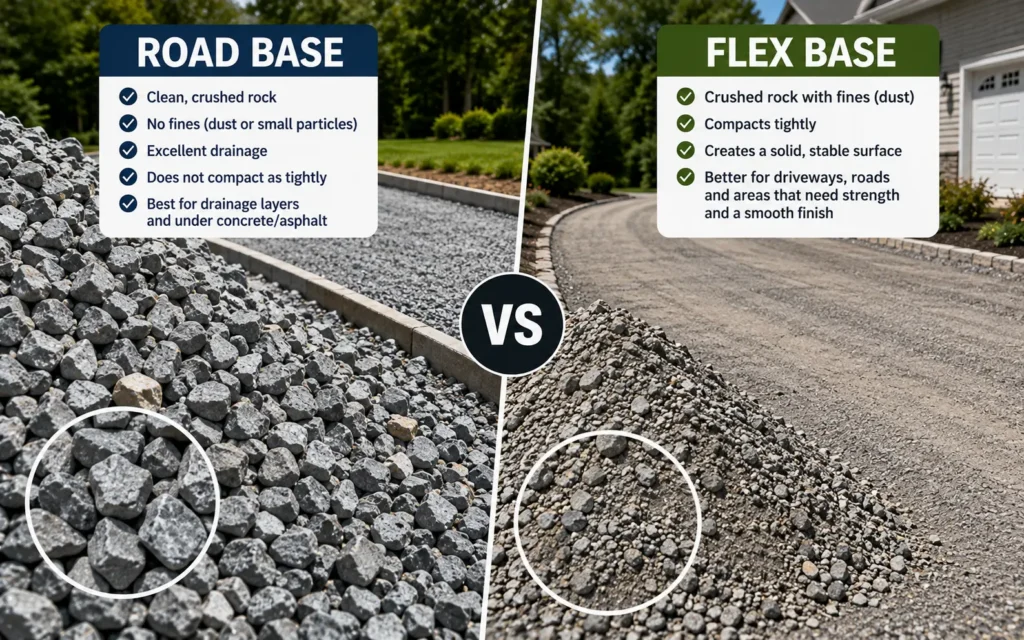
Flex base refers specifically to material meeting TxDOT Standard Specification Item 247 — Flexible Base. This is the Texas Department of Transportation’s published material specification for base aggregate used in state-funded highway and road construction.
Item 247 is not vague. It defines:
Gradation — the required percentage of material passing through sieves at specific sizes. A Grade 1, Type A flex base, for example, must have between 45% and 75% of material passing the No. 4 sieve, and no more than 15% passing the No. 200 sieve. These are specific numerical bands, not general guidance.
Plasticity Index (PI) — a measure of how much the fines in the material behave like clay when wet. A low PI means the fines are non-plastic and won’t swell or pump when saturated. Item 247 sets maximum PI limits for each grade to ensure the base stays stable under wet conditions — a critical requirement in Texas, where clay-heavy subgrades are common.
Wet Ball Mill Value — a measure of how resistant the aggregate is to degradation under repeated loading. This ensures the material won’t break down into fine particles over time under vehicle traffic, which would reduce the base’s load-bearing capacity.
Grade Classifications:
- Grade 1 — the premium specification, with tighter gradation requirements and lower PI limits. Required for TxDOT highway projects and heavy-duty municipal infrastructure. Less commonly available because fewer quarries are approved to supply it.
- Grade 2 — the standard commercial specification. Used for county roads, municipal streets, commercial parking lots, and larger private projects where structural performance is important but state highway standards don't apply. Most contractors in Texas mean Grade 2 when they say "flex base."
The product page on this site references Grade 1 and Grade 2 as well — Grade 2 is what Select Sand & Gravel most commonly supplies for commercial and residential projects across Dallas, Fort Worth, Austin, Houston, San Antonio, and Oklahoma City.
The Practical Difference: When It Actually Matters
For most private projects, general road base and flex base perform similarly. The distinction becomes meaningful in three scenarios:
Scenario 1: Public road or municipal project Any project on or adjacent to a public right-of-way — a county road widening, a municipal street, a TxDOT contract — will specify the material by specification number. If the spec says Item 247 Grade 2, that’s what you submit and what the inspector verifies. Delivering unlabeled crusher run and calling it flex base won’t pass a material submittal. You need material from a TxDOT-approved quarry source with documentation.
Scenario 2: Engineer-reviewed commercial project Commercial projects with a geotechnical engineer or civil engineer of record often include material specifications for the base course. The spec may say “TxDOT Item 247 Grade 2” or simply “flexible base meeting TxDOT standards.” In either case, the engineer is specifying flex base, not generic road base, and the material needs to come from an approved source.
Scenario 3: Compaction testing required Some projects require compaction testing — a Proctor test or nuclear density gauge measurement — to verify the base has reached the specified density. Flex base is engineered to reach predictable compaction densities. Generic road base from unapproved sources may have variable fines content that makes compaction results inconsistent and harder to certify.
For a private residential driveway, a ranch road, a construction staging pad, or a temporary haul road, none of this applies. General road base works perfectly well, costs less to source because it doesn’t require spec compliance and approved quarry documentation, and is available from a wider range of pits.
Side-by-Side Comparison
| Factor | Road Base (General) | Flex Base (TxDOT Item 247) |
|---|---|---|
| Specification | None required | TxDOT Item 247 |
| Gradation | Variable by supplier | Defined sieve analysis bands |
| Plasticity Index | Not controlled | Maximum limits per grade |
| Wet Ball Mill | Not tested | Maximum value required |
| Source approval | Any quarry | TxDOT-approved quarry |
| Grade classifications | N/A | Grade 1 (highway), Grade 2 (commercial) |
| Documentation | Not required | Material submittals available |
| Typical cost | Lower | Slight premium for spec compliance |
| Best for | Private driveways, pads, haul roads | Public roads, municipal, commercial w/ engineer |
| Compaction performance | Good when installed correctly | Engineered for consistent high-density compaction |
Can You Use Both Together?
Yes — and it’s common practice on larger projects. A typical approach for a commercial parking lot or county road in Texas uses flex base as the primary base course (the structural layer), and may use a finer-graded material as a wearing course or topping.
On projects where budget is a constraint, some contractors use a lesser-cost fill material or caliche to build up rough grade, then cap it with a flex base layer that carries the structural load and provides the surface quality needed. The caliche road base article on this site covers that hybrid approach for West Texas and South Texas contexts specifically.
What About Oklahoma?
Oklahoma DOT has its own base aggregate specification — it is not TxDOT Item 247. The ODOT specification covers similar properties (gradation, plasticity, aggregate quality) but uses different specification numbers and may have different numerical requirements than TxDOT.
When ordering base material for Oklahoma City projects or anywhere in Oklahoma where a state or municipal spec applies, “flex base” in the TxDOT sense doesn’t transfer. You need to reference the applicable ODOT specification or the project’s engineer-specified standard. Select Sand & Gravel operates in Oklahoma City and can source base material to meet ODOT requirements — but the conversation needs to start with the actual spec document, not the TxDOT terminology.
The Naming Confusion in Practice
Part of why this is confusing is that the Texas market has essentially made “flex base” the default term for any crushed limestone road base — including general, non-spec material. Drive through any Texas supplier yard and you’ll see signs for “flex base” that don’t necessarily mean TxDOT Item 247. They mean crushed limestone crusher run with fines.
That’s not wrong — it’s just local usage. The flexure properties (the ability to flex slightly under load without cracking, which the product page describes) are inherent to any well-graded crushed limestone base, not just spec material. But when a project document specifies “flex base” or “Item 247,” it means the formal specification, and you need the documentation to prove it.
The clearest way to navigate this: when you call for a quote, tell the supplier whether you need material with spec documentation (for a project with engineer review or municipal oversight) or whether you’re ordering for a private project where formal spec compliance isn’t required. That determines which quarry sources are appropriate and what documentation comes with the load.
Ordering Road Base or Flex Base in Texas and Oklahoma
Select Sand & Gravel sources both general road base and flex base to TxDOT Item 247 (Grade 1 and Grade 2) from approved quarries across Texas, with delivery across Dallas, Fort Worth, Austin, Houston, San Antonio, and Oklahoma City. Multi-pit sourcing means the team can route an order to the most competitive approved source for a given delivery location — which matters both for price and for availability on spec-driven projects.
For large commercial or municipal projects requiring rolling delivery — end-dumps and belly-dumps keeping a paving or grading crew productive — that’s a core part of what Select Sand & Gravel coordinates. The project page describes it as managing “high-tonnage rolling delivery,” which is the practical logistics of keeping base material arriving on schedule rather than piling up or running out at the wrong moment.
Frequently Asked Questions
Are road base and flex base the same thing? In common Texas usage, the terms are often used interchangeably for crushed limestone crusher run. Technically, flex base refers specifically to material meeting TxDOT Item 247, which defines gradation, plasticity index, and aggregate quality requirements. All flex base is road base, but not all road base is flex base. For private residential projects, the distinction rarely matters. For public roads, municipal projects, or engineer-reviewed commercial work, it does.
What does “flex” mean in flex base? It refers to the material’s ability to flex slightly under load without cracking — unlike rigid concrete or asphalt. A well-graded crushed limestone base distributes load across a wide area and accommodates minor soil movement without fracturing. This flexibility under dynamic loading is what makes it suitable for roads that carry repeated heavy vehicle traffic over many years.
What is TxDOT Item 247? Item 247 is the Texas Department of Transportation’s specification for flexible base material. It defines required gradation ranges, maximum plasticity index values, aggregate quality limits (wet ball mill value), and other material properties for base aggregate used in TxDOT-funded highway and road construction. Grade 1 has tighter requirements for state highways; Grade 2 is the standard commercial specification used for county roads, municipal streets, and commercial parking lots.
Do I need flex base for a residential driveway? For a private residential driveway, general road base — crushed limestone crusher run — performs well and does not require TxDOT spec compliance. Flex base to Item 247 is specified for projects with public road access, engineer oversight, or government contracts. The road base driveway post covers residential driveway applications in detail.
How thick should road base or flex base be? For a residential driveway handling passenger vehicles, 4 inches of compacted base is the standard minimum. For driveways carrying trucks or heavy equipment, 6 inches is recommended. Commercial applications vary based on load requirements and soil conditions — an engineer should specify depth for any project with significant load or public access. The upcoming article on road base thickness covers this by application type in full detail.
Is flex base available for TxDOT projects in all Texas markets? Select Sand & Gravel sources flex base from TxDOT-approved quarries and can supply material with the necessary documentation for TxDOT and county road projects across all Texas markets. For spec-driven projects, share the specification number or material submittal requirements when requesting a quote and the team will confirm source compliance before scheduling delivery.
Does Oklahoma use the same flex base specification as Texas? No. Oklahoma DOT uses its own base aggregate specification, which differs from TxDOT Item 247 in specification number and specific requirements. For Oklahoma projects with a formal base spec, reference the applicable ODOT standard rather than TxDOT terminology. Select Sand & Gravel can source material to ODOT requirements for Oklahoma City deliveries.
Can I use crushed concrete instead of flex base? Crushed concrete base performs similarly to crushed limestone road base for many applications — driveways, construction entrances, temporary pads — and is generally less expensive. For projects requiring TxDOT Item 247 flex base, crushed concrete does not qualify unless it has been tested and approved to the specification, which is uncommon. For private projects without spec requirements, it’s a legitimate and cost-effective alternative. See the crushed limestone vs crushed concrete article for a full comparison.

