What Is Crushed Granite Base and Where Is It Used?
If you’ve looked through Select Sand & Gravel’s rock and gravel products and seen “Granite Base” listed alongside crushed limestone, road base, and decomposed granite, you may have wondered what exactly separates it from the other granite products — or from limestone base, for that matter.
The short answer: crushed granite base is a mechanically produced, well-graded aggregate made by crushing solid granite rock through a jaw or cone crusher and screening the result into a range of particle sizes from coarse pieces down to fines. It functions the same way crushed limestone road base does — as a compactable structural layer under driveways, slabs, roads, and pads — but is made from granite instead of limestone.
That distinction matters more in some parts of Texas than others. In central Texas and the Hill Country, where granite formations are abundant and accessible, granite base can be more economical to source than limestone base that has to travel from quarries further afield. In most other Texas markets, crushed limestone dominates simply because limestone quarries are more broadly distributed across the state. Understanding what crushed granite base is — and what it isn’t — helps you make the right call for your specific project and location.
What Crushed Granite Base Is Made Of
Granite is an igneous rock formed deep in the earth’s crust from slowly cooled magma. It’s composed primarily of quartz, feldspar, and mica — minerals that give granite its characteristic speckled gray, pink, or white appearance and its well-known hardness. On the Mohs hardness scale, granite typically rates between 6 and 7 out of 10. For comparison, limestone — the most common road base material in Texas — typically rates between 3 and 4. That hardness difference matters in high-load applications: granite particles resist crushing and degradation under repeated vehicle traffic better than softer stone.
To make crushed granite base, quarried granite is fed through primary and secondary crushers that break it into progressively smaller angular pieces. The crushed material is then screened to produce a well-graded blend — one that contains particles across a range of sizes, from 3/4 inch or larger pieces down to dust-fine screenings. That gradation is deliberate and engineered: the coarser pieces provide structural strength and load-bearing capacity, while the fines fill the voids between them and bind the whole mass together under compaction.
The result is a product that behaves mechanically very much like crushed limestone road base — it compacts densely, sheds water when properly graded, and distributes surface loads across a wide bearing area. The differences are in hardness, color, and source geography.
Crushed Granite Base vs. Decomposed Granite vs. Granite Sand
Before going further, it’s worth being precise about the three granite-derived products Select Sand & Gravel carries, because they are genuinely different materials with different applications.
Crushed Granite Base is mechanically crushed from solid granite bedrock. It is a structural, well-graded aggregate used as a compactable base layer. Think of it as granite road base — the same role crushed limestone plays in most of Texas. It is coarse, angular, and engineered for compaction density and load distribution.
Decomposed Granite (DG) is not mechanically crushed — it is naturally weathered granite that has broken down in place over geological time into a mix of small chips and sand-like fines. DG is quarried and screened, but its origin is erosion and chemical weathering rather than a crusher. It is used for pathways, xeriscaping, driveways as a surface material, and landscape applications. The DG product page on this site covers its characteristics and uses in depth: available in gold and pink tones, valued for its naturalistic appearance and permeability. DG is not a structural base material in the same sense as crushed granite base — it lacks the load-bearing compaction density for slab sub-bases or heavy-traffic driveways.
Granite Sand is the fine, gray, angular material produced during the granite crushing process — the finer screenings that pass through the smallest screens. It’s listed in the sand products section as Granite Sand (Gray). It is used in decorative landscaping, as a construction sand in some applications, and as an arena footing component. It is much finer than crushed granite base.
The simplest way to keep them straight: crushed granite base is structural and coarse; DG is a pathway and landscape surface material from weathered stone; granite sand is fine screenings for specific construction and decorative uses.
Where Crushed Granite Base Is Used
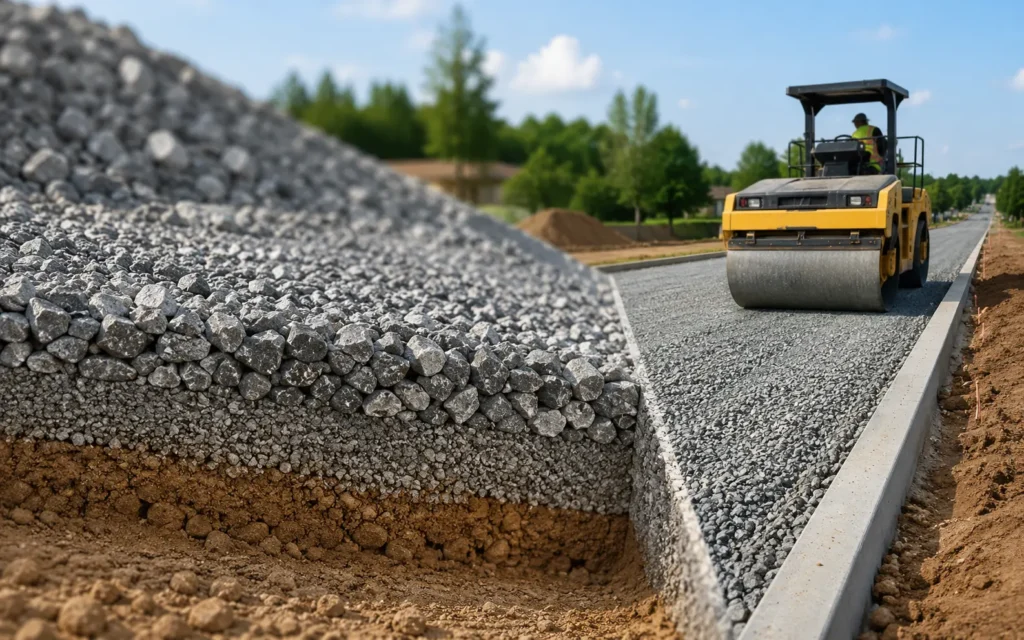
Driveways and Parking Areas
Crushed granite base is used as the sub-base under asphalt or concrete driveways, and as a compacted surface material for unpaved rural or semi-rural driveways. Its angular particle shape creates strong mechanical interlock when compacted — the pieces lock together rather than rolling over each other the way rounded gravel does. This gives the compacted surface good resistance to rutting and lateral movement under vehicle loads.
In central Texas — Austin, San Antonio, and the Hill Country corridor — granite base is a natural fit because of the local geology. The Llano Uplift, a granite dome formation that runs through Burnet, Llano, Mason, and surrounding counties, is one of the largest exposed granite formations in Texas. Quarries in this region produce crushed granite that doesn’t have to travel far to reach job sites in Austin or San Antonio, which can make it competitively priced against crushed limestone that may be sourced from further away.
In the DFW market, limestone base is generally the more cost-competitive choice because the limestone formations of the Cretaceous Escarpment are closer to the major quarry supply centers. Select Sand & Gravel’s multi-pit sourcing model means they can identify which material and source makes the most sense for a specific delivery location — granite base in central Texas markets where it’s more competitive, limestone base where that’s the better value.
Under Concrete Slabs
Like crushed limestone base, properly compacted granite base provides a stable, uniform bearing surface under concrete driveways, patios, building pads, and equipment slabs. The standard recommendation is the same as for limestone base: 4 inches of compacted granite base as a minimum for residential slabs, 6 inches for slabs carrying heavy vehicles or equipment.
The practical advantage of granite’s hardness shows up most clearly in high-load slab applications. Limestone base can degrade under very heavy repeated loading — the calcium carbonate that makes limestone relatively soft also makes it susceptible to gradual crushing of the fines under extreme pressure. Granite fines, being harder and more resistant to degradation, maintain their gradation and compaction density longer under sustained heavy load. For most residential applications, this difference is academic — both materials perform well within residential load ranges. For heavy commercial slabs or industrial pads, it may be worth the conversation.
Equestrian Arena Footing Base
This is a specialized application where granite’s properties are particularly valued in Texas. Horse arena footing is a layered system: a compacted base layer provides the structural foundation, and a softer surface material (sand, rubber, fiber, or a blend) goes on top for traction and cushioning.
The base layer for an equestrian arena needs to be firm, well-drained, and resistant to churning under repeated hoof impact. Crushed granite base and crushed limestone sand — referenced in the crushed limestone sand product page on this site — are both used for this application in Texas. Granite base offers the advantage of hardness and long-term stability; its resistance to degradation means it doesn’t break down into muddy fines over time the way softer base materials can under heavy arena use.
North Texas has a significant equestrian industry, and arena base is a recurring material need for horse properties throughout the DFW area and central Texas.
Road Sub-Base
In road construction, multiple base layers are sometimes used: a sub-base (the lower structural layer, less spec-critical) and a base course (the upper layer, which often must meet TxDOT or county road specifications). Crushed granite base can be used as a sub-base layer in areas where it is the locally available and cost-competitive material, providing structural depth beneath a flex base or asphalt surface course above.
Construction Staging and Access Roads
Temporary haul roads and construction site access roads need to withstand repeated heavy truck traffic without turning to mud. Any crushed base material — limestone, granite, or recycled concrete — works well here. Granite base is used in this application where it’s the most practical available material, particularly in central Texas projects near granite quarry sources.
Crushed Granite Base vs. Crushed Limestone Base
This is the comparison most Texas contractors will want before deciding which to order.
Both are well-graded crushed aggregates that function as compactable structural base layers. The differences are real but often secondary to cost and availability:
Hardness: Granite is significantly harder than limestone. For most residential and light commercial applications, both materials provide more than adequate load-bearing capacity. The hardness advantage of granite becomes more meaningful under very heavy loads or in applications where base degradation over time is a concern.
Water reactivity: Limestone is a carbonate rock that slowly dissolves in slightly acidic water over long time periods. In standard drainage applications this is not a practical concern, but in environments with persistently acidic runoff (near certain industrial sites, for example), granite’s chemical neutrality is an advantage. For typical residential and commercial use, this difference is not significant.
Color: Crushed limestone is white to tan. Crushed granite is typically gray, sometimes with pink or speckled tones depending on the quarry source. For base layers under pavement, color is irrelevant. For exposed surface applications — an unpaved driveway or parking area — granite’s gray-speckled appearance is different from limestone’s white-tan look, and some property owners have aesthetic preferences.
Availability and cost by region: In most of Texas, limestone base is more widely available and typically more cost-competitive because there are more limestone quarries distributed across the state. In central Texas and the Hill Country specifically, granite base from the Llano Uplift quarries can be more competitive for nearby job sites. Select Sand & Gravel sources from multiple pits and can route orders to the most competitive source for a given location.
Compaction performance: Both compact to high density when installed at the right moisture content with a vibratory roller or plate compactor. Granite’s higher hardness means the particles resist crushing during compaction, which can produce a slightly more consistent final density — but for residential applications this difference is not practically significant.
How Much Crushed Granite Base Do You Need?
The same formula that applies to crushed limestone base applies here:
Step 1: Length (ft) × Width (ft) = Square feet
Step 2: Depth (inches) ÷ 12 = Depth in feet
Step 3: Square feet × Depth in feet ÷ 27 = Cubic yards
Step 4: Cubic yards × 1.5 = Tons
Step 5: Tons × 1.10 = Order quantity (adds 10% for compaction and edge waste)
Example — 20 ft × 20 ft patio slab sub-base at 4-inch depth:
- 20 × 20 = 400 sq ft
- 4 ÷ 12 = 0.33 ft
- 400 × 0.33 ÷ 27 = 4.9 cubic yards
- 4.9 × 1.5 = 7.3 tons
- 7.3 × 1.10 = 8 tons to order
One note specific to granite base: because granite is harder than limestone, it resists compaction slightly more — meaning you may need to make additional roller passes or apply more moisture to achieve full compaction density compared to limestone base. This isn’t a significant practical obstacle, but it’s worth knowing if you’re compacting with a smaller plate compactor on a residential project.
Ordering Crushed Granite Base in Texas
Select Sand & Gravel carries crushed granite base as part of its rock and gravel product lineup, available for delivery across Dallas, Fort Worth, Austin, Houston, San Antonio, and Oklahoma City. In central Texas markets where granite base is sourced from nearby Hill Country quarries, it can be a cost-competitive alternative to limestone base — particularly for larger orders where delivery distance is a meaningful part of the total cost.
For projects where you’re comparing granite base against crushed limestone base, describing your job site location and intended use when you call allows the team to give you a realistic comparison of what each material costs delivered to your specific address. That’s what multi-pit sourcing enables — routing the order to the most competitive quarry source for where the material actually needs to go.
Frequently Asked Questions
Is crushed granite base the same as decomposed granite?
No — they are different materials with different origins and different applications. Decomposed granite is naturally weathered granite that has broken down in place over time into fine, sandy particles. It is used for pathways, xeriscaping, and light-traffic driveways as a surface material. Crushed granite base is mechanically crushed from solid granite bedrock, engineered to a specific gradation, and used as a compactable structural base layer under concrete slabs, driveways, and roads. The DG product page and the article on how DG is made cover DG in full detail.
How does crushed granite base compare to crushed limestone road base?
Both are well-graded crushed aggregates used as structural base layers — the key difference is the source rock. Granite is harder than limestone, which gives it slightly better resistance to degradation under heavy loads over time. For most residential and light commercial applications, both materials perform well within normal load ranges. Cost and availability tend to drive the choice more than performance: limestone base is generally more widely available and cost-competitive across Texas, while granite base can be more economical in central Texas where granite quarries are nearby.
Can crushed granite base be used as a driveway surface?
Yes. Compacted granite base makes a serviceable unpaved driveway surface, particularly on rural and semi-rural properties. It compacts to a firm surface that handles vehicle traffic well. The gray, speckled appearance is different from the tan/white of crushed limestone, and some property owners prefer it aesthetically. For best results, apply in two compacted lifts (layers) and ensure proper cross-slope or crown for drainage.
How deep should crushed granite base be under a concrete slab?
The standard minimum for a residential concrete slab is 4 inches of compacted granite base. For slabs that will carry trucks, equipment, or heavy loads, 6 inches is more appropriate. For very heavy commercial or industrial applications, follow the structural engineer’s specification. These are the same depth guidelines that apply to crushed limestone base.
Is crushed granite base available in the Austin and San Antonio markets?
Yes, and in those markets specifically it is often cost-competitive with crushed limestone base because of the proximity to Hill Country granite quarries. Select Sand & Gravel delivers across Austin and San Antonio and can provide a delivered price comparison between granite base and limestone base for your specific job site address.
What is the difference between granite base and granite sand?
Granite sand is the fine screenings from the granite crushing process — a fine-grained material listed in Select Sand & Gravel’s sand products as Granite Sand (Gray). Granite base is a coarser, well-graded structural aggregate produced from the same crushing process but at a larger particle size range. Granite sand is used for decorative applications, some construction sand mixes, and arena footing. Granite base is used as a structural compactable layer. Different gradations, different purposes.
Does granite base compact as well as limestone base?
Yes. Because granite particles are hard and angular, they interlock well under compaction and resist crushing during the compaction process. Achieving full compaction density may require slightly more effort — additional roller passes or more careful moisture management — compared to limestone base, which is softer and compacts a bit more easily. In practice, for residential and commercial applications, both materials reach adequate compaction density without special equipment.
How do I know if granite base or limestone base is the better choice for my project?
For most projects in Texas, either material performs well for the intended use — the decision usually comes down to delivered cost for your specific location. Share your job site address and project type with Select Sand & Gravel and the team can give you a side-by-side delivered price for both, letting you make the call based on real numbers rather than general assumptions.

