Does Crushed Limestone Wash Away in Rain?
The short answer is: it depends on what type of limestone you’re talking about and how it was installed. Loose, uncompacted clean stone moves in heavy rain. Properly compacted road base with fines holds together well through the same storm. A flat limestone surface with no drainage slope will lose material. A crowned or cross-sloped surface sheds water before it can build the velocity needed to carry stone.
The question matters a lot in Texas and Oklahoma, where rain doesn’t arrive gently. A standard Texas thunderstorm can drop two to four inches in under an hour. That’s not a European drizzle that slowly percolates into the ground — it’s a wall of water hitting the surface all at once, and every inch of that water that can’t immediately drain has to go somewhere. If it flows across your limestone driveway or path on the way to somewhere else, it will take some material with it.
Understanding why — and how to prevent it — starts with the physics of how water moves stone.
How Water Moves Limestone: Three Mechanisms
Rain dislodges and moves aggregate material through three distinct mechanisms, each requiring a different response.
Raindrop splash is the first impact of individual raindrops striking a loose, uncompacted surface. The energy of a raindrop hitting dry loose fines can eject small particles several inches in any direction. This is most significant for fine material — limestone screenings, loose crusher dust — on exposed, uncompacted surfaces. Compaction eliminates most of this vulnerability because the particles have nowhere to go when a raindrop hits the bound surface.
Sheetflow is thin, relatively uniform water moving across the surface before it concentrates into channels. This is the water moving across a driveway or path during and immediately after heavy rain. Sheetflow velocity is what matters — slow sheetflow carries very little; fast sheetflow on a slope can carry fine material progressively. The solution is drainage slope that moves this water off the surface laterally rather than allowing it to travel downhill across the full driveway length and build velocity.
Channelized flow is what happens when sheetflow concentrates into a defined path — a wheel rut, a low spot along one edge, the gap between the driveway edge and the grass. Concentrated flow has dramatically more erosive power than sheetflow of the same volume. A shallow channel that develops in a limestone driveway from tire tracking or poor grading will capture sheetflow and concentrate it, accelerating erosion at that point. This is where the visible ruts and washout channels come from.
The Material Difference: Road Base vs Clean Stone
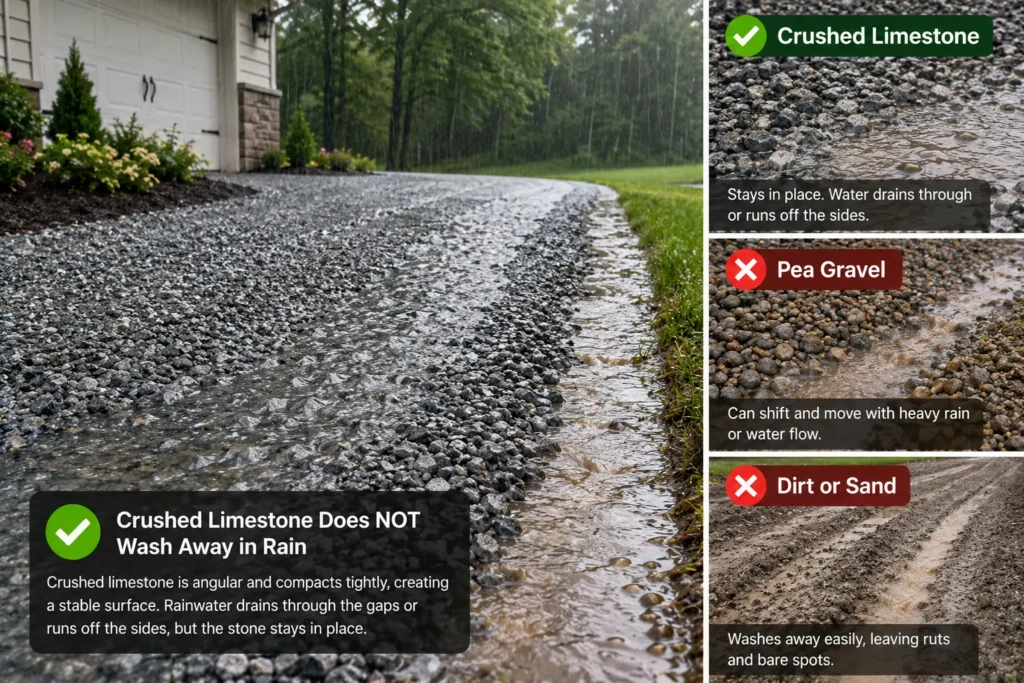
Not all crushed limestone behaves the same way in rain, and the difference comes down to fines.
Road base / crusher run with fines is a blend of larger crushed limestone pieces and fine limestone dust that fills the voids between them. When this material is compacted properly, the fines bind the surface particles together — the road base product page describes it as “the limestone dust fills every gap between the crushed stones, creating a nearly impenetrable surface.” That bound surface sheds water rather than absorbing it. Individual particles can’t move independently because the fines lock them in place. Well-compacted road base sheds even aggressive Texas rain with minimal material loss when the surface is properly sloped.
Clean crushed limestone (#57, pea gravel, river rock) has no fines. Every particle sits independently, nothing binding it to its neighbors. Water flows through and around the particles freely, and surface water flowing across the material pushes individual pieces. These materials move more easily in rain, particularly on any slope, because there’s no binding mechanism to resist the hydraulic force of moving water. This is why you see decorative river rock or pea gravel migrating downhill over a season — the material itself isn’t wrong, but it needs edging and slope management that road base doesn’t require to the same degree.
The how-to-keep-crushed-stone-in-place article on this site identifies the fines distinction correctly: road base’s stone dust creates a surface “almost as hard as concrete” when compacted. That hardness is what resists rain.
Why Texas Rain Is Harder on Limestone Than Most People Expect
Residents who moved to Texas from the Pacific Northwest or the Midwest sometimes underestimate what Texas rain does to an unpaved surface. The difference isn’t total annual rainfall — Houston gets about 50 inches per year, similar to Atlanta or Washington DC. The difference is delivery rate.
Texas thunderstorms are convective — intense, localized, and fast. A storm system that drops two inches of rain in 20 minutes produces a surface runoff rate that a slow one-inch-per-hour rain simply doesn’t generate. The water can’t percolate into the ground fast enough; it all stays on the surface as runoff. And runoff flowing across a limestone driveway carries significantly more material per gallon when it’s moving fast than when it’s moving slowly.
The practical implication: a drainage design that works adequately for gentle, steady rain may fail during a typical Texas summer thunderstorm. When evaluating whether your limestone installation is performing correctly in rain, the right benchmark is the heavy event — not the light drizzle.
Oklahoma City sits in a similar position, in the transition zone between the dry southern plains and the more humid east. The spring storm season in central Oklahoma regularly produces the same type of intense convective rainfall that challenges surface drainage in Texas.
Common Situations Where Limestone Washes Away
Fresh, Uncompacted Material Before the First Compaction Pass
The most vulnerable period for any limestone installation is the window between delivery and compaction. A freshly dumped load of road base that hasn’t been compacted yet is essentially loose aggregate — the fines are there, but they haven’t been activated and interlocked by the roller. A heavy rainstorm during this window can carry significant material, particularly the fines, off the surface.
If rain is forecast within 24–48 hours of your material delivery, either compact immediately after spreading or accept that you’ll need to add top-dressing fines after the storm and compact again. Never leave a large quantity of freshly spread, uncompacted road base sitting through a storm if you can avoid it.
Flat Driveways with No Crown or Cross-Slope
A completely flat limestone driveway — level from edge to edge — gives water nowhere to go. Rain falling on it either ponds in place or, if the whole driveway has even a slight grade toward one end, concentrates into increasing flow velocity as it travels the full driveway length. By the time it reaches the low end, it’s carrying material.
The solution is built into the installation, not added after the fact. A proper driveway crown — the center of the surface several inches higher than the edges — or a consistent cross-slope of 1–2% ensures that water leaves the surface laterally before it can build velocity along the driveway’s length. The road base installation guide on this site covers how to establish and verify this slope during installation. A driveway that consistently loses material at one corner after every rain almost always has a drainage slope problem, not a material problem.
Open Edges Without Containment
Even a well-graded limestone surface will lose material laterally if the edges are open — nothing containing the base at the driveway margin. Tire overhang, rainwater sheeting off the surface edge, and the natural tendency of loose material to migrate outward all work together to push limestone off the edges over time.
This is particularly noticeable after rain because the water moving off the surface carries fines with it as it exits over the edge. The how-to-keep-crushed-stone-in-place article covers edging options: steel or plastic edging for a crisp modern line, brick or larger stone borders for a more decorative edge, or simply a compacted earthen shoulder slightly raised above the driveway surface level. Any of these significantly reduces the edge material loss that accumulates rain after rain.
Sloped Driveways Without Water Management
Sloped driveways are the most challenging scenario for limestone retention. Gravity and flowing water work together, and the same physics that makes road base durable on a flat driveway becomes a problem when water is channeling downhill with increasing velocity.
On a moderately sloped driveway (3–8% grade), the primary solution is compaction — a well-compacted road base surface with adequate fines resists water flow better than loose material. On steeper driveways (8%+), additional measures are needed:
Water bars are the technique used on long rural driveways and forest roads where slope erosion is a persistent problem. A water bar is a low diagonal ridge built across the driveway surface — typically at a 30–45 degree angle to the road centerline — that intercepts water flowing down the slope and diverts it off the side before it concentrates and builds erosive velocity. Water bars can be formed from compacted road base material itself, from embedded logs or timbers, or from embedded rock. On a long rural driveway with significant slope, water bars placed every 50–100 feet depending on the gradient are standard erosion management.
Coarser top material on slopes acts as erosion armor. A 2-inch topping layer of clean crushed stone (3/4″ or larger) over the compacted road base makes it harder for surface water to move the top layer, while the compacted road base beneath provides structural stability. The larger particles simply require more hydraulic force to move than the fine material in bare road base.
The Low Side of a Cross-Sloped Driveway
A driveway with a proper cross-slope concentrates all the runoff at the low edge. This is exactly where it should go — but if that low edge isn’t managed, the concentrated flow at the edge can erode more material than the sheetflow across the rest of the surface. A drainage swale, French drain, or simply a lower shoulder area that directs the collected edge water away from the driveway prevents this from becoming a recurring maintenance point.
What Normal Post-Storm Fines Loss Looks Like
One of the most common questions from homeowners with limestone driveways is whether what they’re seeing after a storm is a problem or just normal behavior. The distinction matters for knowing when to act.
Normal: After a significant Texas thunderstorm, light-colored chalky residue appears at the low edges of the driveway or at the driveway entrance. This is limestone fines — the finest dust particles in the road base — that were carried by surface water and deposited at the low point. The surface of the driveway itself looks intact and firm. This is normal fines migration under heavy rain, and it’s expected on any road base surface. A thin top-dressing of road base fines once or twice a season in high-traffic areas maintains the surface.
A problem: After a moderate rain — not even an extreme event — visible ruts or channels appear on the driveway surface. Material is accumulating in the yard adjacent to the driveway edges in quantity. The surface has developed soft spots that don’t firm back up after the rain ends. These are signs of a drainage slope problem, inadequate compaction, or a base that’s too shallow for the subgrade conditions — not just normal fines migration.
The key diagnostic: if you see material loss only after major storms and the surface returns to firm condition within a day, that’s maintenance. If you see material loss after every rain and the surface stays soft, that’s a structural problem.
Seven Ways to Prevent Limestone from Washing Away
Compact thoroughly before any rain. Compaction activates the fines binding that makes road base rain-resistant. Uncompacted material is always more vulnerable. If delivery timing and weather don’t align perfectly, compact the first lift immediately and plan to address the second lift after the weather window passes.
Build in drainage slope during installation. Crown or cross-slope is established during subgrade preparation — it can’t be corrected easily after the base is compacted and in place. The installation guide covers how to verify slope with a string line and level before the material goes down.
Install edge containment. Steel edging, landscape timbers, concrete curbs, or even a well-formed compacted earthen shoulder keep material from migrating off the edges with every rain. This is one of the highest-value additions to any limestone driveway or path installation.
Use road base rather than clean stone for surfaces that need to stay put. Road base (crusher run with fines) is significantly more rain-resistant than clean stone. If decorative clean stone is desired as a top layer, install it over a compacted road base base, not directly over native soil.
Use geotextile fabric under the base. Fabric prevents native soil from migrating up into the base material during wet conditions, which would reduce the binding effectiveness of the fines over time. For clay soil areas of Texas — most of DFW and central Texas — this is a standard installation step.
Water bars on long sloped driveways. For rural driveways with meaningful gradient, water bars at regular intervals redirect slope runoff off the side before it concentrates into erosive channels. Simple to install during initial construction; much harder to retrofit after damage has developed.
Top-dress proactively, not reactively. A thin annual top-dressing of road base fines on high-traffic sections, compacted in, maintains the surface binding before fines loss becomes significant. This is cheaper and less disruptive than waiting until the surface has deteriorated enough to require full regrading.
Frequently Asked Questions
Does crushed limestone wash away in heavy rain? Properly compacted road base with fines holds up well through heavy rain when the surface is sloped for drainage and the edges are contained. Loose, uncompacted limestone — and clean stone with no fines — moves more easily in heavy rain because there’s no binding mechanism to resist the hydraulic force of moving water. Texas’s intense thunderstorms make drainage slope and compaction more critical here than in most other states.
Is road base or clean stone better in rain? Road base (crusher run with fines) is significantly more rain-resistant than clean stone like #57 limestone, pea gravel, or river rock. The fines bind the surface particles together under compaction, creating a cohesive surface that sheds water rather than allowing water to push individual particles. Clean stone has no fines, so each particle sits independently and moves more easily under surface flow.
Why does limestone wash into my yard after rain? The most common causes are: open edges without containment (material migrates laterally with every rain), a flat or improperly sloped surface (water builds velocity rather than shedding off), or uncompacted material (fines haven’t been activated to bind the surface). Adding edge containment, regrading with proper cross-slope, and compacting will significantly reduce this.
How do I stop my sloped limestone driveway from eroding? For moderately sloped driveways, thorough compaction and proper edge containment are the primary tools. For steeper driveways, add water bars — diagonal ridges across the driveway surface that intercept downhill flow and divert it off the side — and consider a coarser top-dressing material (3/4″ stone) over the road base to armor the surface against fast-moving water.
Is it normal to lose some limestone after a Texas thunderstorm? Minor surface fines loss after major storms is normal for any road base surface. You’ll see light-colored residue at the low edges or driveway entrance — this is fines carried by surface runoff and deposited at the low point. The driveway surface itself should remain intact and firm. Significant material loss after moderate rain, or soft spots that don’t firm back up, indicate a drainage or compaction problem rather than normal maintenance.
How often does a limestone driveway need top-dressing? In high-traffic areas, a thin top-dressing of road base fines once or twice per year maintains the surface binding and prevents cumulative fines loss from becoming a structural problem. Rural driveways with lower traffic and better drainage may go several years between top-dressings. Select Sand & Gravel supplies maintenance quantities as well as full installation loads.
What is a water bar and do I need one? A water bar is a low diagonal ridge built across a driveway surface that intercepts water flowing downhill and diverts it off the side before it concentrates into erosive channels. They’re most useful on long rural driveways with grades of 5% or steeper. On level or gently sloped urban and suburban driveways, proper cross-slope and edge containment typically accomplish the same goal without water bars.
Does Select Sand & Gravel deliver road base for driveway repairs after storm damage? Yes. Maintenance top-dressing and repair loads are a standard part of the business. If a storm season has degraded your limestone driveway surface, a maintenance delivery of road base fines or crusher run to fill in and recompact is typically much less expensive than full reconstruction. Call 1-817-572-6310 for a quote based on your driveway dimensions and current condition.

