How to Size Riprap for Erosion Control
Riprap is one of the most reliable and permanent erosion control solutions available — but its effectiveness depends almost entirely on using the right stone size for the conditions it has to handle. Undersized riprap moves under water velocity and provides no real protection. Oversized riprap wastes material cost and can create unintended flow disruption.
Sizing riprap correctly means understanding the two variables that drive stone selection: the velocity of the water the installation has to resist, and the slope of the surface being protected. This guide walks through both — from the basic principles to the standard size classes used in Texas and Oklahoma construction — so you can approach your project with a clear understanding of what the specification should look like.
Why Stone Size Matters
Riprap works by weight and interlock. Individual stones must be heavy enough that flowing water cannot displace them, and angular enough that they lock together into a stable mass that resists scour as a unit rather than as individual particles.
When water velocity exceeds the resistance of the stone, scour begins — the flow lifts or rolls individual stones, exposes the soil or filter fabric beneath, and progressively undermines the remaining installation. Once scour initiates, it accelerates. An undersized riprap installation that holds through a moderate storm event can fail catastrophically in the next major rain because the subgrade has already been compromised beneath the surface.
The goal of sizing is to specify stone that will stay in place under the design storm velocity with a reasonable safety factor — so the installation holds not just in average conditions, but in the events that actually test it.
The Two Primary Sizing Variables
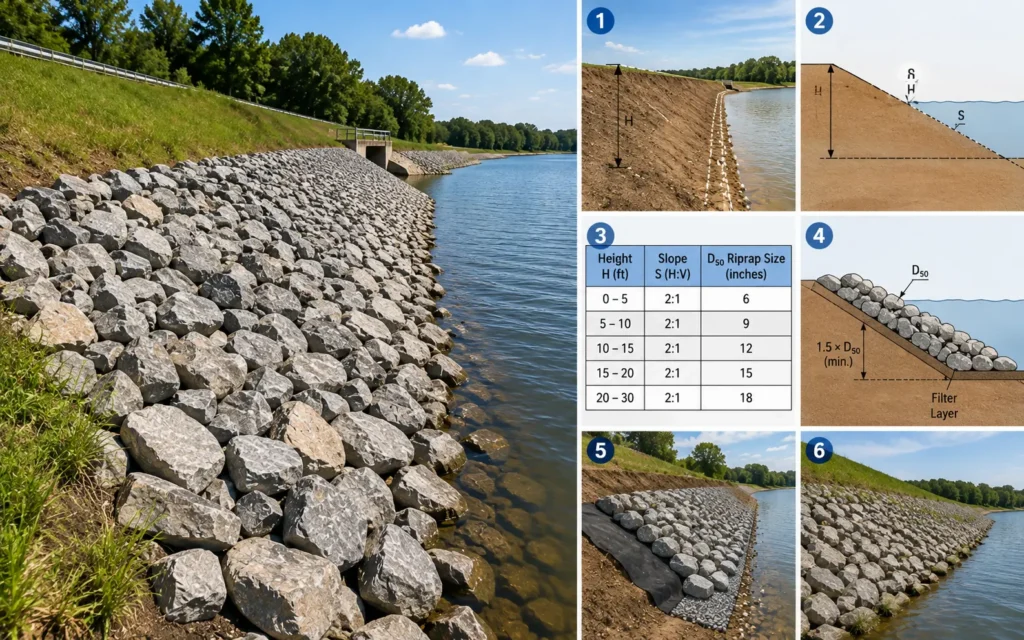
1. Water Velocity
Water velocity is the dominant sizing variable. The faster water moves across or along a surface, the larger and heavier the stone must be to resist displacement.
Velocity in a drainage channel or slope application is a function of the channel slope, cross-section geometry, and flow volume — which in a storm event is driven by the upstream drainage area and rainfall intensity. For engineered drainage projects, a hydraulic engineer calculates design velocity using Manning’s equation or similar methods based on site survey data and design storm parameters.
For practical guidance without a full hydraulic analysis, here are working velocity ranges and the riprap size class typically associated with each:
| Design Velocity | Typical Application | Recommended Size Class |
|---|---|---|
| Up to 4 ft/sec | Low-slope drainage swales, gentle slopes | 4"–8" light riprap |
| 4–6 ft/sec | Moderate slopes, culvert outlet protection | 8"–12" medium riprap |
| 6–10 ft/sec | Steep channels, high-flow drainage ditches | 12"–18" heavy riprap |
| 10–15 ft/sec | Spillways, major channel linings | 18"–24" or larger |
| 15+ ft/sec | Dam faces, major infrastructure | Engineer-specified only |
These are starting-point guidelines. For any project involving significant water volume, public infrastructure, or engineered drainage systems, confirm sizing with a licensed civil or geotechnical engineer. Many Texas municipal drainage projects and all TxDOT work require engineer-stamped specifications.
2. Slope of the Protected Surface
Slope affects both the velocity of water running over it and the gravitational component acting on the stones themselves. A steeper slope means faster water and less friction to hold stones in place — both factors push toward larger stone.
The general relationship:
| Slope | Sizing Implication |
|---|---|
| Flatter than 3:1 (H:V) | Standard size for the velocity class applies |
| 3:1 to 2:1 | Move up one size class from velocity recommendation |
| Steeper than 2:1 | Significant engineering review required; standard riprap may not be appropriate |
A 2:1 slope — 2 feet of horizontal run for every 1 foot of vertical rise — is approximately the practical limit for conventional riprap without specialized engineering. Slopes steeper than this may require grouted riprap (stone set in concrete), retaining structures, or a gabion wall system rather than loose-placed armor stone.
Standard Riprap Size Classes
Riprap is not sold as a single product — it comes in size gradations that define the range of stone sizes in each load. The terminology varies slightly by state and agency, but in Texas and Oklahoma the most common classifications are:
Light Riprap (4″–8″)
The smallest practical riprap size for erosion control applications. Appropriate for:
- Low-velocity drainage swales (under 4 ft/sec)
- Residential downspout outlet protection
- Minor slope stabilization on gentle grades (flatter than 4:1)
- Culvert outlet aprons on small pipes
At this size, individual stones weigh roughly 5–30 pounds. Light riprap can be hand-placed for small residential applications. It is not appropriate for high-flow channels, steep slopes, or any application where water velocity exceeds about 4 feet per second.
Medium Riprap (8″–12″)
The most commonly specified size for residential and light commercial erosion control in Texas. Appropriate for:
- Moderate-velocity drainage channels (4–6 ft/sec)
- Culvert outlet protection on standard-sized pipes (18"–36" diameter)
- Slope stabilization on grades of 3:1 to 4:1
- Channel lining on drainage ditches with moderate flow
- Pond and lake edge protection in areas with wave action from boat traffic or wind
Individual stones in this range weigh roughly 30–150 pounds. Machine placement (excavator or skid steer) is typically required for anything beyond small areas.
Heavy Riprap (12″–18″)
Specified for higher-velocity applications and steeper slopes. Appropriate for:
Individual stones in this range weigh 150–500+ pounds. Heavy equipment is required for placement, and these projects typically involve engineer specifications.
Extra Heavy / Armor Stone (18"–24" and larger)
Reserved for the most demanding applications — high-velocity spillways, major drainage infrastructure, dam armoring, and critical shoreline protection on large water bodies. Individual stones can weigh 500 pounds to several tons. These projects are always engineer-designed and specified, and placement requires heavy construction equipment.
The D50 Concept: What Engineers Use
When a civil engineer specifies riprap, they typically don’t just say “use 12-inch stone.” They specify a D50 — the median stone size, meaning 50% of the stones in the load are larger than this dimension and 50% are smaller.
The D50 is part of a gradation envelope that also specifies a maximum stone size and the percentage of fines allowed. This is important because a well-graded riprap installation — one with a range of sizes — interlocks more effectively than single-size stone. The smaller stones fill voids between larger stones, reducing the openings through which soil can escape and improving the stability of the mass.
Common D50 specifications in Texas:
| Class | D50 | Approximate Weight of D50 Stone |
|---|---|---|
| Light | 6 inches | ~15 lbs |
| Medium | 9–10 inches | ~50–75 lbs |
| Heavy | 12–15 inches | ~150–300 lbs |
| Extra Heavy | 18–24 inches | ~500–1,500 lbs |
If your project has an engineer spec that references a D50, your material supplier needs to confirm that the riprap gradation they’re providing meets that spec. This is especially important for TxDOT, USACE, and municipal drainage projects where material certification may be required.
Filter Fabric: The Step Most People Skip
Sizing the stone correctly is only half the equation. Every riprap installation should include a geotextile filter fabric layer between the native soil and the riprap — and this step is skipped more often than it should be, particularly on residential projects.
Here’s what happens without it: water flowing through the voids between riprap stones creates a pressure differential that pulls fine soil particles up from the subgrade. Over time — sometimes quickly in high-flow events — those fines migrate into the voids, the subgrade begins to hollow out beneath the stone, and the riprap settles and shifts as the soil support disappears beneath it. The installation looks intact from the surface while failing from the bottom up.
Filter fabric prevents this by creating a permeable separation layer that allows water to pass freely but retains soil particles in place. It’s a low-cost material compared to the stone itself, and it extends the functional life of the installation significantly.
Filter fabric installation guidelines:
- Use non-woven geotextile fabric rated for drainage/erosion control applications
- Overlap seams by a minimum of 18 inches in the direction of water flow (upstream overlap over downstream)
- Anchor the fabric at the top of the slope before placing stone — secure with staples or pins every 2–3 feet
- Extend the fabric at least 12 inches beyond the intended riprap footprint in all directions
- Do not allow the fabric to fold or wrinkle significantly — smooth placement produces better long-term performance
Riprap Layer Thickness
Stone size also determines the required layer thickness. As a rule of thumb, riprap layer thickness should be 1.5 to 2 times the D50 stone size.
For medium riprap with a D50 of 9 inches: 9 × 1.5 = 13.5 inches minimum layer thickness, typically rounded to 12–18 inches in practice.
This thickness requirement ensures that the layer has enough depth to resist scour without exposing the filter fabric or soil beneath from individual stone displacement.
Common Riprap Applications in Texas and Oklahoma
Culvert Outlet Protection
One of the most common residential and commercial riprap applications. When water exits a culvert pipe at velocity, it concentrates energy at the outlet and scours the channel downstream — a process called outlet scour or headcutting. A riprap apron placed at the culvert outlet dissipates this energy before it contacts unprotected soil.
The standard configuration is an apron that extends downstream from the pipe end at roughly 3–5 times the pipe diameter in length, and spreads outward at roughly a 1:3 expansion ratio. Stone size is keyed to outlet velocity, which increases with pipe slope and flow volume.
Drainage Ditch and Swale Lining
Concrete-lined drainage channels are expensive. Riprap-lined channels handle the same flow management at lower cost, with the added benefit of remaining permeable and providing some habitat value in natural channel settings. Riprap is specified for the channel bottom and side slopes, with larger stone on the outside of any channel bends where velocity concentrates.
Slope Stabilization
Cut slopes and embankments adjacent to water — roadside ditches, pond edges, lake shores, reservoir embankments — are protected with riprap to prevent rain impact erosion and wave scour from removing soil from the slope face. The riprap size is driven by the slope and the wave energy or water velocity the installation has to resist.
Bridge Abutment and Pier Protection
Bridge foundations are vulnerable to scour — the removal of streambed material around the foundation by current. Riprap placed around abutments and piers provides armor against this scour, protecting the structural integrity of the crossing. This is a life-safety application that always requires engineer design and specification.
Estimating How Much Riprap You Need
Use the same core formula:
Volume (cubic yards) = Length (ft) × Width (ft) × Thickness (ft) ÷ 27
Then convert to tons. Riprap weight per cubic yard varies by stone type, but crushed limestone riprap in Texas typically runs 1.4 to 1.6 tons per cubic yard, depending on gradation and void content. A working average of 1.5 tons per cubic yard is appropriate for most estimation purposes.
Example: A culvert outlet apron 15 feet long, 10 feet wide, 18 inches (1.5 ft) thick:
- 15 × 10 × 1.5 ÷ 27 = 8.3 cubic yards
- 8.3 × 1.5 = 12.5 tons
- Plus 10% overage: approximately 14 tons
Example: A drainage ditch lined with riprap, 200 feet long, 8 feet wide, 12 inches thick:
- 200 × 8 × 1.0 ÷ 27 = 59.3 cubic yards
- 59.3 × 1.5 = 89 tons
- Plus 10% overage: approximately 98 tons
When to Involve an Engineer
Riprap sizing for simple residential applications — a downspout outlet, a gentle slope on a backyard pond edge, a short drainage swale — can reasonably be estimated using the guidelines in this post. For anything beyond that, engineering review is worth it:
- Any project in a regulated floodplain or FEMA flood zone
- Projects adjacent to public drainage infrastructure or waterways requiring permits
- Slopes steeper than 3:1
- Design velocities above 6 ft/sec
- Bridge or culvert projects
- TxDOT, USACE, or municipal right-of-way projects
In Texas and Oklahoma, many drainage and erosion control projects require permits from the Army Corps of Engineers, TCEQ, or local municipalities — particularly those adjacent to waterways. An engineer familiar with the local regulatory environment can identify permit requirements before construction begins and avoid costly retrofitting or removal.
For bulk riprap supply across Texas and Oklahoma — from light residential gradations through heavy armor stone — Select Sand & Gravel sources material direct from regional quarries and coordinates heavy-haul delivery to your site. Contact the team with your project location, slope, and water velocity conditions and they can help confirm the appropriate size class for your application.

