Does Decomposed Granite Get Muddy When Wet?
Decomposed granite is one of the most popular pathway, patio, and driveway surface materials in Texas and Oklahoma — natural-looking, permeable, and considerably cheaper than pavers or poured concrete for the same square footage. It also has a reputation problem: enough people have walked across a soft, muddy DG path after a storm that “does DG turn to mud” is one of the most common questions asked before a project ever gets ordered.
The honest answer is that it depends almost entirely on what kind of decomposed granite was used and how it was installed — not on decomposed granite as a category. Properly compacted, correctly graded DG sheds water and firms up as it dries. Poorly compacted, fines-heavy DG with no drainage plan can absolutely turn to mud, and stay soft for days after a rain event. Both of those are decomposed granite. The difference is entirely in the material spec and the installation.
What Decomposed Granite Actually Is
Decomposed granite is granite rock that has naturally weathered down into a mix of coarse sand-sized particles and fine granite dust — the “fines” that give DG its characteristic compactable texture and hold it together as a semi-solid surface once installed. That fines content is the whole reason DG works as a walkway or patio surface: it’s what allows the material to compact into a firm, walkable crust instead of behaving like loose gravel.
That same fines content is also the reason DG has a reputation for mud. Fine granite dust behaves differently from coarse aggregate when it’s saturated — it holds water, becomes plastic under load, and can turn genuinely soft if there’s too much of it, if it hasn’t been compacted properly, or if water has nowhere to drain away to.
The Real Answer: It Depends on Fines Content and Compaction
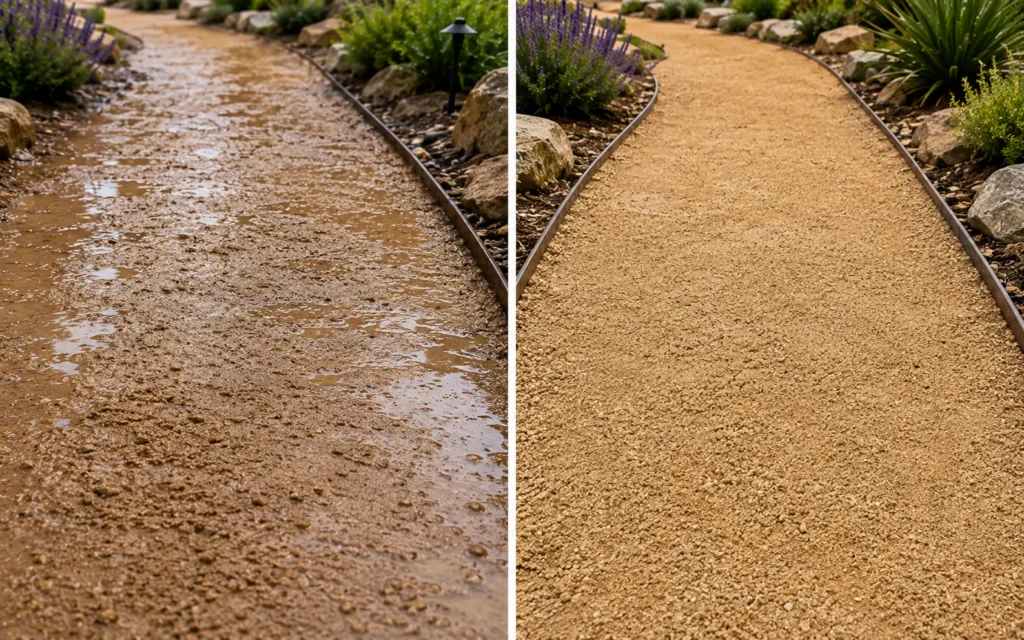
Two variables determine whether a given DG installation turns to mud in wet weather, and neither one is simply “is it decomposed granite.”
Fines percentage. DG products vary in how much fine dust versus coarse particle they contain. A mix with a well-balanced gradation — enough fines to bind and compact, not so much that it becomes a mud-prone paste when saturated — performs very differently in wet weather than a fines-heavy, poorly graded load. This is a material spec question, and it’s worth asking a supplier directly what gradation a given DG product runs, rather than assuming all DG is graded the same way.
Compaction. Decomposed granite is designed to be mechanically compacted, typically with a plate compactor, in thin lifts of roughly 2 inches at a time, often with light moisture added during compaction to help the fines bind. Uncompacted or loosely raked DG never develops the dense, interlocked surface crust that sheds water — it stays loose and granular, which is exactly the condition that turns to mud fastest under rain. A properly compacted DG surface, by contrast, develops a hard-packed top layer that resists water penetration and firms back up quickly once it dries.
Get both of those right — a reasonably graded material and thorough compaction — and standard decomposed granite performs well in wet weather for the vast majority of pathway and patio applications. Get either one wrong, and mud is the predictable result.
Stabilized vs. Natural Decomposed Granite
Beyond gradation and compaction, there’s a second lever available for projects where mud resistance matters most: stabilization.
Natural, unstabilized DG relies entirely on mechanical compaction and fines content to hold together. It’s the lower-cost option and performs well for most residential pathways and patios when properly installed, but it can still soften somewhat during extended wet periods or in high-traffic areas where the compacted crust gets worn down over time.
Stabilized decomposed granite has a binding agent — typically a polymer or resin stabilizer — mixed into the material before or during installation. That binder locks the fines and coarse particles together into a semi-rigid surface that holds up significantly better under repeated wetting, heavy foot or vehicle traffic, and slope conditions where standing water is more likely. Stabilized DG costs more than natural DG per ton, but for driveways, high-traffic commercial pathways, sloped applications, or any site with a documented mud problem in the past, it’s usually the more reliable long-term choice.
| Natural DG | Stabilized DG | |
|---|---|---|
| Binding mechanism | Compaction and natural fines content only | Compaction plus added polymer/resin binder |
| Wet-weather performance | Good if properly compacted and graded | Better — resists softening under repeated wetting |
| Best for | Garden paths, patios, low-traffic areas | Driveways, slopes, high-traffic or commercial use |
| Relative cost | Lower | Higher |
| Maintenance | Periodic re-compaction may be needed | Generally lower maintenance |
Installation Factors That Prevent (or Cause) Mud
Most DG mud problems trace back to one or more installation shortcuts rather than the material itself:
- Skipping the base course. DG installed directly over native soil, especially clay-heavy soil common in much of Texas and Oklahoma, has nothing to drain into and nowhere for excess water to go. A compacted aggregate base — commonly a road base or flex base layer — under the DG surface course gives water somewhere to move and keeps the DG layer itself from sitting in saturated subgrade.
- Inadequate compaction. As covered above, this is the single biggest factor. Compact in thin lifts, not as one thick pass.
- No grade or slope for drainage. A DG surface installed dead level, or worse, sloped toward a low point where water collects, will hold water on the surface far longer than one graded to shed water away from the installation.
- Installing too thick in one lift. A DG layer poured and compacted too thick at once compacts unevenly — the surface can appear firm while the material underneath stays loose, which shows up as soft or muddy spots once water gets in.
- Wrong material for the application. Using a natural, unstabilized DG on a driveway or a sloped, high-traffic area where a stabilized product would hold up better is a spec mismatch, not a DG problem.
Maintenance That Keeps DG From Turning Muddy Over Time
Even a correctly installed DG surface benefits from periodic upkeep, particularly in high-traffic areas or after several wet seasons:
- Re-compact worn or high-traffic areas periodically, especially paths and driveway wheel tracks where the surface crust gets ground down over time
- Top-dress with a thin layer of fresh material and re-compact if the surface has visibly thinned or become loose
- Keep the surface graded so water continues to shed away from the installation rather than pooling
- For stabilized DG, address any cracking or surface breakdown promptly, since gaps in the stabilized crust let water into the unstabilized material underneath
When Decomposed Granite Isn't the Right Choice
For sites with persistent drainage problems, heavy shade that keeps the surface from drying out between rain events, or very high vehicle traffic, even a well-installed and stabilized DG surface may not be the ideal fit. In those situations, a pathway fines product with a different gradation, or a different surfacing approach entirely, may hold up better than pushing DG into conditions it isn’t suited for.
The Bottom Line
Decomposed granite doesn’t inherently turn to mud when it rains — poorly graded, poorly compacted, or improperly drained decomposed granite does. A well-specified, properly compacted DG installation with adequate base drainage sheds water and firms back up quickly after a storm, the same way it’s used successfully on trails, patios, and driveways throughout Texas and Oklahoma. For applications where wet-weather performance is a priority — driveways, slopes, high-traffic commercial paths — stabilized DG closes most of the remaining gap.
Select Sand & Gravel supplies both natural and stabilized decomposed granite across Texas and Oklahoma, along with the base materials needed underneath it. Browse the full range of decomposed granite products, or contact the team with your project location, traffic type, and drainage conditions, and they can help confirm the right material and installation approach for your site.

