Pea Gravel vs River Rock: Which One Is Right for Your Project?
Both pea gravel and river rock are smooth, naturally rounded stones. Both are permanent alternatives to organic mulch. Both drain well and require minimal upkeep. So when you’re standing at the planning stage of a landscape bed, patio, drainage channel, or backyard pathway, how do you actually decide between them?
The answer comes down to size, surface feel, visual weight, and what the application demands. This guide covers every common use case side by side — drainage, landscaping, patios, driveways, play areas, and cost — so you can make a confident decision before you order.
The Basic Difference
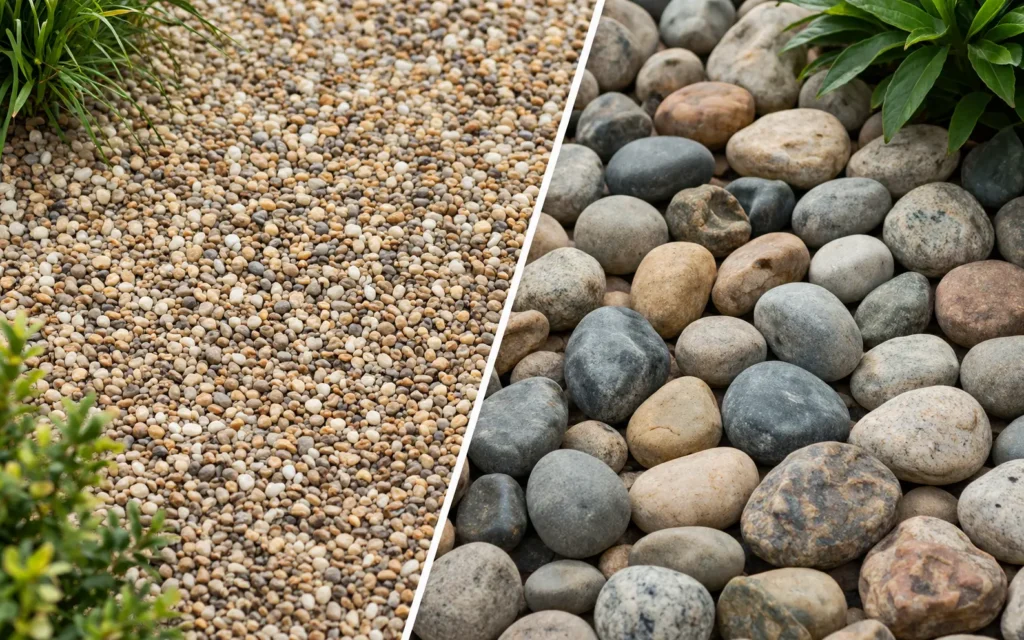
Pea gravel is small — typically 3/8 to 5/8 of an inch. The stones are naturally rounded and smooth from water tumbling, and in a standard blend they come in a mix of tans, buffs, whites, and grays. The name comes from the size: roughly as large as a garden pea.
River rock is larger — commonly available from 1 inch up through 5 inches and beyond, depending on the variety. Like pea gravel, it’s water-tumbled and smooth, but its size creates a completely different visual weight and physical behavior underfoot.
That size difference is the root of every practical distinction between them.
Pea Gravel vs River Rock: Head-to-Head by Application
For Drainage
Both materials drain exceptionally well. Rounded stones don’t compact, which means water moves freely through the void spaces between particles — neither material impedes flow the way compacted base or fine sand would.
Where pea gravel wins: Pipe bedding and trench drainage. Pea gravel’s small particle size flows easily around perforated pipe and fills tightly into narrow trenches, making it a practical choice for French drains, septic lateral lines, and utility corridor drainage. It settles snugly around infrastructure without leaving large voids that could allow pipe movement.
Where river rock wins: Surface drainage channels, dry creek beds, and outlet protection. River rock’s larger size resists displacement in high-velocity water flow far better than pea gravel. In a heavy Texas rain event, pea gravel in a surface swale or culvert outlet will migrate. A properly sized river rock won’t. For any drainage application where water volume and velocity are significant — downspout outlets, drainage swales, channel linings — river rock is the more durable specification.
Verdict: Pea gravel for subsurface and pipe-adjacent drainage. River rock for surface drainage channels and areas where water velocity is a factor.
For Landscaping
This is where personal preference, design style, and plant context start to matter as much as performance specs.
Pea gravel in landscaping: The small, uniform size creates a fine-textured, almost refined ground cover. It reads as a neutral background that lets plantings command attention. It works well in tight spaces — between stepping stones, around container plantings, in narrow borders — where larger stone would look oversized. The soft color palette (tans, creams, grays) blends into virtually any landscape style without demanding attention.
The tradeoff: pea gravel migrates. Foot traffic, animal activity, and wind all displace small stones over time, particularly at bed edges. Without solid containment edging, pea gravel gradually spreads into lawn areas and adjacent beds. It also has a tendency to scatter when walked through — it shifts underfoot and spreads laterally rather than staying in place the way larger stone does.
River rock in landscaping: The larger size creates visual weight and presence. River rock reads as a design element rather than just background fill — individual stones are large enough to be noticed, and a well-installed river rock bed has a deliberate, structural quality that smaller aggregate doesn’t achieve. It stays in place better than pea gravel under foot traffic and in exposed areas, and it handles the intense Texas summer heat without scorching nearby plants the way dark mulch can.
River rock is the natural choice for dry creek bed features, boulder-and-stone garden designs, large landscape beds around established trees, and any application where the stone itself is part of the visual design rather than just a mulch substitute.
Verdict: Pea gravel for fine-textured neutral backgrounds and tight spaces. River rock for bold landscape features, dry creek beds, and large-scale beds where material displacement is a concern.
For Patios
Neither pea gravel nor river rock is a structural patio surface — neither compacts into a rigid foundation. But both are used in patio contexts in different ways.
Pea gravel patios: A loose pea gravel patio — a contained area of pea gravel enclosed by edging, with furniture sitting on top — is a legitimate and popular DIY patio approach, particularly in casual backyard settings. It’s inexpensive, installs quickly, and drains perfectly (no puddles after rain). With 2–3 inches of depth over a properly prepared base and good edge containment, a pea gravel patio holds up well for outdoor furniture, fire pits, and relaxed entertaining.
The honest limitations: furniture legs sink and wobble slightly on pea gravel. High heels are a problem. Pea gravel tracks into the house on shoes. And without edging maintenance, it gradually spreads. These are manageable issues for an informal backyard space, but dealbreakers for a formal entertaining area.
River rock patios: River rock is less commonly used as a pure patio surface because the larger stones are uneven underfoot and make furniture placement difficult. Where river rock earns its place in patio design is as a border, accent zone, or decorative surround — framing a concrete or paver patio, filling gaps between stepping stones in a patio approach, or creating a dry creek feature that borders the patio edge. Used this way, river rock adds visual texture and drainage function without creating a walking surface challenge.
Verdict: Pea gravel is the better choice for a loose, informal patio surface. River rock works better as a design accent or border around a patio rather than underfoot.
For Driveways
Neither material is ideal as a primary driveway surface on its own.
Pea gravel on a driveway creates a soft, shifting surface that vehicle tires displace with every pass — particularly during turning maneuvers. Stones scatter onto adjacent lawn areas and the surface becomes uneven quickly. It’s not a driveway specification.
River rock has the same problem at a larger scale — rounded stones under vehicle weight shift and roll rather than locking together. They’re equally unsuitable as a structural driveway surface.
For a functional unpaved driveway, angular crushed material — road base or flex base — is the correct specification. Angular particles interlock and compact into a rigid surface that resists displacement under vehicle load. River rock or pea gravel as a decorative dressing alongside a proper driveway is fine; as the driveway itself, neither holds up.
Verdict: Neither is appropriate for driveway use. Use road base or flex base for the structural layer.
For Pathways and Walkways
Pea gravel pathways: This is one of pea gravel’s strongest applications. A 2–3 inch depth of pea gravel within a contained pathway edging creates a comfortable, permeable walking surface with a satisfying crunch underfoot. It’s universally used in garden path applications, works well between raised beds in vegetable gardens, and handles moderate foot traffic without significant maintenance.
The key requirements: good edge containment on both sides, and a geotextile fabric base layer to prevent fines migration and weed growth. Without containment, the path gradually loses definition as stones migrate into adjacent areas.
River rock pathways: Larger river rock (2 inches and up) makes for an irregular walking surface — the stones shift and roll slightly underfoot, which many people find uncomfortable for extended walking. Smaller river rock in the 1–1.5 inch range is more walkable but still less comfortable than pea gravel for barefoot use or long garden paths.
Where river rock works in pathway contexts is as a stepping stone companion — large flat stones set in a bed of river rock, where the rock fills the spaces between stepping stones decoratively without needing to be the walking surface itself.
Verdict: Pea gravel is the better walking surface for dedicated pathways. River rock works best as a gap filler around stepping stones rather than a standalone path surface.
For Play Areas and Pet Zones
Pea gravel has a long history as a playground and pet area surface for good reason. The small, smooth stones are gentle on bare feet and paws, drain quickly after rain (no puddles forming under play equipment), and are non-toxic. Many playground safety standards recognize pea gravel as an acceptable fall-attenuating surface at appropriate depths.
For dog runs and pet yards, pea gravel drains urine efficiently, is easy to sanitize with a hose, and doesn’t hold heat the way rubber mulch does. The main concern is dogs who enjoy picking up and carrying stones — for that subset of dogs, a different surface is worth considering.
River rock is not suitable for play areas or pet zones. The larger, heavier stones create a trip and injury hazard for children, and the irregular surface under play equipment doesn’t meet fall protection standards. For pets, larger stones can become mouth hazards for curious dogs and are harder on paws than the smooth, small profile of pea gravel.
Verdict: Pea gravel — clearly and without qualification — for play areas and pet zones. River rock is not appropriate for these applications.
For Pool Surrounds and Water Features
River rock is the dominant choice for pool surrounds, water features, and pond borders. Its larger size provides a stable, non-slip surface around water (wet pea gravel can be slippery), its visual presence creates a naturalistic or resort-style aesthetic, and its rounded profile is safe for bare feet at water’s edge. Mexican beach pebble — a premium river rock variety — is particularly popular for high-end pool coping because its deep black color under water creates a dramatic visual effect.
Pea gravel can be used around pools in contained border areas, but its small size makes it more likely to be tracked into the pool via foot traffic, which creates filter maintenance issues over time. For pool-adjacent use, it’s better suited to areas set back from the water edge.
Verdict: River rock for pool surrounds and water feature edges. Pea gravel for surrounding landscape areas away from the water edge.
Cost Comparison: Pea Gravel vs River Rock
Prices vary by region, supplier, and material type, but in the Texas and Oklahoma market the general relationship holds consistently:
| Pea Gravel | River Rock (Texas/Regional) |
River Rock (Imported: Colorado, Arizona, Mexican Pebble) |
|
|---|---|---|---|
| Typical cost per ton | Lower | Moderate | Premium |
| Typical cost per cubic yard | Lower | Moderate | Premium |
| Coverage at 3" depth (per ton) | ~55–65 sq ft | ~50–60 sq ft | ~50–60 sq ft |
| Lifespan | Indefinite (no degradation) | Indefinite (no degradation) | Indefinite (no degradation) |
| Replacement/top-off needed | Occasional (migration loss) | Rarely | Rarely |
A few cost factors worth understanding:
Pea gravel is generally the most affordable option per ton in this comparison, making it the practical choice for large coverage areas where budget matters and the application doesn’t require the visual presence of larger stone.
Texas-sourced river rock sits in the middle — regionally quarried, so transportation costs are contained. It’s a cost-effective way to get the larger-stone aesthetic without the premium pricing of imported varieties.
Imported river rock (Colorado, Arizona, New Mexico, Mexican beach pebble) carries a premium due to long-distance hauling. These are best used as accent materials in high-visibility areas rather than broad ground cover, where the price-per-square-foot becomes significant.
Both materials are permanent investments. Unlike wood mulch, which decomposes and requires annual replacement, neither pea gravel nor river rock degrades. The upfront cost is the primary cost — you’re not budgeting for recurring replacement.
Coverage calculation: To estimate how much you need regardless of material:
Volume (cubic yards) = Length (ft) × Width (ft) × Depth (ft) ÷ 27
Then multiply by your supplier’s weight-per-yard to convert to tons.
Maintenance: What to Expect from Each
Pea gravel maintenance:
- Edge containment check annually — re-secure or replace edging where stones have migrated out
- Occasional raking to redistribute displaced material after heavy rain or high-traffic events
- Weed pulling when seedlings appear (fabric underlay minimizes this significantly)
- Periodic top-dressing in high-traffic areas every few years as migrated material is gradually lost
River rock maintenance:
- Edge containment check annually — re-secure or replace edging where stones have migrated out
- Occasional rinsing or blowing off of debris and organic material that accumulates between stones
- Weed management (same as pea gravel — fabric underlay is the best prevention)
- Virtually no top-dressing needed under normal conditions
River rock wins on the maintenance front. Its size and weight mean it resists displacement from foot traffic, wind, and moderate water flow far better than pea gravel. A well-installed river rock bed requires almost nothing from you year to year.
The Decision Framework: Which One Is Right for You?
Choose pea gravel when:
- You need a comfortable, walkable pathway surface
- Budget is a constraint and you're covering a large area
- The application is a play area, pet zone, or garden path where small, smooth stones are the priority
- You're filling narrow spaces between stepping stones or pavers
- Drainage around pipe or utility infrastructure is the primary goal
Choose river rock when:
- Visual impact and design presence matter — the stone is a feature, not just background fill
- The application involves surface water flow (swales, dry creek beds, culvert outlets)
- The area gets enough wind or animal activity that small stones would scatter
- You're designing around a pool, water feature, or pond edge
- You want maximum permanence with minimum annual maintenance
When either works: Garden bed ground cover, decorative drainage borders, foundation perimeter landscaping, and general xeriscape applications where both size options are aesthetically appropriate. In these cases, budget and personal preference are the deciding factors.
Both pea gravel and river rock are available from Select Sand & Gravel in bulk, with delivery across Texas and Oklahoma. If you’re not sure which size and variety fits your project, the dispatch team can walk through the application with you before you order.

