Different Types of River Rock: A Complete Guide for Landscaping and Construction
River rock is one of the most versatile materials in landscaping and construction — but “river rock” is not a single product. It’s a category that includes several distinct stone types, each with a different origin, color palette, surface texture, size range, and ideal application.
If you’re trying to decide between Texas river rock and Colorado river rock, or wondering where Mexican beach pebble fits versus Arizona river rock, this guide breaks down every type available in the Texas and Oklahoma markets — including what makes each one distinct and which applications each type handles best.
What Makes Stone "River Rock"?
Before covering specific types, it helps to understand what river rock actually is and how it differs from quarried or crushed stone.
River rock is naturally rounded stone that has been shaped by water movement over long periods of time. As stone tumbles through riverbeds and stream channels, the edges wear down and the surfaces become smooth. The result is a rounded, tactile stone with no sharp edges — the opposite of angular, mechanically crushed aggregate.
That natural rounding is what makes river rock valuable for:
- Drainage applications where water needs to move freely through void spaces
- Decorative landscaping where texture and visual warmth matter
- Areas where bare feet or animal paws will contact the surface
- Water features where liner safety is important
What it cannot do is compact. Because river rock has no fines and rounded surfaces that resist interlocking, it will not form a rigid bearing surface. For driveways, pads, or structural bases, angular crushed material — like granite base or road base — is the correct specification.
The Different Types of River Rock
1. Texas River Rock
Color palette: Tans, browns, creams, and warm grays — an earthy, neutral palette that reflects the native limestone and alluvial geology of Central and North Texas riverbeds.
Texture: Smooth and water-tumbled, with a naturally varied surface that reflects the multi-rock composition of Texas river systems. Individual stones vary more in color and surface character than imported varieties.
Size range: Typically available from small pea-sized material up through larger cobbles, with mid-range 2–5 inch sizes being most common for landscape applications.
Best for:
- Dry creek beds throughout Central Texas and DFW where a native, naturalistic look is the goal
- Decorative garden borders as a permanent replacement for organic mulch
- Downspout drainage areas to dissipate water and prevent soil erosion
- Xeriscape ground cover around drought-tolerant native plantings
- Pet-friendly landscaping — the smooth, non-angular surface is gentle on paws
Why choose Texas river rock: It’s the most cost-effective river rock option in the Texas market because it’s sourced regionally, which reduces hauling costs compared to imported varieties. Its neutral color palette blends well with native vegetation and complements the warm tones of brick, stucco, and limestone architecture common across Texas. For projects where the stone should complement the landscape rather than command it, Texas river rock is the practical first choice.
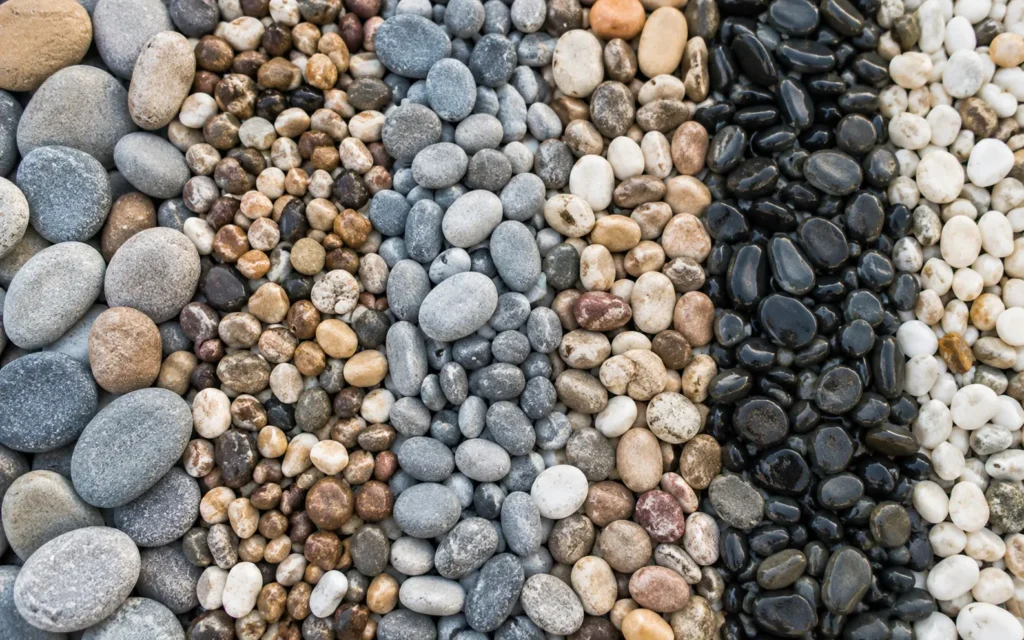
2. Colorado River Rock
Color palette: Charcoal, deep blue-gray, plum, and sage — a cool, sophisticated palette that reads as distinctly “imported” and provides strong contrast against light-colored architecture and plantings.
Texture: Exceptionally smooth, with a high-polish feel that results from the high-velocity mountain stream tumbling Colorado rock undergoes. Among all river rock types, Colorado stone typically has the smoothest surface.
Size range: Available in a range of sizes; often sourced in larger cobble sizes that make a strong visual statement in landscape design.
Best for:
- Modern and contemporary landscape designs where the stone is a primary design element
- Dry creek beds that should read as a dramatic architectural feature rather than a natural drainage channel
- High-contrast garden beds paired with light-colored gravel or decomposed granite
- Commercial entryway features and corporate landscaping
- Pool perimeters where the deep gray-blue creates a striking contrast with water
Why choose Colorado river rock: The color is the primary reason. Colorado river rock’s deep gray, charcoal, and plum tones are not available in Texas-sourced material. For landscape architects and designers specifying a modern, high-contrast, or monochromatic design scheme, Colorado rock delivers a look that regional stone simply cannot replicate. The colors are permanent mineral pigments — they will not fade, bleach, or wash out under Texas UV exposure, and the stones become dramatically more vibrant when wet.
One note: Colorado river rock is a specialty import, which is reflected in the price. For large-volume applications — ground cover across wide beds or extensive dry creek runs — the cost premium over Texas material is significant. Colorado rock is best used as an accent material or for feature areas rather than broad coverage.
3. Arizona River Rock
Color palette: Terracotta red, desert gold, burnt orange, and deep copper — warm, saturated, Southwest-inspired tones driven by high iron-oxide mineral content in the native stone.
Texture: Smooth and rounded from water tumbling, with a surface that catches light differently than gray or neutral stone, giving it a warm glow in direct sunlight.
Size range: Available in a range of sizes suitable for landscape ground cover through larger cobble applications.
Best for:
- Southwestern and desert-inspired landscape designs
- Xeriscape installations featuring cacti, agaves, and succulents — Arizona rock's color palette complements these plants naturally
- Properties with terracotta, adobe, or stucco exteriors where the warm tones create visual continuity
- Dry creek beds designed to evoke the visual of a Sonoran desert wash
- Pool borders and fire pit surrounds where warm color enhances the setting
Why choose Arizona river rock: Color and regional character. Arizona river rock’s warm iron-oxide tones are unavailable in Texas or Colorado material. For a Southwestern design aesthetic — or simply for a warm, golden tone that reads differently than the cool grays of Colorado stone or the neutral tans of Texas rock — Arizona river rock fills a unique visual niche. Like Colorado rock, these colors are natural and UV-stable, remaining vibrant for decades without fading.
4. New Mexico River Rock
Color palette: A transitional blend between the warm tones of Arizona stone and the cooler neutrals of Colorado rock — typically featuring tans, light browns, and warm grays with occasional rusty tones.
Texture: Water-tumbled and smooth, with a slightly less uniform surface than Colorado rock but a similar natural rounded quality.
Best for:
- Designs that need a warmer palette than Colorado stone but more restraint than Arizona rock
- Transitional landscapes that bridge Southwest and natural/organic design styles
- Dry creek beds and drainage features where a varied, natural appearance is the goal
- Landscape beds complementing adobe or natural wood architectural elements
Why choose New Mexico river rock: It occupies the middle ground between Arizona and Colorado stone on the color spectrum. For projects where Arizona river rock feels too intense and Colorado rock reads too cool, New Mexico river rock offers a warm but balanced alternative. Its color variation within a single load also creates a more organic, natural feel than the more uniform character of other imported varieties.
5. Mexican Beach Pebble
Color palette: Matte charcoal gray when dry, transforming into deep, glossy jet-black when wet. This wet-to-dry color shift is a defining characteristic no other river rock type delivers.
Texture: The smoothest of all river rock types. Mexican beach pebbles are tumbled by ocean waves rather than river currents, producing an exceptionally uniform, almost polished surface with virtually no surface variation. The result is architecturally precise — each stone reads as almost identical in texture.
Origin: Unlike the other varieties, Mexican beach pebble is not river-sourced — it’s hand-collected from beaches in Baja California, Mexico. The ocean wave tumbling produces a distinctly different surface character than river-tumbled stone.
Size range: Available in multiple sizes, from small pebbles through larger cobbles, often sorted into tighter size ranges than river varieties.
Best for:
- Modern Zen and minimalist garden designs where visual precision matters
- Pool coping, spa surrounds, and water features where a glossy black surface under water is the design goal
- Indoor planters, atriums, and high-end container gardens
- Architectural dry creek beds where the stone is the focal point, not the background
- Commercial and hospitality landscape installations where premium materials signal brand quality
- High-end residential projects where no other stone achieves the same visual refinement
Why choose Mexican beach pebble: It’s the only true black landscaping stone in this category, and its dramatic wet/dry color shift makes it uniquely dynamic. No quarried, crushed, or river-sourced alternative achieves the same look. Its non-porous volcanic composition means it resists staining from soil, irrigation chemicals, and fertilizers that can discolor lighter stones over time. The tradeoff is cost — hand-sorting and long-distance hauling from Baja make this the most premium-priced option in the river rock category.
One practical caution: the smooth, rounded surface can become slippery when wet. Mexican beach pebble is not a suitable walking surface in areas where traction matters — for high-traffic paths, decomposed granite or pathway fines are the appropriate choices.
Different Types of River Rock for Landscaping: Which One Fits Your Project?
Choosing between river rock types for landscaping comes down to four factors: color palette, budget, application, and the aesthetic story you’re trying to tell. Here’s a direct comparison:
| Type | Color | Aesthetic | Best Landscaping Use | Price Point |
|---|---|---|---|---|
| Texas River Rock | Tan, brown, cream, warm gray | Natural, native, organic | Dry creek beds, xeriscape, drainage | Most affordable |
| Colorado River Rock | Charcoal, blue-gray, plum | Modern, cool, high-contrast | Accent beds, water features, commercial | Premium |
| Arizona River Rock | Terracotta, desert gold, copper | Warm, Southwest, bold | Xeriscape, succulent beds, fire pits | Premium |
| New Mexico River Rock | Tan, warm gray, light rust | Transitional, natural, warm | Drainage, mixed-style beds | Mid-range |
| Mexican Beach Pebble | Charcoal/black (jet-black when wet) | Architectural, minimalist, luxury | Zen gardens, pool coping, water features | Highest |
For Natural, Low-Budget Landscaping
Texas river rock is the answer. It’s locally sourced, widely available, cost-effective for large coverage areas, and its neutral palette works with virtually every Texas landscape style. For mulch replacement across wide beds, dry creek drainage channels, or simple garden borders, Texas river rock delivers strong results at the lowest cost per square foot.
For Modern or Contemporary Designs
Colorado river rock or Mexican beach pebble — the choice depends on application area and budget. Colorado rock is the right call for large accent beds and dry creek features where coverage is needed. Mexican beach pebble is the right call for focal-point features, planters, pool surrounds, or any application where the stone is meant to be noticed individually.
For Southwestern or Desert-Inspired Designs
Arizona river rock is the clear choice. Its iron-oxide-driven color palette is the natural companion to cacti, agaves, ornamental grasses, and drought-tolerant plantings. For xeriscape designs evoking a desert Southwest aesthetic in the Texas heat, no other stone delivers the same visual coherence.
For Drainage-Priority Applications
Any river rock type performs well for drainage because all maintain open void space between rounded particles. For pure drainage function where aesthetics matter less — French drain outlets, foundation perimeter drainage, culvert protection — Texas river rock is the most cost-effective choice. For decorative drainage features where the stone is visible and aesthetics are part of the design, any of the imported varieties upgrades the look without sacrificing function.
River Rock Size and Coverage: What to Know Before You Order
River rock is generally available in three size categories across all varieties:
- Small (3/4" – 2"): Best for tight garden beds, planter topping, and areas where a fine, even surface is the goal
- Medium (2" – 5"): The most versatile range — works for dry creek beds, garden borders, drainage features, and general ground cover
- Large cobble (5" – 10"+): Used for structural dry creek bed anchors, water feature surrounds, and accent boulders in landscape design
Coverage estimate: As a general rule, one ton of river rock covers approximately:
- 2 inches deep: 80–100 square feet
- 3 inches deep: 55–65 square feet
- 4 inches deep: 40–50 square feet
Actual coverage varies by stone size and void content — your supplier can confirm coverage calculations for the specific product and size you’re ordering.
For landscape beds, 3 inches is the recommended minimum depth to fully cover geotextile fabric and provide a substantial, consistent appearance. Thinner applications look sparse and allow fabric to show through as stones settle.
River Rock vs. Other Landscape Materials
River rock is one of several ground cover options for landscaping. Here’s how it compares to the two most common alternatives:
River rock vs. decomposed granite: Decomposed granite compacts to a firm surface and is the right choice for walkways, pathways, and any area where a stable footing matters. River rock does not compact and stays loose — better for drainage beds, borders, and aesthetic ground cover where traffic is minimal.
River rock vs. mulch: Organic mulch decomposes and needs annual replacement, attracts certain insects, and can blow or wash away in heavy weather. River rock is permanent, doesn’t decompose, doesn’t attract pests, and stays in place. The upfront cost is higher, but the long-term value significantly favors river rock for permanent landscape beds.
River rock vs. pea gravel: Pea gravel is smaller (3/8″ – 5/8″) and more uniform than most river rock, making it better for tight garden path surfaces and areas where a finer texture is preferred. River rock’s larger size makes a bolder visual statement and handles erosion control in drainage features better than pea gravel.
Where to Get River Rock in Texas and Oklahoma
Select Sand & Gravel delivers all five river rock varieties — Texas, Colorado, Arizona, New Mexico, and Mexican Beach Pebble — in bulk across the full Texas market and into Oklahoma.
Bulk delivery is available to Dallas, Fort Worth, Austin, Houston, San Antonio, and Oklahoma City. For a full overview of all decorative stone and river rock options, visit the river rock product page or the landscape rock and decorative rock delivery page for delivery area details.
Contact the dispatch team to confirm current availability, discuss the right variety for your project, and get a bulk delivery quote.

