Can You Mix Topsoil and Fill Dirt Together?
Topsoil and fill dirt are two of the most commonly ordered bulk soil materials — and one of the most common practical questions is whether you can combine them. Maybe you have leftover fill dirt on site. Maybe you’re trying to balance cost on a large project. Maybe you’re not sure which one to use and wondering if mixing them is a reasonable middle ground.
The short answer is yes, you can mix them — but whether you should depends entirely on what the mixed material needs to do. Here’s a straightforward breakdown of when mixing works, when it doesn’t, and how to do it right.
What You're Actually Mixing
Before getting into ratios and applications, it helps to understand what these two materials actually are — because the difference between them determines how a blend will behave.
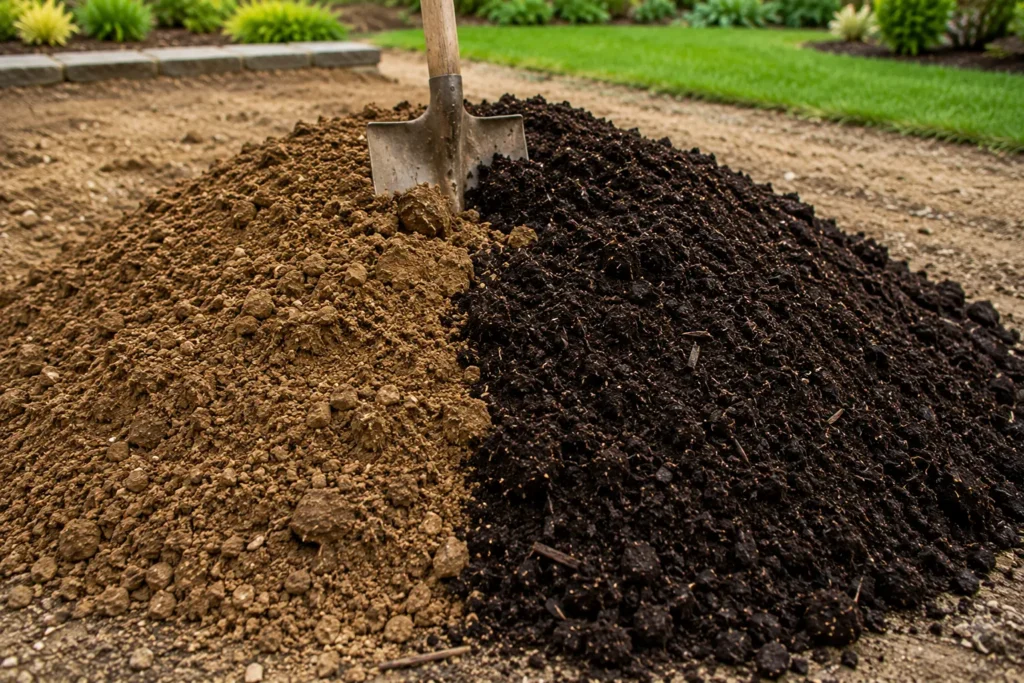
Topsoil is the upper layer of native earth — typically the top 2 to 8 inches — where organic matter, microorganisms, and nutrients are concentrated. It’s the layer plants root into and where most biological soil activity takes place. Quality screened topsoil has a workable, friable texture and supports plant growth. Its organic content makes it lighter, more moisture-retentive, and more biologically active than fill dirt.
Fill dirt comes from deeper in the ground — below the organic-rich topsoil horizon. It’s predominantly mineral: clay, sand, silt, and rock fragments with little to no organic matter. That lack of organic content is actually a feature for structural applications — organic matter decomposes over time and causes settling, which is exactly what you don’t want under a foundation, pad, or grade. Fill dirt is dense, compactable, and stable. It’s not intended to grow things in.
When you mix them, you’re creating a blended material that sits somewhere between the two in terms of drainage, nutrient content, compaction behavior, and biological activity. Whether that blend is useful or problematic depends on the application.
When Mixing Topsoil and Fill Dirt Makes Sense
Building Up Grade Before a Lawn or Landscape Bed
This is the most common and most practical use case for mixing — or more accurately, layering and blending the two materials.
If you need to raise a lawn area significantly — say 6 to 12 inches or more — using pure topsoil for the entire depth is expensive and often unnecessary. The deep base layer doesn’t need to be nutrient-rich topsoil; it just needs to provide stable grade. Fill dirt handles that efficiently. The top 4 to 6 inches, where grass roots will actually live, should be quality screened topsoil.
In practice, this isn’t so much “mixing” as it is a two-layer system: fill dirt brings the area to near-grade, topsoil provides the finish growing layer on top. Tilling the interface between the two layers — working the top few inches of fill dirt into the bottom of the topsoil layer — creates a transition zone that prevents a hard separation line between materials, which can impede root penetration and water movement.
Practical approach:
- Fill to within 4–6 inches of target grade using compacted fill dirt
- Spread 4–6 inches of screened topsoil over the fill
- Till the interface 2–3 inches to blend the transition zone
- Grade to final surface and establish lawn or planting
Filling Raised Beds on a Budget
A raised bed filled entirely with premium garden soil or topsoil can be expensive for large structures — a 4×8 raised bed at 12 inches deep holds approximately 1.2 cubic yards, and multiple beds add up quickly.
A common cost-effective approach is a blended fill: the bottom third to half of the bed filled with a topsoil/fill dirt mix (or topsoil alone), and the top 6–8 inches filled with a richer growing medium — compost-blended topsoil, garden soil, or a purpose-made raised bed mix. The roots of most vegetables and annuals are concentrated in the top 6–8 inches, so the deep fill layer is primarily for volume, not nutrition.
In this application, a 50/50 topsoil and fill dirt blend in the lower portion works reasonably well — the topsoil contributes enough organic matter and structure to support any roots that do reach deeper, while the fill dirt keeps cost down for a layer that doesn’t need high performance.
Important caveat: Don’t use high-clay fill dirt as the deep fill in a raised bed without amendment. Dense clay in the bottom of a contained bed creates a perched water table — water sits on the clay layer rather than draining through, leading to root rot in the planting zone above. If your fill dirt is clay-heavy, either avoid it in raised beds or mix it with coarse sand to improve drainage before use.
Filling Low Spots in an Established Lawn
For filling minor low spots and depressions in an existing lawn — areas that collect water after rain or create uneven mowing surfaces — a light blend of topsoil and screened fill can work adequately for spots up to a few inches deep.
For shallow fills (1–2 inches), pure topsoil is the better choice since the grass roots need to grow through it. For deeper fills (3–6 inches) in a depression, a blended approach works: fill the bottom with a topsoil/fill mix, top with straight screened topsoil for the final inch or two where the grass needs to re-establish.
When You Should NOT Mix Topsoil and Fill Dirt
Under Foundations, Building Pads, or Structural Fills
Never use topsoil — or any material with meaningful organic content — as structural fill beneath a foundation, slab, or load-bearing pad. Organic matter decomposes over time, causing the fill to compress and settle unevenly. That settlement translates directly into foundation movement, slab cracking, and structural problems.
Structural fill should be clean fill dirt or select fill — material with consistent mineral composition, predictable compaction behavior, and no organic content that will break down. Mixing in topsoil defeats the entire purpose of engineered structural fill.
If you have topsoil on a site that needs structural fill, strip and stockpile the topsoil separately, complete the structural fill work, then return topsoil to the surface layer where it belongs.
For Compaction-Dependent Applications
Fill dirt compacts. Topsoil, with its organic content and looser structure, resists compaction and doesn’t achieve the same density under compaction effort. If the application requires a specific compaction standard — a road subgrade, a utility trench backfill, a parking area base — mixing in topsoil reduces compaction performance and can create a soft, unstable layer.
For any application where a proctor compaction standard or density spec matters, use fill dirt or a specified base material without topsoil content.
As a Direct Substitute for Quality Growing Medium
Mixing topsoil and fill dirt doesn’t create a premium growing medium — it dilutes topsoil with a material that has no plant nutrition value and potentially poor drainage. For applications where plant performance is the priority — vegetable gardens, annual flower beds, high-performance lawn establishment — using quality screened topsoil without dilution (or amending with compost rather than fill dirt) produces much better results.
The temptation to stretch topsoil budget by blending in fill dirt is understandable, but for small planting areas where plant performance matters, the cost savings rarely justify the reduced growing quality.
The Right Ratios for Common Blending Applications
When blending is appropriate, the ratio of topsoil to fill dirt affects the performance of the mix:
| Application | Suggested Ratio | Notes |
|---|---|---|
| Lawn grade base (deep fill layer) | 100% fill dirt | No topsoil needed below 6 inches |
| Lawn grade finish layer | 100% screened topsoil | Top 4–6 inches only |
| Raised bed lower fill | 50/50 topsoil to fill | Only if fill is not clay-heavy |
| Lawn low-spot fill (3–6 inch depth) | 60% topsoil / 40% fill | Top inch should be pure topsoil |
| In-ground garden bed amendment | Avoid fill dirt | Use compost to amend topsoil instead |
| Structural fill / foundation | 100% fill dirt | Never add topsoil |
A Practical Note on Texas Fill Dirt and Clay Content
In Texas, fill dirt composition varies considerably by region and source. Fill dirt from the Blackland Prairie areas of DFW and Central Texas tends to be high in expansive clay — the same geology that causes foundation movement across the region. High-clay fill dirt has specific behaviors worth understanding before blending:
It compacts well when dry — which is why it’s used for building pads and structural fills. But it also swells significantly when wet and shrinks when dry, cycling through expansion and contraction with every rain and drought cycle.
Blending high-clay fill dirt into a surface layer for lawn or landscape use on a Texas site can introduce those clay characteristics into the growing zone — reducing drainage, increasing surface compaction after rain, and creating harder, cracked soil surface during dry periods.
For Texas lawn and landscape applications where blending makes sense, screened sandy loam is often a better blending partner than standard fill dirt. Sandy loam’s higher sand fraction improves drainage in the mix and avoids introducing additional clay into a growing zone that may already be fighting Texas clay subgrade beneath it.
Frequently Asked Questions
Will mixing topsoil and fill dirt harm plants? Not directly — but heavy clay fill dirt blended into the growing zone can reduce drainage and create compaction that limits root development. The impact depends on the clay content of your fill dirt and the proportion used. For plants that are sensitive to drainage (most vegetables, many perennials), keep fill dirt out of the active root zone.
Can you till topsoil and fill dirt together after they’re delivered? Yes. If both materials are delivered and spread adjacent to each other, a tiller or rototiller will blend them effectively across the top 6–8 inches. This is a practical approach for establishing the transition zone between a fill dirt base and a topsoil surface layer.
Does fill dirt have any nutrients? Essentially none. Fill dirt is excavated from below the organic horizon and contains no meaningful organic matter, microbial activity, or plant-available nutrients. Any planting zone needs topsoil, compost, or amendment — not fill dirt — as the growing medium.
Is select fill dirt better than common fill dirt for blending? Select fill dirt is a higher-quality, more consistent fill material with better compaction performance and less debris than common fill. For structural applications, select fill is the preferred specification. For blending with topsoil in landscape applications, the difference is less critical — what matters most is the clay content and consistency of whatever fill you’re using.
Can you mix topsoil with sand instead of fill dirt? Yes — and for many Texas applications, mixing screened topsoil with coarse sand is actually a better approach than mixing with fill dirt. Sand improves drainage without introducing clay, creates a more plant-friendly growing medium, and doesn’t compact as severely as clay-heavy fill. A 70/30 topsoil-to-coarse-sand blend is a reasonable DIY growing medium improvement for heavy-clay lawn areas.
The Bottom Line
Mixing topsoil and fill dirt is practical and cost-effective when used in the right context — deep grade building, raised bed volume fill, and layered lawn construction. It’s a problem when organic topsoil content ends up in structural fills that need to compact and stay stable, or when the blend is used as a substitute for quality growing medium where plants actually need the nutrients and drainage that topsoil provides.
The most reliable approach for most projects: use fill dirt for structural depth and grade building, and reserve screened topsoil for the top 4–6 inches where lawns, plants, and landscape beds actually root and perform.

