How Long Does Decomposed Granite Last?
Decomposed granite is one of the most popular natural surfacing materials in Texas and the Southwest — and one of the most common questions before installation is how long it actually holds up.
The honest answer: it depends on which type of DG you’re using, how it was installed, and what your surface has to handle. Loose decomposed granite behaves very differently from stabilized decomposed granite, and the lifespan gap between the two is significant.
Here’s a practical breakdown of what affects DG longevity, what to expect from each type, and what you can do to extend the life of your surface.
The Short Answer
- Loose decomposed granite: Typically lasts 5 to 7 years before it needs meaningful replenishment, though light annual maintenance can stretch this considerably.
- Stabilized decomposed granite: With proper installation and minimal upkeep, a well-built stabilized DG surface can last 15 years or longer before requiring significant remediation.
Neither number is a hard expiration date. DG doesn’t “fail” the way a cracked concrete slab does — it gradually loses material through displacement, erosion, and compaction loss. How quickly that happens depends on the variables below.
What Actually Causes Decomposed Granite to Degrade?
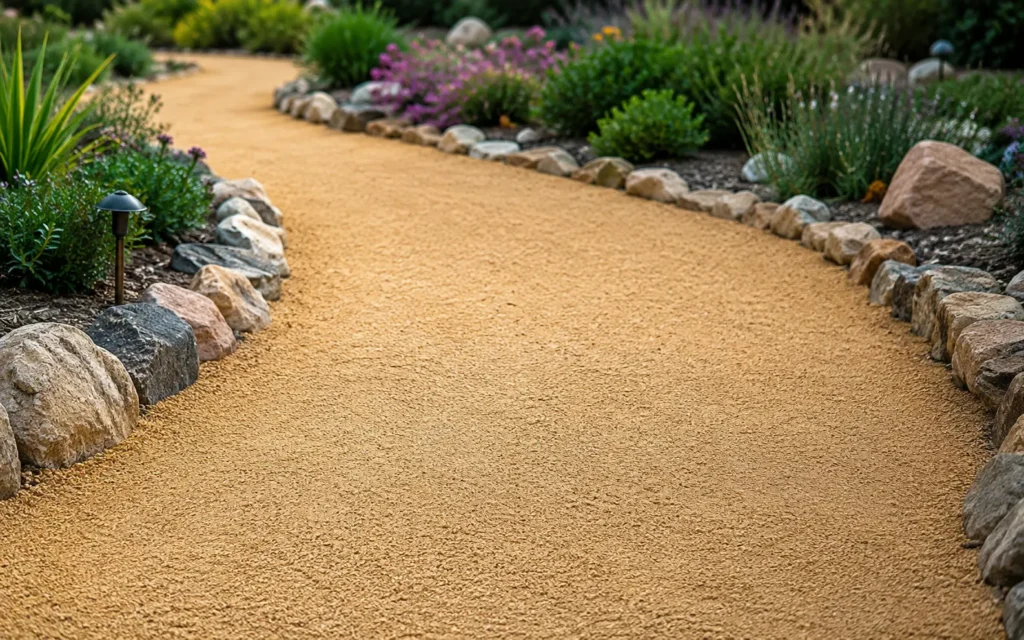
Understanding the degradation process helps you set realistic expectations and make smarter maintenance decisions.
1. Surface Erosion from Rain and Runoff
This is the primary cause of DG loss in Texas and Oklahoma. Heavy rainfall — especially the intense, short-duration storms common across DFW, Houston, and San Antonio — creates sheet flow across the surface that picks up and carries fine granite particles downhill or into drainage areas.
The fines in decomposed granite are what hold the surface together. When they wash away, the remaining coarser particles become loose and uneven, accelerating further erosion. A properly graded installation with contained edges slows this process significantly. An uncontained flat pour on a slope without edging will lose material rapidly.
2. Foot Traffic and Vehicle Load
Foot traffic gradually displaces surface fines, particularly in high-use areas like entry paths, gate approaches, and patio areas around chairs and tables. Vehicle traffic is considerably more aggressive — tires churn and displace material with every pass, particularly during turning maneuvers.
For light residential foot traffic, a 3–4 inch loose DG installation holds up well for years. For driveway applications or areas with any vehicle load, stabilized decomposed granite is the correct specification — the polymer binder locks particles together and resists the displacement that loose DG cannot.
3. Wind Displacement
In open or exposed areas — particularly in West Texas and Oklahoma where wind events are frequent and intense — DG fines are susceptible to wind erosion. This is less of a factor for enclosed courtyard applications or areas with surrounding vegetation, but for exposed open beds, it contributes to gradual material loss.
4. Weed Growth Through the Surface
Weeds don’t degrade DG material itself, but they accelerate surface disruption. Root systems push through the DG layer and break up the compacted surface, creating voids and uneven areas that accelerate erosion and foot traffic wear. A professional-grade geotextile fabric installed beneath the DG during initial installation is the most effective defense against this.
5. Compaction Loss Over Time
A freshly installed and properly compacted DG surface has excellent structural integrity. Over time, the fines redistribute and the surface gradually becomes less firm. In loose DG, this manifests as a softer, more “crunchy” feel underfoot and visible surface irregularities. Stabilized DG resists this far longer because the binder maintains particle cohesion even as weather cycles work on the surface.
Loose DG vs. Stabilized DG: Lifespan Comparison
| Factor | Loose DG | Stabilized DG |
|---|---|---|
| Typical Lifespan | 5–7 years before topping off | 15+ years with basic maintenance |
| Rain Resistance | Moderate — fines wash in heavy rain | High — binder retains fines |
| Vehicle Traffic | Not recommended | Suitable for light vehicles |
| Displacement Resistance | Low on slopes | High on slopes and grades |
| Weed Resistance | Moderate (with fabric) | High (dense cured surface) |
| Dust / Tracking | More noticeable | Significantly reduced |
| Replenishment Needed | Every 2–3 years in high-use areas | Rarely — patch repairs only |
| ADA Compliance | Not typically achievable | Achievable when properly compacted |
| Cost | Lower upfront | Higher upfront, lower long-term |
For residential pathways, xeriscape ground cover, and garden beds with low traffic, loose decomposed granite is a practical, cost-effective choice that holds up well with light annual maintenance. For driveways, commercial pathways, park trails, sloped surfaces, or anywhere ADA accessibility matters, stabilized decomposed granite is the specification that will hold up long-term.
How Installation Quality Affects Longevity
The lifespan figures above assume competent installation. Poor installation can cut those numbers significantly.
Depth matters. For walkways and general ground cover, 2–4 inches of DG is standard. Under 2 inches, the surface loses integrity quickly under any traffic. For driveways, 4–6 inches is the baseline — insufficient depth under vehicle load results in rutting and rapid displacement.
Subgrade preparation matters. DG installed over soft, uneven, or poorly drained subgrade will shift and settle unevenly as the subgrade moves. A firm, graded, and compacted subgrade extends DG life considerably.
Edge containment matters. Without solid edging — metal, concrete, or timber borders — DG material migrates laterally into surrounding areas. Edge containment keeps material in place and dramatically reduces the replenishment frequency.
Geotextile fabric matters. Landscape fabric beneath the DG layer serves two functions: it prevents fines from migrating into the subsoil (which causes the surface to sink and soften), and it suppresses weed growth that would otherwise disrupt the surface from below. This single step has an outsized impact on how long your DG surface holds up.
Maintenance That Extends DG Lifespan
Decomposed granite is often described as low-maintenance — and relative to concrete or pavers, that’s true. But “low-maintenance” is not “no maintenance.” The following routine keeps a DG surface performing well past the typical replacement window.
Annual top-dressing: In high-traffic areas, a light replenishment of fresh DG every 1–2 years replaces lost fines and restores surface density. This is far less disruptive and expensive than a full reinstall.
Raking after heavy rain events: After significant storms, raking the surface redistributes displaced material and prevents permanent low spots from forming. In Texas, doing this after major rain events keeps the surface level and compact.
Spot patching for stabilized DG: When a low spot or worn area develops in a stabilized DG surface, the repair is straightforward — scarify the area, add fresh stabilized material, moisten it, and recompact. The repaired area integrates cleanly with the existing surface.
Weed removal before root establishment: Pulling weeds when they’re young prevents root systems from breaking up the surface structure. Waiting until weeds are established means the roots have already created disruption that accelerates erosion.
Edge maintenance: Periodically checking and re-securing edge containment prevents lateral migration that gradually thins the surface in border areas.
Does Climate Affect How Long DG Lasts in Texas?
Yes — and it’s worth understanding what specific Texas and Oklahoma conditions mean for your DG surface.
Heavy rainfall cycles: Central Texas and Houston in particular see intense rainfall events that create significant runoff. Proper grading (2% minimum slope away from structures) and good edge containment are especially important in these markets. Without them, even a well-installed DG surface loses material fast in a severe storm.
Expansion and contraction from heat: Texas summers are extreme. The thermal cycling from summer heat (regularly 100°F+) to winter cold doesn’t damage DG structurally the way it damages concrete or asphalt, since DG has no rigid matrix to crack. This is actually one of DG’s advantages in Texas — it handles temperature extremes better than hard surfacing.
Clay subgrades: Much of DFW and surrounding areas sit on expansive clay soil that swells when wet and shrinks when dry. This subgrade movement affects every surface above it. Installing DG over a properly prepared, non-expansive base layer mitigates this, but it’s worth discussing with your installer if your site has clay subgrade issues.
How Does DG Compare to Other Landscape Materials for Longevity?
If you’re evaluating decomposed granite against alternatives, here’s a practical lifespan comparison for common landscape surface materials:
| Material | Typical Lifespan | Maintenance Level |
|---|---|---|
| Loose DG | 5–7 years (before top-off) | Low–moderate |
| Stabilized DG | 15+ years | Low |
| Pea Gravel | Indefinite (no degradation, migrates) | Moderate (displacement) |
| River Rock | Indefinite (no degradation) | Low |
| Wood Mulch | 1–3 years | High (annual replacement) |
| Concrete | 25–50 years | Low (but cracks) |
| Asphalt | 15–20 years | Moderate (sealing) |
DG occupies a practical middle ground — it outlasts organic mulch by a wide margin, costs less upfront than concrete or pavers, handles Texas heat better than asphalt, and provides a natural aesthetic that hard surfacing can’t match. Stabilized DG in particular competes well on lifespan with mid-range hard surfacing options.
For purely decorative applications — garden beds, tree wells, accent areas around features — landscape rock or river rock offers indefinite longevity since stone doesn’t degrade. But for functional surfaces that need to be walked on, DG’s compactability is an advantage those materials don’t offer.
Frequently Asked Questions
Does decomposed granite dissolve or break down chemically over time?
No. Granite is an igneous rock with no meaningful chemical reactivity in standard soil and weather conditions. The “degradation” of DG is entirely physical — material displacement and compaction loss — not chemical breakdown. The granite itself is geologically stable.
How do I know when my DG surface needs replenishment?
The visible signs are: surface feels soft or inconsistent underfoot, visible bare patches or low spots, loose coarse particles with no fines holding them together, and areas where the geotextile fabric is becoming visible. Any of these indicate the surface has lost enough fines that a top-dressing is warranted.
Can decomposed granite be reused or recycled?
Yes. Displaced DG that has washed into surrounding areas can be raked back onto the surface, screened if necessary, and recompacted. Because DG is a natural mineral with no binding agent (in the loose version), it doesn’t degrade and can be recovered and reused effectively.
Does the color of decomposed granite fade over time?
The gold and pink tones of Texas DG do mellow slightly with weathering and UV exposure over years. The change is gradual and subtle — more of a patina than a dramatic color shift. Fresh material added during top-dressing will be slightly brighter than the aged surface, but this evens out within a season.
Is decomposed granite good for slopes?
Loose DG on steep slopes (greater than 10–15% grade) will erode quickly. For any meaningful slope, stabilized decomposed granite with a polymer binder is the correct spec. The binder locks particles in place and resists the surface creep and washout that loose DG cannot withstand on a grade.
The Bottom Line
Loose decomposed granite, well-installed and properly maintained, realistically delivers 5–7 years before meaningful replenishment is needed — and with annual top-dressing, that timeline extends further. Stabilized DG, with its polymer binder and higher resistance to erosion and displacement, can hold up 15 years or more with only minor patch repairs along the way.
The largest variables in DG longevity are installation quality, edge containment, subgrade preparation, and traffic load. Get those right, and DG is one of the most cost-effective and durable natural surfacing options available for Texas landscapes.
If you’re planning a DG installation in Texas or Oklahoma, Select Sand & Gravel supplies both decomposed granite and stabilized decomposed granite in bulk, with direct delivery across Dallas, Fort Worth, Austin, Houston, San Antonio, and Oklahoma City. Contact the team to confirm product availability and discuss the right specification for your project.

