How to Stabilize Decomposed Granite: A Complete Guide for Long-Lasting DG Surfaces
Decomposed granite (DG) is a popular landscaping material because it offers the natural beauty of stone while creating a more affordable alternative to concrete, pavers, and asphalt. It is commonly used for pathways, patios, courtyards, garden trails, and even some low-traffic driveways.
However, one common challenge with regular decomposed granite is that it can shift, wash away, become dusty, or develop uneven areas over time—especially in places exposed to rain, foot traffic, or vehicle movement.
This leads many homeowners and contractors to ask: how do you stabilize decomposed granite?
The most effective way to stabilize decomposed granite is by using a stabilizing agent that binds the fine granite particles together, combined with proper base preparation, correct installation depth, moisture control, and compaction. Stabilized DG creates a firmer surface that maintains the natural appearance of decomposed granite while improving durability and reducing maintenance.
What Is Stabilized Decomposed Granite?
Stabilized decomposed granite is regular DG mixed with a binding agent that helps hold the granite particles together after installation.
Standard decomposed granite naturally contains fine particles that allow it to compact, but without additional stabilization, the surface can still move over time. Rain, wind, foot traffic, and erosion can gradually loosen the material.
A stabilizer works by creating a stronger bond between the small granite particles. The result is a surface that feels more solid underfoot while still maintaining the natural stone appearance.
Stabilized decomposed granite is commonly used for:
- Pedestrian pathways
- Garden walkways
- Patios
- Courtyards
- Landscape areas
- Low-traffic outdoor surfaces
It is especially useful where a loose gravel appearance is not desired but a fully paved surface is unnecessary.
Why Does Decomposed Granite Need Stabilization?
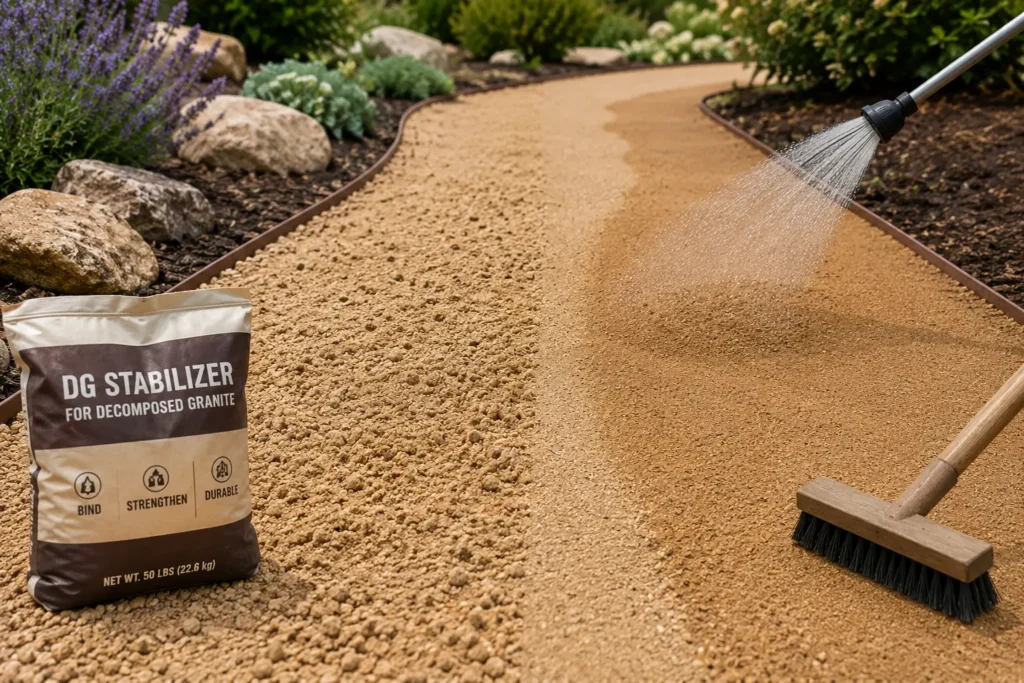
Decomposed granite is naturally compactable, but several factors can cause it to become unstable.
One major issue is water movement. During heavy rain, loose DG particles can wash away, creating low spots and uneven surfaces.
Another issue is foot traffic. On frequently used pathways, repeated walking can loosen the upper layer and create dust or displaced material.
Driveways and sloped areas experience even greater challenges because vehicle weight and water runoff place more stress on the surface.
Stabilizing decomposed granite helps address these problems by improving:
Surface strength: The material holds together better instead of remaining loose.
Erosion resistance: Stabilized DG is less likely to wash away during rainfall.
Maintenance requirements: A stable surface requires fewer repairs and less frequent replenishing.
How to Stabilize Decomposed Granite Properly
Start With Proper Base Preparation
The biggest mistake people make when installing decomposed granite is focusing only on the top layer.
A stabilizer cannot compensate for a weak foundation.
Before installing DG, the area should be properly excavated, graded, and compacted. Loose soil should be removed, and the underlying surface should provide adequate support.
For pathways and patios, many professional installations include a compacted aggregate base beneath the DG layer. Materials such as road base flex base are commonly used because they create a strong foundation that reduces settling and movement.
A stable base allows the stabilized DG surface to perform much better over time.
Choose the Right Type of Stabilizer
There are different types of decomposed granite stabilizers available, and the right choice depends on the application.
Some stabilizers are designed for pedestrian pathways, while others are formulated for higher-use areas.
The stabilizer should be compatible with the DG material and suitable for the expected traffic level.
For example, a garden pathway may only require moderate stabilization, while a patio or frequently used walkway may need a stronger system.
The goal is to create enough bonding strength without making the surface feel artificial or overly rigid.
Mix Stabilizer With Decomposed Granite Correctly
Proper mixing is essential for achieving consistent results.
The stabilizer needs to be evenly distributed throughout the DG material. Uneven mixing can create weak areas where the surface remains loose.
The amount of stabilizer required depends on the product specifications, the type of DG, and the intended use.
Adding too little may not provide enough strength, while adding too much can affect drainage and change the natural appearance of the material.
Following manufacturer recommendations is important for achieving the desired performance.
Install DG at the Correct Depth
The installation depth of decomposed granite depends on how the surface will be used.
For pedestrian pathways, DG is commonly installed several inches deep after proper preparation.
Areas with heavier use may require additional depth and stronger base support.
Installing DG too thin can cause the underlying soil to become exposed quickly, while installing it too thick without proper compaction can create instability.
The depth should match the purpose of the project, not simply the amount of material available.
Compact the Stabilized Decomposed Granite
Compaction is one of the most important steps in stabilizing DG.
After the material is placed and leveled, it should be compacted to help the particles lock together.
A plate compactor is commonly used for larger projects, while smaller areas may be compacted with appropriate hand tools.
The material should usually have the correct moisture level during compaction. Slightly damp DG typically compacts better than completely dry material because moisture helps the particles settle together.
However, excessive water can create problems by making the surface unstable.
Can You Stabilize Existing Decomposed Granite?
Yes, existing DG can sometimes be stabilized, but the success depends on its current condition.
If the existing surface is severely eroded, uneven, or contaminated with weeds and organic material, it may need to be removed and rebuilt.
For DG that is mostly intact, the surface may be regraded, additional material added, mixed with stabilizer, and compacted again.
Simply spraying a stabilizer on top of loose DG usually does not provide the same long-term results because the binding material needs to work throughout the DG layer.
Is Stabilized Decomposed Granite Better Than Regular DG?
For many applications, stabilized DG provides better performance than standard DG.
Regular DG is more affordable and works well for decorative areas, low-traffic landscaping, and projects where occasional maintenance is acceptable.
Stabilized DG is a better option when you want:
- A firmer walking surface
- Reduced dust
- Better resistance to erosion
- Less material movement
However, stabilized DG is not the same as concrete or asphalt. It still maintains the natural characteristics of crushed granite and may require occasional maintenance depending on weather and usage.
Can Stabilized Decomposed Granite Be Used for Driveways?
Stabilized DG can be used for some driveway applications, but it is not suitable for every situation.
A residential driveway with light vehicle traffic may perform well with properly installed stabilized DG and a strong compacted base.
However, areas with frequent heavy vehicles, poor drainage, steep slopes, or weak soil may require stronger materials.
For higher-load driveway applications, materials such as recycled asphalt or crushed concrete may provide better structural performance.
The correct choice depends on traffic conditions and site requirements.
How Long Does Stabilized Decomposed Granite Last?
A properly installed stabilized DG surface can last many years with regular maintenance.
Its lifespan depends on:
- Quality of installation
- Amount of traffic
- Drainage conditions
- Climate
- Maintenance practices
Poor drainage and improper installation are among the biggest reasons stabilized DG surfaces fail prematurely.
A well-prepared base and correct compaction are often more important than the stabilizer itself.
Common Mistakes When Stabilizing Decomposed Granite
One common mistake is installing DG directly over unstable soil without preparing the base.
Another is using the wrong stabilizer or incorrect mixing ratios, which can result in weak bonding.
Some installations also fail because the surface is not compacted properly.
Finally, ignoring drainage can shorten the lifespan of any DG installation. Even stabilized material needs proper water management to perform well.
Final Thoughts
Learning how to stabilize decomposed granite is essential if you want a durable, low-maintenance natural stone surface.
The process involves more than adding a stabilizer. A successful installation requires proper ground preparation, selecting the right stabilization product, installing the correct depth, controlling moisture, and compacting the material properly.
For pathways, patios, and landscape projects, stabilized decomposed granite provides an excellent balance between natural appearance, affordability, and improved durability.
By using quality DG products and following professional installation practices, homeowners and contractors can create attractive outdoor surfaces that remain stable and functional for years. Select Sand & Gravel provides reliable aggregate materials, including decomposed granite products, to support landscaping and construction projects throughout Texas.

