What Is the Best Rock for a Drainage Channel?
A properly designed drainage channel plays an important role in controlling stormwater, preventing erosion, and protecting landscapes, roads, and structures from water damage. One of the most important decisions when building a drainage channel is choosing the right type and size of rock.
So, what is the best rock for a drainage channel?
The best rock for most drainage channels is durable, angular stone such as riprap, crushed limestone, or granite rock, with the ideal size depending on water flow, channel slope, and erosion risk. For many residential drainage applications, 2- to 6-inch rock is commonly used, while channels exposed to heavy water flow may require larger riprap stones.
The right drainage rock should do more than allow water to pass. It should also resist movement, prevent soil erosion, withstand weather conditions, and maintain the shape of the channel over time.
Choosing the wrong material can lead to washed-out channels, clogged drainage paths, and expensive repairs.
Why Rock Is Used in Drainage Channels
Drainage channels experience repeated exposure to moving water. During heavy rainfall, fast-moving water can remove soil, create ruts, and weaken slopes.
Rock helps solve these problems by creating a protective layer between flowing water and the soil beneath.
A properly installed rock drainage channel provides several benefits:
- Reduces soil erosion caused by water flow
- Slows down water velocity
- Protects channel slopes
- Improves long-term drainage performance
- Requires less maintenance compared with exposed soil channels
Unlike concrete-lined channels, rock channels can blend naturally into landscapes while still providing effective erosion control.
What Makes a Good Drainage Channel Rock?
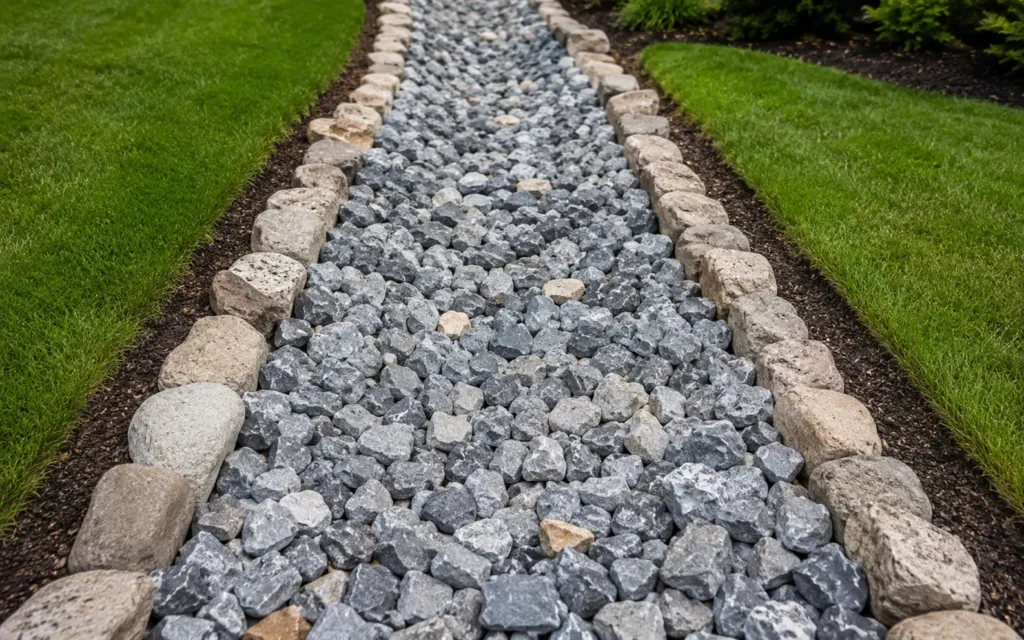
Not every type of rock is suitable for drainage applications. The best drainage rock should have several important characteristics.
Durability
Drainage rock must withstand constant exposure to water, weather changes, and temperature fluctuations.
Soft stones can break down over time, creating sediment buildup and reducing channel effectiveness.
Hard materials such as granite and quality limestone are commonly selected because they maintain their shape and strength for many years.
Angular Shape
Angular rock generally performs better than smooth, rounded stone in drainage channels.
The sharp edges help stones lock together, creating a more stable surface that is less likely to move during heavy water flow.
Rounded river rock may look attractive, but it can shift more easily when exposed to strong currents.
Correct Size
Rock size is one of the most important factors in drainage channel performance.
If the stone is too small, water can easily move it downstream. If it is too large, it may create unnecessary gaps and reduce the channel’s ability to distribute water evenly.
The correct size depends on:
- Water flow speed
- Channel slope
- Drainage area
- Soil conditions
- Expected rainfall intensity
Best Types of Rock for Drainage Channels
Several rock types are commonly used for drainage channels. The best choice depends on whether the project is decorative, residential, or engineered for heavy water control.
Riprap Rock — Best Overall Choice for Erosion Control
Riprap is one of the most widely used materials for drainage channels because it is specifically designed to resist moving water.
Riprap consists of large, durable stones placed along waterways, slopes, and channels to prevent erosion.
It is commonly used for:
- Stormwater channels
- Creek banks
- Culvert outlets
- Sloped drainage areas
- Flood protection projects
Materials such as riprap are available in different sizes, allowing contractors to choose the appropriate stone based on water conditions.
For areas with strong water flow, riprap is usually one of the best choices because the larger stones remain stable under hydraulic pressure.
Crushed Limestone — Best for General Drainage Applications
Crushed limestone is another popular option for drainage projects.
Its angular shape allows the particles to interlock, creating a stable surface while still allowing water movement.
Crushed limestone is commonly used for:
- Residential drainage swales
- French drain systems
- Driveway drainage areas
- Landscape drainage improvements
Products such as crushed limestone are widely used in construction because they provide strength, availability, and dependable performance.
However, the specific limestone size matters. Fine limestone materials may compact tightly and reduce drainage, while larger crushed limestone provides better water movement.
Granite Rock — Best for Long-Term Durability
Granite is one of the hardest natural stones and performs well in demanding drainage environments.
It is highly resistant to weathering and maintains its structure over long periods.
Granite rock is often used for:
- Large drainage channels
- Commercial projects
- Heavy erosion protection
- Areas exposed to frequent flooding
Although granite may cost more in some regions, its durability can make it a good long-term investment.
River Rock — Best for Decorative Drainage Channels
River rock is commonly chosen when appearance is a major consideration.
Its smooth, rounded appearance creates an attractive natural look for landscaping drainage features.
However, river rock is generally better suited for low-flow drainage areas because the rounded stones do not interlock as effectively as angular rock.
For decorative backyard drainage channels or dry creek beds, river rock can be an excellent choice.
For high-flow channels, angular riprap is usually a better option.
What Size Rock Should Be Used in a Drainage Channel?
There is no single rock size that works for every drainage channel.
A general guideline is:
Small Residential Drainage Channels
For shallow landscape drainage channels with moderate water flow:
1 to 3 inch rock may be suitable.
These sizes work well for decorative swales and areas where erosion risk is limited.
Medium Drainage Channels
For more active drainage areas:
3 to 6 inch rock is commonly used.
This size provides better stability while still allowing effective water movement.
Heavy-Duty Drainage Channels
For channels exposed to strong water flow:
6 inches or larger riprap may be required.
Engineered drainage projects often determine rock size based on calculations involving water velocity, slope, and channel dimensions.
Should You Use Gravel or Large Rock for a Drainage Channel?
The choice between gravel and larger rock depends on the purpose of the channel.
Gravel works well for areas where water movement is gentle and filtration is the main goal.
However, gravel can wash away in channels with fast-moving water.
Large angular rock is usually better for erosion protection because it stays in place and absorbs the force of flowing water.
For example, a decorative backyard drainage area may work well with gravel or river rock, while a hillside drainage channel may require riprap.
How to Install Rock in a Drainage Channel
Proper installation is just as important as selecting the correct rock.
A typical rock drainage channel installation involves:
Preparing the Channel
The channel should be shaped to direct water flow properly. Remove loose soil, vegetation, and debris before placing rock.
Adding a Filter Layer
In many installations, a geotextile fabric is placed underneath the rock.
This prevents soil from mixing with the stone while allowing water to pass through.
Placing the Rock
Rock should be distributed evenly across the channel.
For erosion control applications, larger stones are often placed strategically to create stability.
Checking Water Flow
After installation, observe how water moves through the channel during rainfall.
Adjustments may be needed if water begins flowing around the rock rather than through the protected channel.
Common Mistakes When Choosing Drainage Rock
One of the biggest mistakes is choosing rock based only on appearance.
A beautiful decorative stone may not perform well under heavy water flow.
Another mistake is using rock that is too small. Small stones can easily be displaced during storms.
Poor drainage design is another issue. Even the best rock cannot solve problems caused by incorrect grading or insufficient channel capacity.
The rock must be matched to the actual water conditions of the site.
Final Thoughts
So, what is the best rock for a drainage channel?
For most drainage and erosion-control applications, durable angular rock such as riprap, crushed limestone, or granite provides the best performance. The ideal choice depends on water flow, channel size, slope, and whether the goal is drainage, erosion protection, or landscape appearance.
For heavy water movement, riprap is often the preferred solution because it is specifically designed to resist erosion. For residential drainage and landscaping, crushed limestone or appropriately sized river rock may provide excellent results.
A successful drainage channel is not just about choosing a rock type—it requires the correct stone size, proper installation, and understanding of site conditions. Working with an experienced aggregate supplier like Select Sand & Gravel helps ensure you select the right material for a drainage solution that performs reliably for years.
A properly designed drainage channel plays an important role in controlling stormwater, preventing erosion, and protecting landscapes, roads, and structures from water damage. One of the most important decisions when building a drainage channel is choosing the right type and size of rock.
So, what is the best rock for a drainage channel?
The best rock for most drainage channels is durable, angular stone such as riprap, crushed limestone, or granite rock, with the ideal size depending on water flow, channel slope, and erosion risk. For many residential drainage applications, 2- to 6-inch rock is commonly used, while channels exposed to heavy water flow may require larger riprap stones.
The right drainage rock should do more than allow water to pass. It should also resist movement, prevent soil erosion, withstand weather conditions, and maintain the shape of the channel over time.
Choosing the wrong material can lead to washed-out channels, clogged drainage paths, and expensive repairs.
Why Rock Is Used in Drainage Channels
Drainage channels experience repeated exposure to moving water. During heavy rainfall, fast-moving water can remove soil, create ruts, and weaken slopes.
Rock helps solve these problems by creating a protective layer between flowing water and the soil beneath.
A properly installed rock drainage channel provides several benefits:
- Reduces soil erosion caused by water flow
- Slows down water velocity
- Protects channel slopes
- Improves long-term drainage performance
- Requires less maintenance compared with exposed soil channels
Unlike concrete-lined channels, rock channels can blend naturally into landscapes while still providing effective erosion control.
What Makes a Good Drainage Channel Rock?
Not every type of rock is suitable for drainage applications. The best drainage rock should have several important characteristics.
Durability
Drainage rock must withstand constant exposure to water, weather changes, and temperature fluctuations.
Soft stones can break down over time, creating sediment buildup and reducing channel effectiveness.
Hard materials such as granite and quality limestone are commonly selected because they maintain their shape and strength for many years.
Angular Shape
Angular rock generally performs better than smooth, rounded stone in drainage channels.
The sharp edges help stones lock together, creating a more stable surface that is less likely to move during heavy water flow.
Rounded river rock may look attractive, but it can shift more easily when exposed to strong currents.
Correct Size
Rock size is one of the most important factors in drainage channel performance.
If the stone is too small, water can easily move it downstream. If it is too large, it may create unnecessary gaps and reduce the channel’s ability to distribute water evenly.
The correct size depends on:
- Water flow speed
- Channel slope
- Drainage area
- Soil conditions
- Expected rainfall intensity
Best Types of Rock for Drainage Channels
Several rock types are commonly used for drainage channels. The best choice depends on whether the project is decorative, residential, or engineered for heavy water control.
Riprap Rock — Best Overall Choice for Erosion Control
Riprap is one of the most widely used materials for drainage channels because it is specifically designed to resist moving water.
Riprap consists of large, durable stones placed along waterways, slopes, and channels to prevent erosion.
It is commonly used for:
- Stormwater channels
- Creek banks
- Culvert outlets
- Sloped drainage areas
- Flood protection projects
Materials such as riprap are available in different sizes, allowing contractors to choose the appropriate stone based on water conditions.
For areas with strong water flow, riprap is usually one of the best choices because the larger stones remain stable under hydraulic pressure.
Crushed Limestone — Best for General Drainage Applications
Crushed limestone is another popular option for drainage projects.
Its angular shape allows the particles to interlock, creating a stable surface while still allowing water movement.
Crushed limestone is commonly used for:
- Residential drainage swales
- French drain systems
- Driveway drainage areas
- Landscape drainage improvements
Products such as crushed limestone are widely used in construction because they provide strength, availability, and dependable performance.
However, the specific limestone size matters. Fine limestone materials may compact tightly and reduce drainage, while larger crushed limestone provides better water movement.
Granite Rock — Best for Long-Term Durability
Granite is one of the hardest natural stones and performs well in demanding drainage environments.
It is highly resistant to weathering and maintains its structure over long periods.
Granite rock is often used for:
- Large drainage channels
- Commercial projects
- Heavy erosion protection
- Areas exposed to frequent flooding
Although granite may cost more in some regions, its durability can make it a good long-term investment.
River Rock — Best for Decorative Drainage Channels
River rock is commonly chosen when appearance is a major consideration.
Its smooth, rounded appearance creates an attractive natural look for landscaping drainage features.
However, river rock is generally better suited for low-flow drainage areas because the rounded stones do not interlock as effectively as angular rock.
For decorative backyard drainage channels or dry creek beds, river rock can be an excellent choice.
For high-flow channels, angular riprap is usually a better option.
What Size Rock Should Be Used in a Drainage Channel?
There is no single rock size that works for every drainage channel.
A general guideline is:
Small Residential Drainage Channels
For shallow landscape drainage channels with moderate water flow:
1 to 3 inch rock may be suitable.
These sizes work well for decorative swales and areas where erosion risk is limited.
Medium Drainage Channels
For more active drainage areas:
3 to 6 inch rock is commonly used.
This size provides better stability while still allowing effective water movement.
Heavy-Duty Drainage Channels
For channels exposed to strong water flow:
6 inches or larger riprap may be required.
Engineered drainage projects often determine rock size based on calculations involving water velocity, slope, and channel dimensions.
Final Thoughts
So, what size rock is best for a gabion basket?
For most gabion applications, 4 to 8 inch durable, angular rock is the recommended size range because it provides the right combination of stability, drainage, and long-term durability.
However, the ideal stone size depends on the basket mesh opening, project purpose, environmental conditions, and structural requirements.
For retaining walls and erosion control, strong angular materials such as granite, limestone, or riprap are typically preferred. For decorative landscaping, appearance may influence the choice of stone more than structural performance.
Choosing the correct gabion rock and working with an experienced aggregate supplier like Select Sand & Gravel helps ensure your gabion structure remains stable, functional, and visually appealing for years to come.

