What Is Decomposed Granite and How Is It Made?
Decomposed granite shows up on garden paths, patios, driveways, and dog runs across Texas and Oklahoma, usually described simply as “DG” without much explanation of what the material actually is. The name is more literal than most people expect: decomposed granite is granite — the same hard, crystalline rock used for countertops and monuments — that has broken down, through a genuinely geological process, into a mix of coarse sand-sized grains and fine rock dust that can be compacted into a firm, walkable surface.
Understanding how that breakdown happens, and how the material is processed after it’s mined, explains most of what makes DG behave the way it does in a landscaping project — why it compacts the way it does, why particle size and color vary between sources, and why some products are labeled “natural” while others are labeled “stabilized.”
Granite's Journey From Bedrock to Landscaping Material
Granite is an igneous rock, formed from magma that cooled slowly beneath the earth’s surface over long geological timescales. That slow cooling is what gives granite its coarse, visible crystal structure — interlocking grains of quartz, feldspar, and mica that are large enough to see with the naked eye, unlike rock that cooled quickly at the surface.
Over time, granite that’s exposed at or near the surface is subjected to weathering — the combined effect of temperature cycling, water infiltration, freeze-thaw stress, and chemical breakdown acting on the rock over thousands to millions of years. Granite weathers unevenly at the mineral level: feldspar and mica break down chemically faster than the harder quartz crystals, and the differing thermal expansion rates of the different minerals in the rock create internal stress that gradually fractures the crystal boundaries holding the grains together.
The result is exactly what the name describes: granite that has literally decomposed, in place, from a single solid mass into a granular material made up of the same mineral grains that made up the original rock — now loose rather than locked together. Left undisturbed, this weathered granite forms a natural surface layer, sometimes many feet deep, sitting on top of unweathered bedrock. That weathered layer is what gets quarried and processed into the material sold as decomposed granite.
From Quarry to Product: How Raw DG Gets Processed
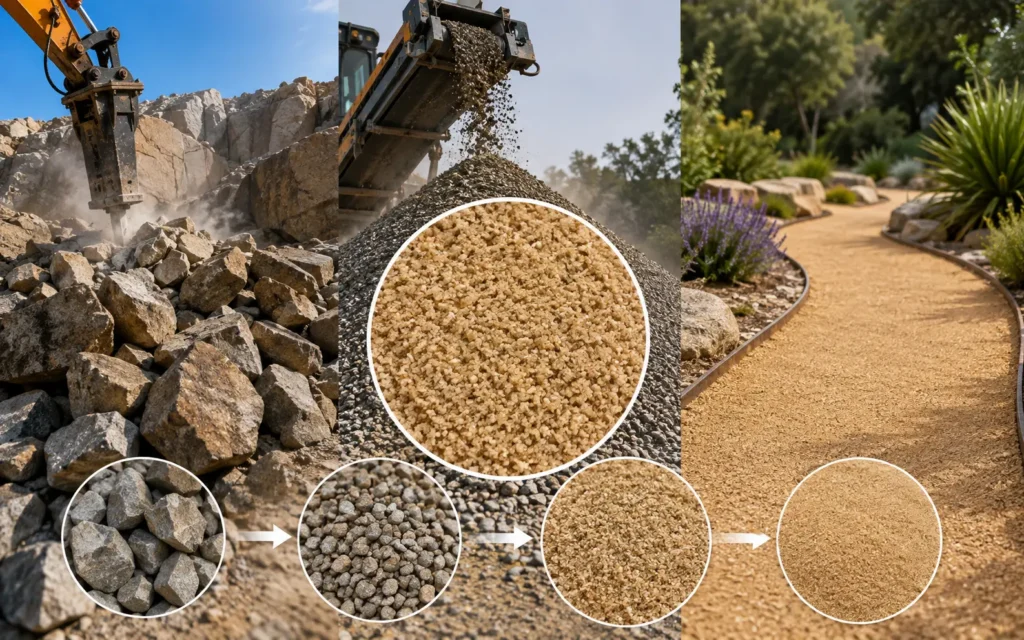
Decomposed granite is typically extracted from quarries where this natural weathering layer is exposed, using excavation equipment rather than the blasting and hard-rock cutting required for solid granite quarrying — the material is already broken down enough that it doesn’t need to be mechanically fractured the way intact bedrock does.
Once extracted, raw DG goes through several processing steps before it’s ready for sale:
Screening. Raw decomposed granite as it comes out of the ground contains a wide range of particle sizes, from fine dust up to larger chunks of partially weathered rock and occasional oversized fragments. Screening passes the material through mesh screens to remove oversized material and sort the remainder into consistent gradations — this is what produces the different product sizes seen in a gravel size chart or product spec sheet, from fine pathway material to coarser decorative aggregate.
Blending. Because natural DG deposits vary in their ratio of fines to coarse particle even within a single quarry, many suppliers blend material from different screening passes to hit a target gradation — enough fine material to compact and bind properly, enough coarse material to resist erosion and provide texture, without either extreme.
Washing (for some products). Certain DG products are washed to reduce excess fine dust content, particularly for applications like drainage aggregate where too much fine material would clog void spaces. Pathway and patio-grade DG, by contrast, generally keeps more of its natural fines content, since that’s what allows it to compact into a firm surface.
Stabilization (optional, added after processing). Natural DG relies on its own fines content and mechanical compaction to hold together once installed. For applications where more binding strength is needed — driveways, sloped surfaces, high-traffic paths — a polymer or resin binder can be mixed into the screened material to produce stabilized decomposed granite, which locks the particles together into a semi-rigid surface that holds up to more traffic and wet-weather cycling than the natural product.
Why Particle Composition Determines Performance
The reason decomposed granite behaves so differently from a material like river rock or crushed limestone comes back to that mineral-level weathering process. DG isn’t uniform crushed stone — it’s a natural blend of fine dust and coarser grains, all originating from the same parent rock, in proportions that vary by deposit and are then refined through screening and blending.
That fines content is what allows DG to be mechanically compacted into a dense, walkable surface the way loose gravel or crushed stone can’t. It’s also why installation quality matters so much for DG specifically — a properly compacted DG surface develops a hard crust that sheds water and resists rutting, while poorly compacted DG stays loose and granular, closer to its unprocessed state.
Why Color and Texture Vary by Source
Decomposed granite color comes directly from the mineral composition of the parent granite it weathered from — the same minerals that give solid granite countertops their range of colors (tan, gold, gray, reddish-brown, and blends of these) produce a similar range in DG, since it’s literally the same rock, just broken down. This is why DG sourced from different quarries or regions can look noticeably different even when graded to the same particle size, and why matching an existing installation sometimes means sourcing from the same original quarry rather than just specifying the same product name.
Natural vs. Stabilized: Two Products From the Same Raw Material
It’s worth being clear that natural and stabilized DG aren’t two different rocks — they’re the same weathered granite material, processed and screened the same way, with stabilized DG simply having a binder added afterward. The choice between them comes down to the application:
| Natural DG | Stabilized DG | |
|---|---|---|
| Composition | Weathered granite fines and coarse grains | Same material, plus polymer/resin binder |
| Binding mechanism | Compaction and natural fines content | Compaction plus chemical binder |
| Best suited for | Garden paths, patios, low-traffic areas | Driveways, slopes, high-traffic or commercial use |
| Relative cost | Lower | Higher |
Common Uses for Decomposed Granite
Once processed, DG’s combination of natural appearance, permeability, and compactability makes it a common choice for:
- Garden paths and walkways
- Patios and outdoor living areas
- Dog runs and pet-friendly surfacing
- Driveways, typically using stabilized product
- Xeriscaping and drought-tolerant landscape design, often paired with other landscaping rock materials for texture and color contrast
- Between-pavers and joint fill material in hardscape installations
The Bottom Line
Decomposed granite is granite in the most literal sense — the same igneous rock, broken down over geological time by weathering rather than mechanical crushing, then screened, blended, and in some cases stabilized to produce a usable landscaping and pathway material. That natural origin is what gives DG its characteristic compactability, its variation in color and texture between sources, and the difference in performance between natural and stabilized products.
Select Sand & Gravel supplies both natural and stabilized decomposed granite sourced from regional quarries across Texas and Oklahoma. Browse the full decomposed granite product line, or contact the team with your project details and they can help match color, gradation, and stabilization to your application.

