What Is the Difference Between Gabion Rock and Riprap?
Gabion rock and riprap get confused constantly, and it’s an easy mix-up to make — both are erosion control materials, both rely on stone rather than concrete, and both show up in the same drainage, slope stabilization, and channel lining projects. Ask for one when a project actually calls for the other, and you’ll either end up with stone that’s the wrong size for the basket mesh, or a loose rock installation that isn’t graded the way an unconfined slope needs it to be.
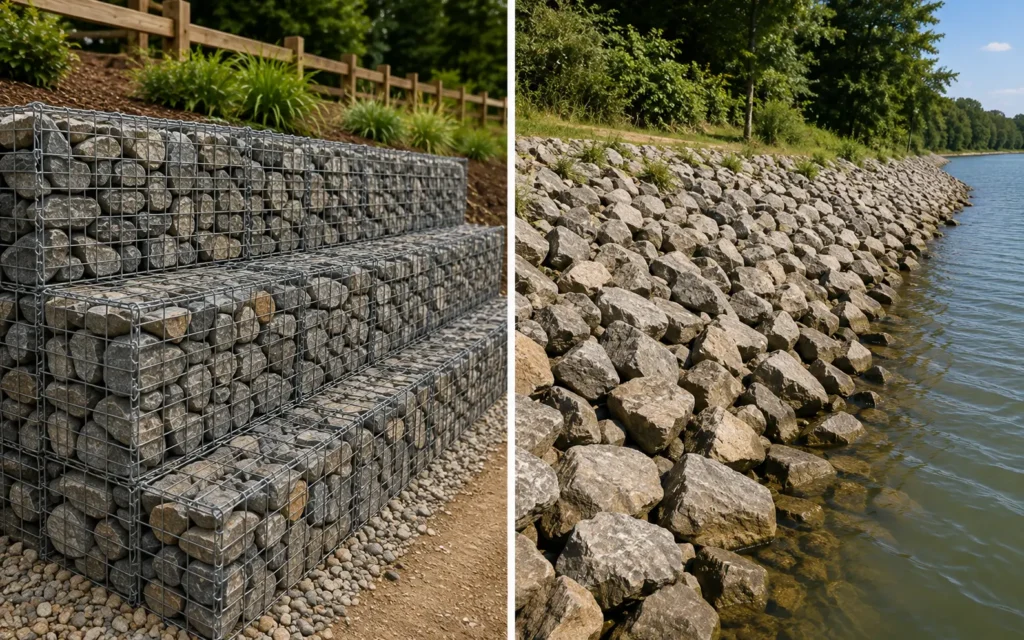
The core difference comes down to containment. Riprap is loose stone, placed directly on a slope or channel and held in place entirely by its own weight and interlock. Gabion rock is stone that goes inside a wire mesh basket, where the cage — not the individual stone — does most of the work of keeping the mass in place. That one distinction drives almost every other difference between the two: how the stone is sized, how it’s graded, what it costs to install, and which projects each one is actually suited for.
The Core Distinction: Confined vs. Unconfined Stone
Riprap is an unconfined system. Each stone has to be heavy and angular enough to resist being displaced by flowing water entirely on its own, relying on friction and interlock with the surrounding stones. There’s no external structure holding the mass together — it’s the stone itself that has to do all the work, which is why riprap sizing is driven so directly by water velocity: the faster the flow, the heavier each individual stone has to be to stay put.
Gabion rock is a confined system. The wire basket carries the structural load of holding the mass together, so the individual stones don’t need to be nearly as large or heavy to resist displacement — the cage prevents movement regardless of whether any single stone, on its own, would hold against the flow. This is what allows gabion structures to use smaller stone than an equivalent riprap installation would need for the same water velocity, and it’s also what allows gabion rock to be stacked into a vertical or near-vertical wall face, something loose riprap simply cannot do on its own.
Sizing: Why the Numbers Are Different
Riprap sizing is driven primarily by design water velocity and secondarily by slope, using size classes like light (4″–8″), medium (8″–12″), heavy (12″–18″), and extra heavy (18″–24″+) depending on the flow conditions. Engineers typically specify a D50 — the median stone size in a graded load — along with a maximum size and allowable percentage of fines, because a well-graded mix interlocks more effectively than uniform stone.
Gabion rock sizing is driven primarily by the mesh opening of the basket, not by water velocity. Fill stone needs to be large enough that it can’t work its way through the mesh, but small enough to pack into the basket with reasonable void reduction — commonly landing in a tighter range around 3 to 5 inches for standard basket mesh, though this varies by basket specification. Because the wire cage is doing the containment work, gabion fill doesn’t need the graded envelope riprap does; consistent, well-sorted stone within the target range actually produces a more stable, evenly packed basket than a wide size spread would.
| Riprap | Gabion Rock | |
|---|---|---|
| Containment | None — loose placement | Wire mesh basket |
| Primary sizing driver | Water velocity and slope | Basket mesh opening |
| Typical size range | 4"–24"+ depending on class | Roughly 3"–5", sized to mesh |
| Gradation | Graded mix (D50 + max size + fines %) | Tighter, more uniform sizing |
| Shape requirement | Angular, interlocking | Angular preferred, less critical than riprap |
Installation: What Actually Goes Into the Ground
A riprap installation is placed directly on a prepared slope or channel bed, typically over a geotextile filter fabric layer that keeps underlying soil from migrating up through the voids in the stone. Layer thickness generally runs 1.5 to 2 times the D50 stone size. Beyond the fabric and the placement itself, there’s no additional structural component — the stone is the finished installation.
A gabion rock installation involves assembling and lacing wire baskets, installing internal cross-tie bracing on anything taller than about a foot to keep the wire faces from bulging under fill pressure, hand- or machine-filling the baskets, and lacing the lids closed — with filter fabric and drainage backfill behind the basket line on any wall application. It’s a more labor-intensive build with more steps and more component parts (wire, lacing, bracing) beyond the stone itself, but the result can do something riprap can’t: stand as a near-vertical retaining structure rather than lying across a slope.
What Each One Is Actually Used For
Riprap is the right call when the goal is armoring a surface against moving water — a slope, a channel bottom, a culvert outlet, a shoreline — without changing the surface’s grade or geometry. It follows the existing slope rather than replacing it. Typical applications:
- Culvert outlet aprons and channel lining
- Slope stabilization on grades up to about 2:1 (steeper slopes generally need something other than loose riprap)
- Shoreline and pond edge protection against wave action
- Bridge abutment and pier scour protection
Gabion rock is the right call when the project needs to hold back soil, retain a grade change, or build a near-vertical structure — situations where loose stone physically can’t stay in place on its own. Typical applications:
- Retaining walls, including on soft or uneven subgrade where a rigid concrete wall would be more likely to crack
- Steep slope stabilization beyond what loose riprap can hold — gabion terracing is a common alternative on 2:1 or steeper grades
- Channel walls and lining in high-velocity applications where loose stone would be undersized without going to armor-stone scale
- Sound barriers, erosion-control check dams, and other structures needing a defined vertical or stepped face
A useful way to think about it: riprap protects a surface, gabion rock builds a structure. If the project needs the stone to lie across an existing slope and resist the water moving over it, that’s riprap. If the project needs the stone to hold a defined shape and retain material behind it, that’s gabion.
Cost and Labor Comparison
Riprap is generally the lower-cost option per ton delivered and placed, since installation is largely a placement and grading operation once the fabric is down — no baskets, wire, or lacing labor involved. It’s also faster to install at scale, since large volumes of stone can be placed and spread with an excavator rather than hand-packed into baskets.
Gabion rock installations cost more per square foot of coverage, both in material (baskets, lacing wire, cross-ties in addition to the stone) and labor (basket assembly and hand-filling take considerably more time than spreading loose stone). That added cost buys a structure that can do things riprap can’t — retain a vertical cut, stand as a wall rather than a slope covering, and hold steeper grade changes than loose stone can manage on its own.
| Riprap | Gabion Rock | |
|---|---|---|
| Relative material cost | Lower per ton | Higher (stone + baskets + wire) |
| Relative labor cost | Lower — placement and grading | Higher — basket assembly and hand-fill |
| Installation speed | Faster at scale | Slower, more labor-intensive |
| Structural capability | Slope/surface armor only | Can retain soil, build vertical faces |
Can They Be Used Together?
Yes, and on some projects they are. A common configuration pairs a gabion retaining wall with riprap placed at its toe or along an adjacent channel — the gabion wall handles the vertical grade change and soil retention, while riprap manages water velocity and scour at the base of the wall or along the channel it faces. Neither material is a substitute for the other in that setup; they’re solving two different problems in the same location.
Which One Does Your Project Need?
If the goal is protecting an existing slope, channel, or shoreline from water velocity without changing its grade, riprap is almost always the right and more economical choice. If the goal is retaining soil, holding a cut, or building a structure that stands up rather than lies down — especially on soft subgrade or where a concrete wall isn’t practical — gabion rock is the answer.
For projects that fall in between — steep slopes, high-velocity channels near the practical limit of loose riprap, or sites where soil conditions make a rigid wall risky — it’s worth a conversation with a civil or geotechnical engineer before ordering material, since the wrong choice at that boundary is expensive to correct after the fact.
Select Sand & Gravel supplies both gabion rock and riprap across Texas and Oklahoma, sourced from regional quarries and delivered direct to your site. Contact the team with your project details — slope, water velocity, and whether you’re protecting a surface or retaining one — and they can help confirm which material, and which size class, fits the application.

