How Much Does a Ton of Crushed Limestone Cost?
If you’ve ever tried to budget a driveway, a base layer, or a commercial sitework job in Texas or Oklahoma, you already know the frustration: you ask around for a crushed limestone price, and nobody gives you the same number twice. One supplier quotes by the ton, another by the yard, and the price swings by $10 or more depending on who you call and where the job is.
That’s not a scam — it’s just how aggregate pricing works. Crushed limestone is one of the most widely ordered materials in the region, and its cost depends on several variables that shift from job to job. Understanding what drives the number is the only way to budget accurately and avoid getting caught short on either the material or the money.
At Select Sand & Gravel, we’ve been sourcing and delivering crushed limestone to contractors and homeowners across Texas and Oklahoma since the early 1980s. This guide breaks down what limestone actually costs, what moves the price up or down, and how to calculate what your specific project needs before you pick up the phone.
What Does Crushed Limestone Cost Per Ton?
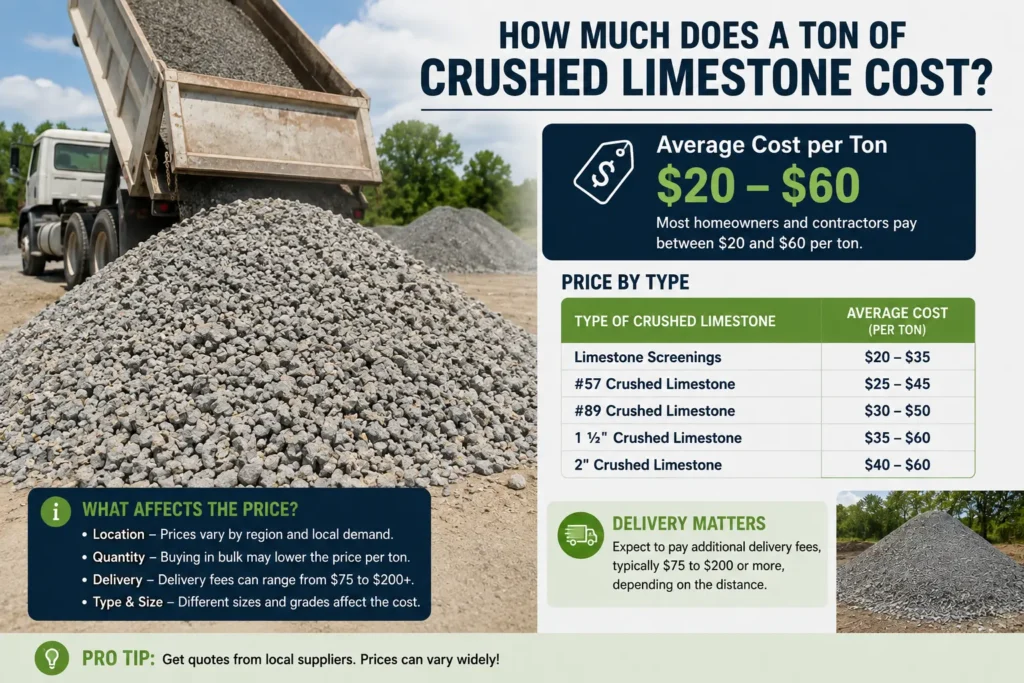
For material only — before delivery — crushed limestone in Texas and Oklahoma generally runs somewhere between $12 and $35 per ton, depending on the grade, the quarry, and current market conditions.
That’s a wide range, and it’s intentional. A ton of #57 limestone for a residential drainage project is a very different product from a ton of 3×5 gabion rock going into a commercial retaining wall. Finer, more precisely screened grades cost more to produce. Clean, washed material costs more than crusher run. TxDOT-spec flex base carries a slight premium over commodity road base because it requires approved quarry sourcing and verified gradation.
The delivered price is what matters. Material cost and haul cost are two separate line items, and depending on how far the quarry is from your job site, freight can equal or exceed the material cost on smaller orders. Always get a delivered quote for your specific address — not a general “price per ton” from the web.
Factors That Move the Price
1. The Size and Grade You're Ordering
Crushed limestone is not one product. It’s a category with a range of sizes and specs, each produced differently and priced accordingly:
- #57 Limestone (3/4") — the most widely ordered grade in Texas. Used for driveways, drainage, and under concrete slabs. Broadly available from quarries across the state, which keeps pricing competitive. This is what went into Globe Life Field (9,000 tons) and the Samsung Semiconductor Plant (23,000 tons) — both jobs Select Sand & Gravel supplied.
- Road Base / Flex Base — a crushed limestone blend that includes fines (stone dust), engineered to compact tightly. Typically lower cost per ton than clean #57, but used in much higher volumes. Flex Base to TxDOT Item 247 spec carries a slight premium because it requires an approved quarry source.
- Gabion Rock (3×5" or 4×8") — larger, angular pieces used in gabion baskets and retaining structures. Less common than #57, sometimes priced higher depending on sourcing.
- Crushed Limestone Sand — the fine byproduct of the crushing process, used as a compactable base for pavers, arena footing, and precision grading. Pricing varies by quarry and availability.
The grade you specify affects both the material price and which quarries can supply it. That’s one reason multi-pit sourcing matters — when you’re not tied to one source, you can match the order to the most competitive quarry for that specific grade.
2. Delivery Distance
Trucking cost is calculated by the mile, and limestone quarries are not evenly distributed across Texas and Oklahoma. A project near a major quarry corridor (central Texas Hill Country, the DFW area) will have a lower delivered cost than the same order hauled to an outlying job site in Oklahoma City or the Gulf Coast.
This is why your supplier needs your job site address, not just your city, before they can give you a real number. Freight adds real dollars per ton, and it varies significantly by location.
3. How Much You're Ordering
Volume pricing is standard in the aggregate industry. A 10-ton residential order costs more per ton than a 500-ton commercial order — that’s just how bulk purchasing works. The larger contractors who run high-volume commercial projects through Select Sand & Gravel benefit from pit-direct pricing that’s genuinely different from what you’d get ordering a few yards at a time from a retail supplier.
If you’re a smaller contractor who doesn’t run huge volume on any single job, sourcing through a supplier who buys at scale — and passes that advantage to you — can close the gap.
4. Market Conditions and Fuel
Diesel is the backbone of every aggregate delivery, and fuel cost fluctuations flow directly into haul pricing. Beyond fuel, regional quarry output, seasonal construction demand, and weather-related disruptions all affect availability and price. Spring and fall are the heaviest construction seasons in Texas, and tight supply during those periods can push prices up. If your project has flexibility, locking in a price early is worth considering on large-volume orders.
5. Clean Stone vs. Crusher Run
“Clean” crushed limestone — washed, screened to a consistent size, with fines removed — costs more to produce than crusher run or base blends where fines remain in the material. For applications that require drainage (a pipe bedding layer, a French drain, a foundation perimeter drain), clean stone is often the right call regardless of price. For structural base applications where you want the fines to bind the material into a dense layer, crusher run or road base is often the better product and the lower cost.
Cubic Yards vs. Tons: The Conversion You Need
Most suppliers in Texas price crushed limestone by the ton. Many homeowners and some contractors think in cubic yards. Here’s the conversion:
- 1 cubic yard of crushed limestone ≈ 1.5 tons (range: 1.4–1.6, depending on size and moisture)
- 1 ton of crushed limestone ≈ 0.67 cubic yards
When limestone includes fines — as road base does — it’s denser, and the weight per yard runs toward the higher end of that range. Clean #57 limestone, which has more void space between the angular pieces, sits closer to 1.4 tons per yard.
The existing post on this site How Much Does a Yard of Crushed Stone Weigh?, covers the weight variables in more detail if you need to work through the physics of it.
How Much Crushed Limestone Does Your Project Need?
Before you call for a quote, having a rough quantity in hand speeds everything up. Here’s the formula:
Step 1: Length (ft) × Width (ft) = Square feet
Step 2: Depth (inches) ÷ 12 = Depth in feet
Step 3: Square feet × Depth in feet ÷ 27 = Cubic yards
Step 4: Cubic yards × 1.5 = Tons
Step 5: Tons × 1.10 = Order quantity (adds 10% for compaction and edge waste)
Example — A standard driveway (50 ft × 12 ft, 4-inch depth):
- 50 × 12 = 600 sq ft
- 4 ÷ 12 = 0.33 ft
- 600 × 0.33 ÷ 27 = 7.3 cubic yards
- 7.3 × 1.5 = 10.9 tons
- 10.9 × 1.10 = 12 tons to order
For a project like the Ed Bluestein Blvd Tollway expansion in Austin — which required 25,000 tons of limestone across multiple phases — the math obviously scales, but the formula is the same.
How Crushed Limestone Compares to Other Base Materials
If you’re weighing your options before committing to limestone, here’s a brief comparison to the other base materials commonly used in Texas and Oklahoma:
Crushed Limestone vs. Recycled Asphalt Recycled asphalt is typically less expensive per ton and can self-bind in hot weather. For low-traffic rural driveways, it’s a reasonable option. But it softens in extreme Texas summer heat and doesn’t perform as well as limestone for applications requiring a firm, stable base.
Crushed Limestone vs. Crushed Concrete Crushed concrete is often slightly less expensive and is a legitimate alternative for road base and construction entrance applications. The tradeoff is aesthetics — recycled concrete is gray and inconsistent-looking — and in some cases the presence of reinforcing steel fragments requires more careful screening. For functional, non-visible base work, crushed concrete is worth comparing. See Crushed Limestone vs. Crushed Concrete for a full breakdown.
Crushed Limestone vs. Road Base/Flex Base Road base is crushed limestone — just in a different gradation. When compaction density and load distribution matter (driveways, pads, commercial base), road base is the right call. When drainage matters more than compaction (perimeter drains, pipe bedding), clean #57 limestone is the better fit.
Crushed Limestone vs. Pea Gravel Pea gravel costs more per ton, is smooth and rounded (doesn’t interlock), and is used for drainage and decorative applications rather than structural base work. It’s not a substitute for crushed limestone in any base or structural application.
Getting an Accurate Quote
When you call a supplier for crushed limestone pricing, have this information ready:
- Job site address — this is what determines freight cost, not just your city
- Grade or size — #57, road base, gabion, crushed limestone sand, or whatever your spec or project requires
- Quantity — estimated tons or cubic yards (use the formula above)
- Delivery window — when the material needs to be on site and how many loads, if spread over time
At Select Sand & Gravel, someone answers when you call. We source from multiple pits across Texas and Oklahoma, which means we can compare pricing across quarries in real time and route your order to the most competitive source for your specific delivery location. That’s different from calling a single-pit supplier, who can only quote what their one yard has — at whatever price they’re running that day.
We’ve supplied projects ranging from 5,000 tons of pea gravel at the Facebook Data Center in Fort Worth to 25,000 tons of limestone for the Ed Bluestein Blvd corridor in Austin. The scale changes; the way we work doesn’t.
Why Prices Vary Between Suppliers
A single-pit quarry can only quote what it has, at the cost it carries. A logistics broker with no pit relationships quotes retail and adds margin. Select Sand & Gravel sits between those — we buy direct from multiple quarry sources at volume, which means we’re often more competitive than vertically integrated suppliers who mark up from retail.
As an employee-owned company since 2022, every dispatcher and driver has a stake in how your order goes. That’s not marketing language; it changes how people behave when a delivery gets complicated or a schedule shifts.
Frequently Asked Questions
How much does crushed limestone cost per ton in Texas?
Material-only pricing typically runs between $12 and $35 per ton depending on the grade ordered, the quarry source, and current market conditions. Delivered cost — which includes freight to your job site — is a separate line item and can add significantly to the total, especially for sites farther from major quarry corridors. Always get a delivered quote for your specific address.
Is crushed limestone sold by the ton or by the yard?
Most Texas and Oklahoma suppliers price crushed limestone by the ton. Some quotes by the cubic yard. One cubic yard of crushed limestone weighs approximately 1.5 tons, so converting between the two is straightforward. When comparing quotes from different suppliers, confirm whether the price is per ton or per yard before drawing conclusions.
What is #57 limestone and how much does it cost?
#57 limestone is 3/4-inch crushed limestone — the most common grade used for residential and commercial driveways, drainage layers, and as a sub-base under concrete slabs. It’s broadly available from quarries across Texas, which keeps pricing competitive relative to specialty grades. It’s the material Select Sand & Gravel supplied for Globe Life Field and the Samsung Semiconductor Plant, among many other projects.
Can delivery cost more than the material itself?
On small residential orders in areas far from a quarry, yes — delivery can approach or exceed the material cost. On large commercial orders, delivery becomes a smaller percentage of the total. This is why specifying your job site address when requesting a quote matters: the delivered price is what you actually pay.
Can I pick up crushed limestone myself instead of paying for delivery?
Some quarries allow customer pickup, but a cubic yard of crushed limestone weighs approximately 1.5 tons — well beyond the safe payload of a standard half-ton pickup. For any meaningful quantity, professional delivery is the practical option. Tandem dump trucks carry 14–16 tons per load; end-dump trailers handle 20–25 tons. Trying to make multiple pickup trips in a personal truck is both unsafe and, once you add fuel and time, often more expensive than a delivered order.
Does crushed limestone pricing change seasonally?
Yes. Texas peak construction seasons — typically spring and fall — drive higher demand for base materials, which can tighten supply and push prices up. For large-volume jobs, locking in pricing ahead of the construction window is worth the conversation with your supplier.
What’s the difference in cost between #57 limestone and road base?
Road base (crusher run) typically costs less per ton than clean #57 limestone because it requires less processing — the fines stay in the material rather than being screened out. The tradeoff is that the road base is a compaction material, not a drainage material. If your project needs drainage, #57 is the right product regardless of the price difference.
How do I know if I need #57 limestone or road base for my project?
The simplest guide: if you need drainage, use #57 (clean, open-grade stone that water moves through). If you need a compacted structural base for a driveway, slab, or pad, use road base (limestone with fines that bind under compaction). If you’re not sure, describe the project when you call — the team at Select Sand & Gravel will tell you which product fits.
Final Thoughts
Crushed limestone generally runs $12–$35 per ton for the material alone, with delivery cost on top depending on distance and volume. The grade, your location relative to the quarry, and how much you’re ordering are the three biggest variables. Getting a delivered quote — not just a materials price — from a supplier who sources from multiple pits is the most reliable way to build an accurate number into your bid.

