What Is the Difference Between #57 Stone and #67 Stone?
If you’ve ever requested a quote for drainage aggregate, concrete mix, or pipe bedding and been asked “do you want #57 or #67?” — you’re not alone in wondering whether the answer actually matters.
Both are clean, open-graded crushed stone sizes defined by ASTM C33. Both are widely available as crushed limestone in Texas and Oklahoma. And both are used in drainage, concrete, and utility work. But the difference between them is real, and choosing the wrong one for your application can affect drainage performance, concrete workability, and long-term project outcomes.
Here’s exactly what separates #57 stone from #67 stone — and how to know which one your project needs.
The Short Answer
#57 stone is larger — its dominant particle size is 3/4 inch, with a gradation range from 1 inch down to the No. 4 sieve (approximately 0.187 inches).
#67 stone is slightly smaller — its dominant particle size is closer to 1/2 inch, with a gradation range from 3/4 inch down to the No. 4 sieve.
That size difference — roughly 1/4 inch in dominant particle — is what drives every practical distinction between them.
ASTM C33 Gradation Specs: Side by Side
Both sizes fall under ASTM C33, the standard specification for concrete aggregates, which also governs how stone is sized and graded across construction applications broadly.
| Property | #57 Stone | #67 Stone |
|---|---|---|
| ASTM C33 Size Number | No. 57 | No. 67 |
| Nominal Maximum Size | 1 inch | 3/4 inch |
| Dominant Particle Size | ~3/4 inch | ~1/2 inch |
| Gradation Range | 1" down to No. 4 sieve | 3/4" down to No. 4 sieve |
| Void Content (approx.) | 38–42% | 35–38% |
| Fines Content | None (clean) | None (clean) |
| Drainage Rate | Higher | Slightly lower |
Both materials are “clean” — meaning fines, dust, and screenings have been removed through screening or washing. This is what gives them their drainage properties. Neither should be confused with road base or flex base, which intentionally contain fines for compaction.
How the Size Difference Affects Performance
Void Space and Drainage
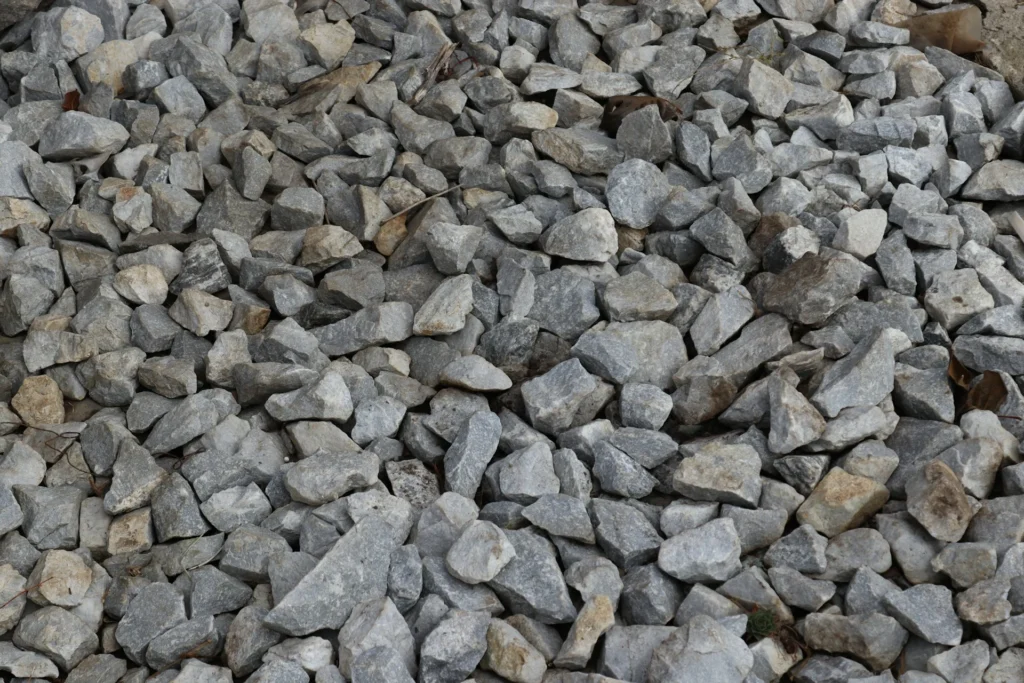
The larger the stone, the larger the voids between particles. #57 stone, with its slightly larger dominant particle, creates a more open matrix — roughly 38–42% void space versus 35–38% for #67.
In practice, this means #57 drains marginally faster and handles higher water volumes more efficiently. For a residential French drain or retaining wall backfill, the difference is rarely decisive. For a large commercial drainage system or a high-inflow area where water volume is significant, #57’s greater permeability is worth specifying.
Concrete Workability
In concrete mix design, aggregate size directly affects how the mix moves and finishes. #67 stone, being slightly smaller, produces a more workable mix — it’s easier to pump, places more smoothly, and finishes with less surface roughness. This makes it the preferred choice for:
Pumped concrete (slabs, walls poured via concrete pump)
Architectural or decorative concrete where surface finish matters
Thinner slabs where larger aggregate would create bridging problems
#57 stone is used in standard structural mixes — footings, thick slabs, mass concrete — where workability is less critical and compressive strength is the priority.
Pipe Bedding and Trench Work
Both sizes are used for pipe bedding, but the choice often comes down to pipe diameter and trench width. #67’s smaller particles flow more easily around smaller-diameter pipes and into narrow trenches, making it slightly easier to work with in tight utility corridors. #57 is the standard for larger-diameter pipes and wider trenches where the extra drainage capacity is beneficial.
Many Texas municipal specifications call out either size interchangeably for utility bedding, so always check the project spec sheet before ordering.
When to Use #57 Stone
Choose #57 stone when:
- Drainage performance is the priority. French drains, retaining wall backfill, foundation drainage, and culvert outlet protection all benefit from #57’s larger void structure.
- You’re working with a standard structural concrete mix. #57 is the workhorse aggregate for footings, non-pumped slabs, and general concrete work.
- The application involves high inflow or heavy precipitation. The larger void space handles storm events and high-volume groundwater more effectively.
- Pipe diameter is 4 inches or larger. The stone flows well around standard drainage pipe without bridging.
In the DFW, Austin, Houston, and San Antonio markets, #57 crushed limestone is the default drainage spec for most residential and commercial contractors — it’s what most quarries stock in the largest volume, and it’s what most engineers default to when drainage is the goal.
When to Use #67 Stone
Choose #67 stone when:
- You’re specifying concrete that will be pumped. Smaller aggregate travels through pump lines more reliably and with less risk of blockage.
- The concrete pour involves thin sections or dense rebar. Smaller stone navigates congested reinforcement more easily.
- The trench or application space is narrow. #67 fills tightly around smaller pipes and in restricted spaces.
- Your engineer or DOT spec explicitly calls for it. Some state highway and municipal infrastructure projects specify #67 for concrete work. Always follow the written spec.
For drainage applications specifically, the performance gap between #57 and #67 is narrow enough that either will work in most residential scenarios. If you can only get one or the other from your supplier, either will function acceptably in a standard French drain.
Can You Substitute One for the Other?
In many residential applications — yes, in practice. But before substituting, consider two things:
Is there a written specification? If a civil engineer, architect, or municipality has specified one size, substituting the other without written approval is a contract and liability risk. Get approval in writing.
What does the application demand? If drainage performance is critical or you’re working with pumped concrete, the specific size was likely chosen for a reason. Honor the spec.
For general contractor and homeowner projects without a formal spec, #57 and #67 are functionally interchangeable in most drainage and surface applications. The half-inch size difference rarely produces a noticeable outcome difference in a residential French drain or backfill scenario.
What About #57 vs. Other Common Sizes?
For full context, here’s how both sizes fit within the broader ASTM gradation system:
| ASTM Size | Dominant Particle | Best For |
|---|---|---|
| #4 | 1.5 inches | Heavy drainage, large rip rap base courses |
| #57 | 3/4 inch | French drains, structural concrete, pipe bedding |
| #67 | 1/2 inch | Pumped concrete, narrow trenches, fine drainage |
| #89 | 3/8 inch | Permeable pavement, fine drainage layers |
| #10 (screenings) | Fines | Compaction base filler, joint stabilization |
If you want a broader look at how aggregate sizes map to common construction applications, the gravel size chart covers the full range from pea gravel through large riprap.
What Rock Type Is Used for #57 and #67 in Texas?
In Texas and Oklahoma, both #57 and #67 stone are produced almost exclusively from crushed limestone. The state sits on abundant Cretaceous-era limestone deposits that are quarried regionally, crushed to ASTM gradations, and screened clean. The result is an angular, high-friction aggregate with good compressive strength and consistent gradation.
Crushed granite is occasionally available as an alternative, but limestone dominates the Texas aggregate market for cost and availability reasons. When you order #57 or #67 from a Texas supplier, you’re almost certainly getting crushed limestone unless you specify otherwise.
Estimating How Much You Need
Both sizes follow the same weight-to-volume relationship for crushed limestone:
1 cubic yard ≈ 1.4 to 1.5 tons
1 ton ≈ 0.65 to 0.7 cubic yards
Use this formula to estimate volume:
Volume (cubic yards) = Length (ft) × Width (ft) × Depth (ft) ÷ 27
Then multiply cubic yards by 1.4–1.5 to get tons.
Example: A French drain trench 80 feet long, 18 inches wide, and 24 inches deep:
80 × 1.5 × 2 ÷ 27 = 8.9 cubic yards
8.9 × 1.4 = approximately 12.5 tons
Summary
The difference between #57 stone and #67 stone comes down to roughly a quarter-inch in dominant particle size — but that difference determines drainage rate, concrete workability, and how well the material behaves in tight trench conditions.
#57 is the larger, higher-drainage option — the default for French drains, retaining wall backfill, and standard structural concrete in Texas.
#67 is the slightly smaller option — preferred for pumped concrete, narrow utility trenches, and applications where a tighter gradation is beneficial.
If you’re sourcing either material in bulk for a project in Texas or Oklahoma, Select Sand & Gravel supplies crushed limestone in the gradations your project requires, with bulk hauling direct from regional quarries. For questions on sizing or spec confirmation, the rock and gravel products page is a good starting point — or call the dispatch team directly to discuss your project requirements.

