How Much Landscape Rock Do I Need? A Practical Estimation Guide
Updating your curb appeal in Dallas or installing a xeriscape garden in San Antonio requires more than just an eye for design—it requires precise math. One of the most common hurdles for any homeowner or contractor is determining exactly how much landscape rock do I need for the job.
Ordering too little leads to project delays and multiple delivery fees, while ordering too much leaves you with a heavy pile of stone and no place to put it. At Select Sand & Gravel, we’ve spent decades helping customers across Texas and Oklahoma navigate these calculations to ensure every delivery is just right.
The Basic Formula for Landscape Rock Calculation
To determine your material needs, you must move from measuring “area” to measuring “volume.” Because landscape rock is typically sold by the cubic yard or by the ton, you need to calculate the three-dimensional space your project will fill.
Step 1: Measure the Square Footage
First, measure the length and width of the area you plan to cover. If you have a rectangular garden bed that is 20 feet long and 10 feet wide, your total area is 200 square feet. For irregular or circular areas, it is often easiest to break the space into smaller sections and add them together.
Step 2: Determine Your Depth
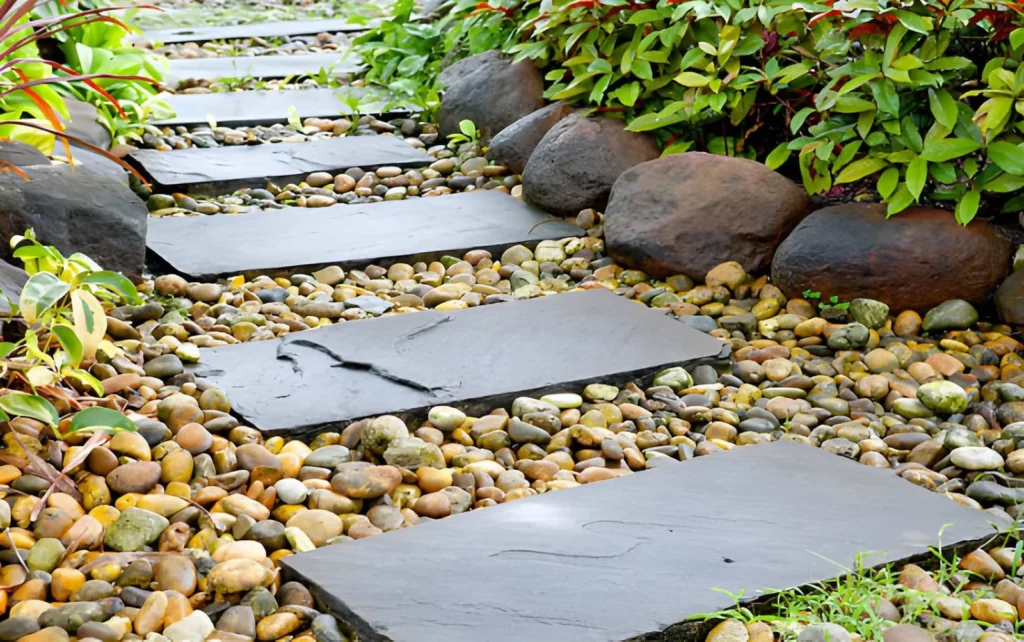
The depth of your rock layer is critical. For most decorative landscape rocks, such as Colorado River Rock or Mexican Beach Pebbles, a depth of 2 to 3 inches is standard. If you are using smaller materials like Decomposed Granite for a walkway, you might want a more substantial 3-to-4-inch base for better stability and weed suppression.
Step 3: Convert to Cubic Yards
Once you have your square footage and depth (in feet), use this industry-standard formula:
(Square Footage x Depth in Feet) / 27 = Cubic Yards
Example: For a 200 sq. ft. area at 3 inches deep (0.25 feet):
(200 x 0.25) / 27 = 1.85 Cubic Yards.
Factors That Influence Your Stone Quantity
While the math provides a baseline, real-world variables can shift your requirements. Understanding these nuances is part of the expertise we provide at Select Sand & Gravel.
The Size of the Rock (Gradation)
The size of the individual stones changes how they settle. Larger decorative rocks (like 3-to-5-inch river rock) create more air gaps, meaning they may cover slightly more area but might require a deeper layer to prevent the underlying landscape fabric from showing through. Conversely, smaller gravels pack more tightly and may require a bit more tonnage to achieve the same visual “fullness.”
Compaction and Settling
If you are using a material that packs down, such as Road Base or crushed rock with fines, you must account for compaction. These materials can lose 10% to 15% of their volume once they are tamped or rolled into place. When ordering for driveways or high-traffic paths, it is always wise to add a small buffer to your total.
Converting Cubic Yards to Tons
In many parts of Texas and Oklahoma, landscape rock is sold by weight (tonnage) rather than volume. On average, most landscape rocks weigh approximately 2,800 pounds per cubic yard, which is 1.4 tons.
To convert your yards to tons, simply multiply your cubic yardage by 1.4. In our previous example of 1.85 yards, you would need approximately 2.6 tons of stone.
Professional Hauling and Custom Orders
At Select Sand & Gravel, we make the “heavy lifting” part of your project simple. As an employee-owned company, we take personal pride in the logistics of your delivery. Whether you need a Tandem Dump Truck for a residential driveway in Fort Worth or an End-Dump Trailer for a commercial site in Houston, we ensure your material arrives exactly as promised.
We also specialize in custom orders for unique materials, including:
- Decorative Landscape Rock
- Decomposed Granite
- Mexican Beach Pebbles
- Colorado River Rock
Conclusion: Precision Planning for Your Landscape
Knowing how much landscape rock you need is the difference between a stressful weekend and a successful renovation. By measuring your area, deciding on a proper depth, and converting those numbers into tonnage, you can order with confidence.
Ready to transform your property? Let the employee-owners at Select Sand & Gravel help you finalize your numbers and schedule your delivery.
[Click here to explore our Decorative Landscape Rock selection] and request a quote for your next project in Dallas, Austin, San Antonio, or Oklahoma City today.

